On this page
By the late 1950s, scientists were trying to grow isolated plant cells into full tissues, a process called tissue culture. The standard nutrient recipes of the day kept cells alive but yielded slow growth. At the University of Wisconsin, Toshio Murashige, a doctoral student, and his advisor Folke Skoog set out to find an unknown growth hormone in tobacco juice that they believed was responsible for sudden bursts of cell growth.
Instead, they found that the secret was not a hormone at all. It was simply a much higher concentration of ordinary mineral salts.
The search for a hidden growth factor
Murashige and Skoog began by analyzing the ash of tobacco leaves, testing which minerals the rapidly growing tissues absorbed. They systematically adjusted the levels of nitrate, potassium, and ammonium in their experimental cultures. When they raised the inorganic salt concentrations well beyond the accepted standards of the time, the tissue cultures exploded in size.
In their 1962 paper, they reported that their revised medium increased the yield of tobacco callus (*Nicotiana tabacum*) by 25 times compared to older formulations (Murashige & Skoog, 1962). The discovery proved that nutrient deficiency, rather than a lack of hormones, had been the bottleneck in tissue culture.
What makes MS medium different?
The Murashige and Skoog (MS) medium is a complex blend of macronutrients, micronutrients, iron, and vitamins. Its defining feature is a very high concentration of nitrogen and potassium.
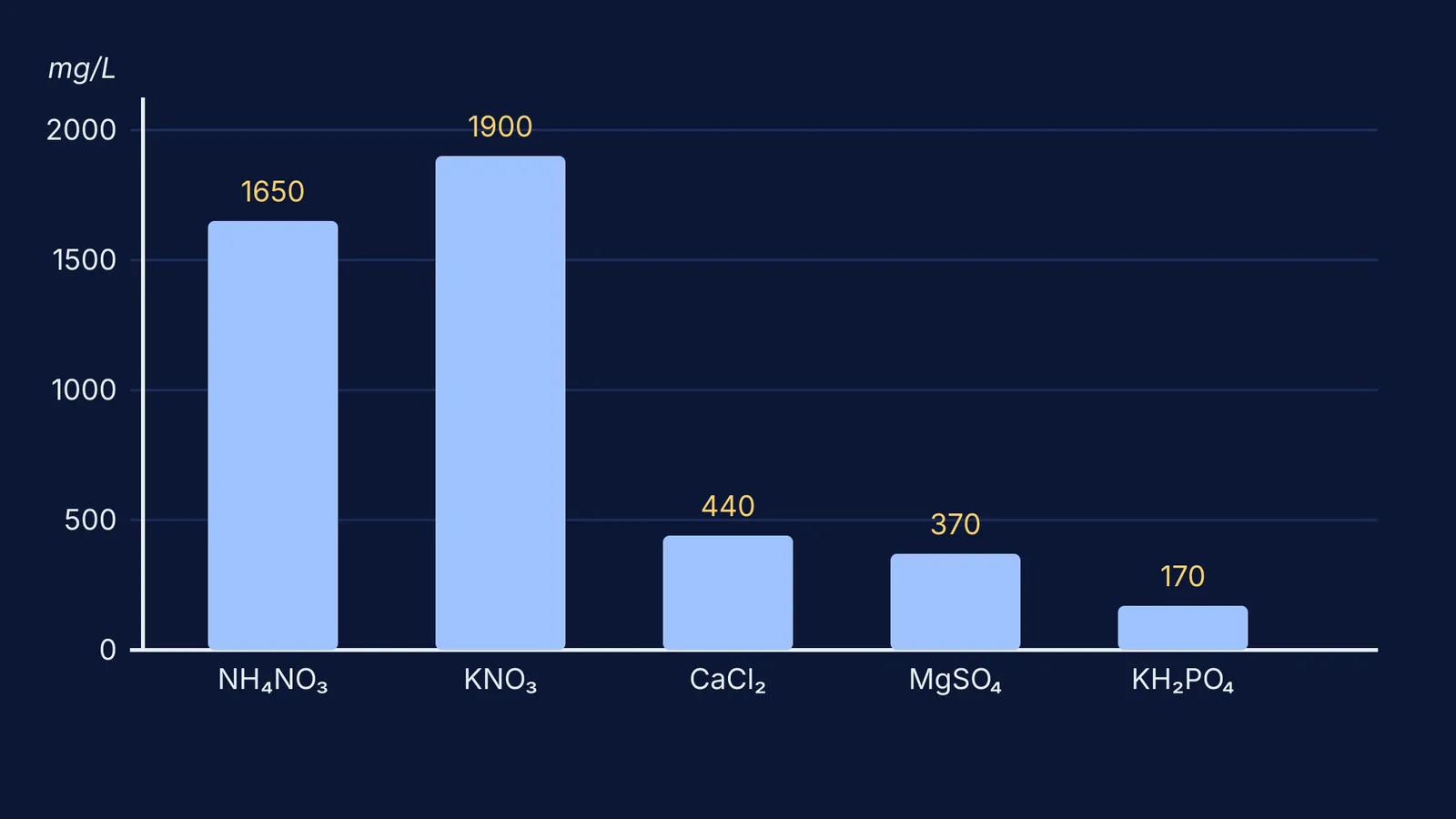
The standard recipe requires macronutrients in massive quantities compared to earlier media, as originally published by Murashige and Skoog (1962):
Ammonium nitrate (NH₄NO₃): 1650 mg/L
Potassium nitrate (KNO₃): 1900 mg/L
Calcium chloride (CaCl₂): 440 mg/L
Magnesium sulfate (MgSO₄): 370 mg/L
Potassium phosphate (KH₂PO₄): 170 mg/L
It also includes trace elements like zinc sulfate and boric acid, vitamins such as myo-inositol, and a carbon source, typically 30,000 mg/L of sucrose (Murashige & Skoog, 1962). The final mixture is typically adjusted to a pH of 5.7 to 5.8 and solidified with 6,000 to 10,000 mg/L of agar.
If you are struggling to memorize the components of culture media or the stages of plant development, sitting with a textbook isn't always the fastest way to learn. Fermi's AI tutor can work out what you already know and build a plan for the session, teaching through it and checking your understanding as it goes.
Why did the high salt concentration matter?
Before 1962, scientists assumed that high concentrations of salts would be toxic to plant cells in a test tube. Murashige and Skoog showed that as long as the ions were balanced correctly—particularly the ratio of ammonium to nitrate—the cells could handle, and indeed required, a high ionic strength.
This robust salt mixture acts as a strong buffer. It remains stable even if there are minor variations in water quality or preparation, making it highly reliable for laboratories worldwide. For a closer look at how plant tissues specialize after dividing, our guide to apical, intercalary and lateral meristems explains where active growth happens in a living plant.
How do you prepare MS medium?
When making the medium in a laboratory, follow this standard checklist, based on the original Murashige and Skoog (1962) protocol, to avoid precipitation and ensure the minerals remain available to the plant:
Dissolve macronutrients: Add the major salts one by one to distilled water, ensuring each dissolves completely before adding the next.
Add micronutrients and vitamins: Use pre-made concentrated stock solutions for trace elements, as weighing fractions of a milligram is prone to error.
Add the carbon source: Stir in the sucrose until the solution is completely clear.
Adjust the pH: Use drops of dilute NaOH or HCl to bring the pH exactly to 5.7 or 5.8.
Add the gelling agent: Stir in the agar just before heating and sterilizing the mixture in an autoclave.
A baseline for modern biology
Although it was originally designed for tobacco, the MS medium turned out to be remarkably versatile. It works for a vast range of plant species, both monocots and dicots.
By providing a universal, standardized nutrient baseline, the MS medium removed a major variable from biological experiments. Researchers no longer had to invent their own recipes by trial and error. This standardization paved the way for modern agricultural biotechnology, enabling techniques like artificial hybridisation, mass micropropagation, and genetic engineering. Today, if a laboratory is cloning disease-free crops or studying how a single cell develops into a seedling, they are almost certainly starting with the recipe published by Murashige and Skoog.