On this page
The paper coffee filter began as a kitchen experiment in Germany in 1908, using paper from a child's exercise book. The science behind it is in your Class 6 chapter on separation.
Who was Melitta Bentz and what did she invent?
According to the German Patent and Trade Mark Office (DPMA), Melitta Bentz was born in Dresden on 31 January 1873 and was a housewife and mother of three. Her experiment used two things she had at home: a perforated brass cup and blotting paper from her son's exercise book.
She put the paper in the cup, added ground coffee and poured water over it. The coffee dripped through the holes into a cup below, as the Wikipedia account of her life describes.
The DPMA records that she registered her coffee filter with the patent office on 20 June 1908, and it was protected as a utility model on 8 July 1908. The protected design was a "coffee filter with a domed underside, recessed bottom and inclined flow holes". The office points out that she was one of the first women to have her own invention personally protected.
How did a kitchen experiment become a company?
The same DPMA history says the business was founded on 15 December 1908 with starting capital of 72 Reichspfennig, run from one room in the family's Dresden flat. Melitta and her husband Hugo had 100 cartons of filter paper and 50 filters made. At the 1909 Leipzig Trade Fair they sold more than 1,200 units. The DPMA page says the family business now produces 50 million coffee filters every day.
What does a coffee filter have to do with Class 6 filtration?
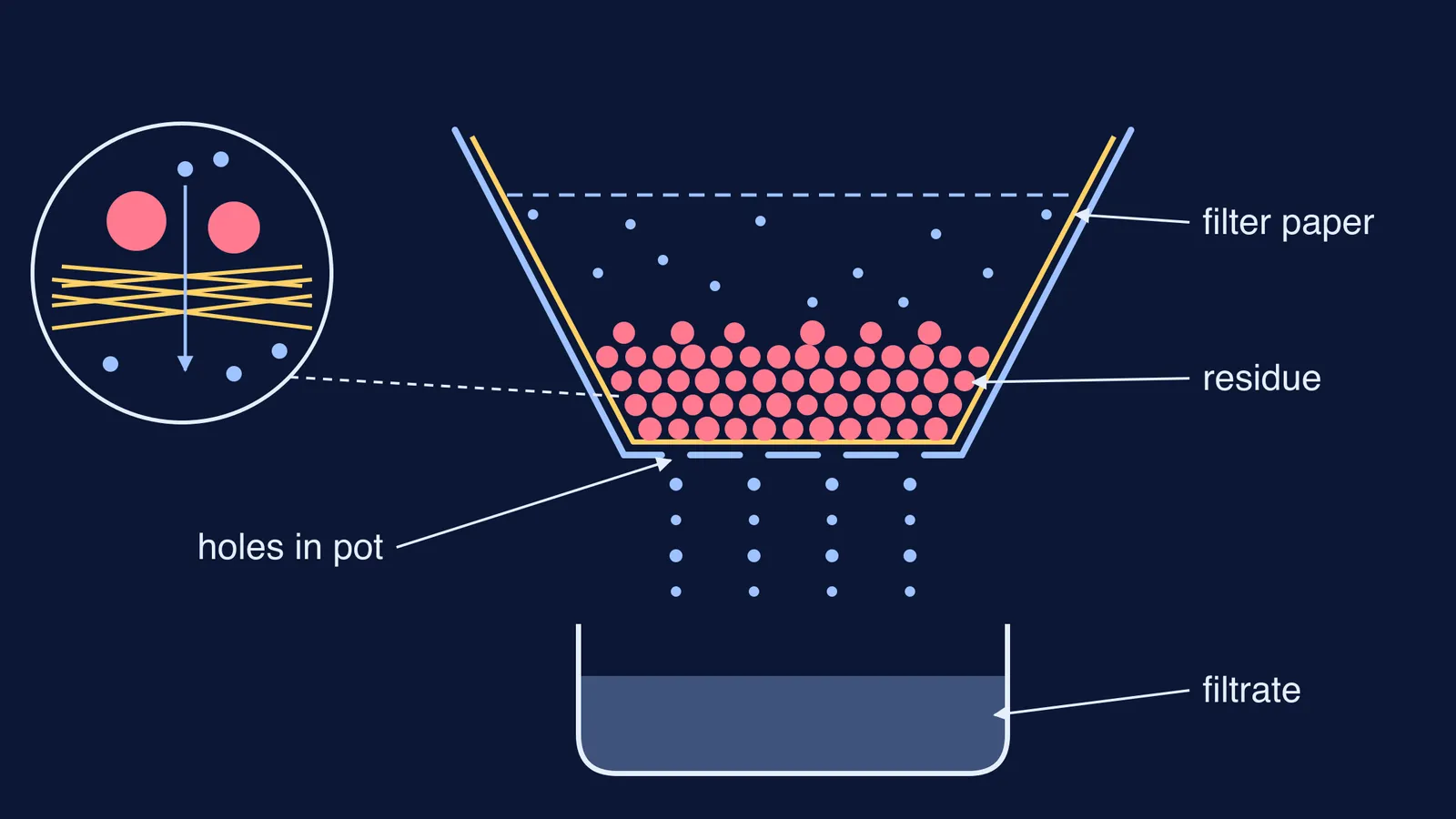
NCERT's Class 6 science textbook, Curiosity, covers it in Chapter 9, Methods of Separation in Everyday Life. It starts with a tea strainer: pouring tea through it to hold back the leaves is called filtration. It then explains that cloth works as a filter because of the tiny pores between its threads. Finally it says: "A filter paper is one such filter that has very fine pores in it."
The chapter also says the choice of filter depends on the size of the particles you want to remove, and that cotton, charcoal and sand can all be used as filters.
In those terms, the holes in the brass cup were far too big, like a strainer. Blotting paper had pores small enough to stop the coffee grounds but big enough to let water through. The brass cup held the paper up, just as the funnel does in the textbook activity.
How can you try Melitta's experiment at home?
This version of the textbook's Activity 9.4 asks Bentz's question: which filter has holes the right size?
Stir a spoonful of garden soil into a glass of water. Leave it for five minutes. The mud settling to the bottom is sedimentation; gently pouring the top water into a second glass is decantation.
Before going further, write down a prediction: which will give the clearest water, a tea strainer, a folded cotton handkerchief, or a filter paper? Give a reason in terms of hole size.
Pour a third of the water through the tea strainer into glass A.
Pour a third through the cloth into glass B. Try one layer, then two: the book asks how many layers of cloth you need for clear water.
Fold a filter paper in half, then in half again, and open it into a cone (a paper coffee filter just needs opening). Set it in a funnel and pour the rest through into glass C.
Line up glasses A, B and C. Name the residue and the filtrate in each one, and check your prediction.
Do not drink the water, however clear it looks. Filtration does not remove substances dissolved in the water; to get salt out of seawater, the same chapter uses evaporation instead. If you brew real coffee the Bentz way, let an adult handle the hot water.
Which separation method should you use?
A quick check, built from the methods in the NCERT chapter:
Big, easy-to-see solid pieces, few of them: handpicking
Two solids of different sizes, like flour and bran: sieving
Heavy and light solids, like grain and husk: winnowing
An insoluble solid in a liquid: sedimentation and decantation, then filtration to finish
A solid dissolved in a liquid, like salt in water: evaporation
For parents, one question does more than any worksheet: "Why didn't she just use the brass cup on its own?" If your child answers in terms of hole size compared with particle size, they have understood the chapter.
If residue, filtrate and decantation keep blurring together, the Fermi Concept Library gives every concept in chemistry its own lesson and its place in the map. And if you are not sure where to start on the whole chapter, Fermi's AI tutor works out what you already know and builds a plan for the session.
Next time you see a paper filter, explain it in two words: residue and filtrate.