

On this page
How do you know where you are in a dark room you walked into a minute ago? Your brain keeps track using signals from many cells. In 2005, May-Britt and Edvard Moser found one of the key cell types, and its firing pattern turned out to be pure geometry. This post covers their discovery, the maths inside it, and what a student can learn from how they worked.
Who are May-Britt and Edvard Moser?
Their Nobel facts pages give the details. May-Britt Moser was born on 4 January 1963 in Fosnavåg, Norway. Edvard Moser was born on 27 April 1962 in Ålesund, Norway. They met at the University of Oslo, where May-Britt studied psychology, and both received doctorates in neurophysiology in 1995. After time at the University of Edinburgh and University College London, they moved to the Norwegian University of Science and Technology (NTNU) in Trondheim.
What did scientists already know?
The 2014 Nobel press release starts with John O'Keefe. In 1971 he found nerve cells in the hippocampus of rats that fired only when the rat was at a certain place in a room. Other cells fired at other places. He called them place cells, and concluded that together they formed a map of the room.
That left a question. A map needs a sense of distance and direction too. How does the brain measure them?
What are grid cells?
The Mosers were mapping connections into the hippocampus in rats moving around a room. In a nearby area, the entorhinal cortex, they saw a striking pattern. Their 2005 Nature paper with Torkel Hafting and colleagues describes the key unit as the grid cell, "activated whenever the animal's position coincides with any vertex of a regular grid of equilateral triangles spanning the surface of the environment".
The paper reports more:
Neighbouring grid cells share the same orientation and spacing, but their grids are shifted, so each covers different points.
The spacing gets larger from the top to the bottom of the region they recorded.
The grid is anchored to landmarks in the room but persists when those landmarks are removed. That suggests the cells keep track of position by adding up movement, a process called path integration.
The press release adds that other entorhinal cells respond to head direction and to the borders of the room, and with place cells they form a positioning system, an "inner GPS".
The geometry inside a grid cell
The firing points of one grid cell sit on a triangular lattice. Here is what that means, using a sample spacing of 50 cm chosen only for the arithmetic (real spacings vary between cells).
Pick any firing point. Its nearest firing points are 50 cm away, and there are 6 of them. Six equilateral triangles meet at a point because 6 × 60° = 360°.
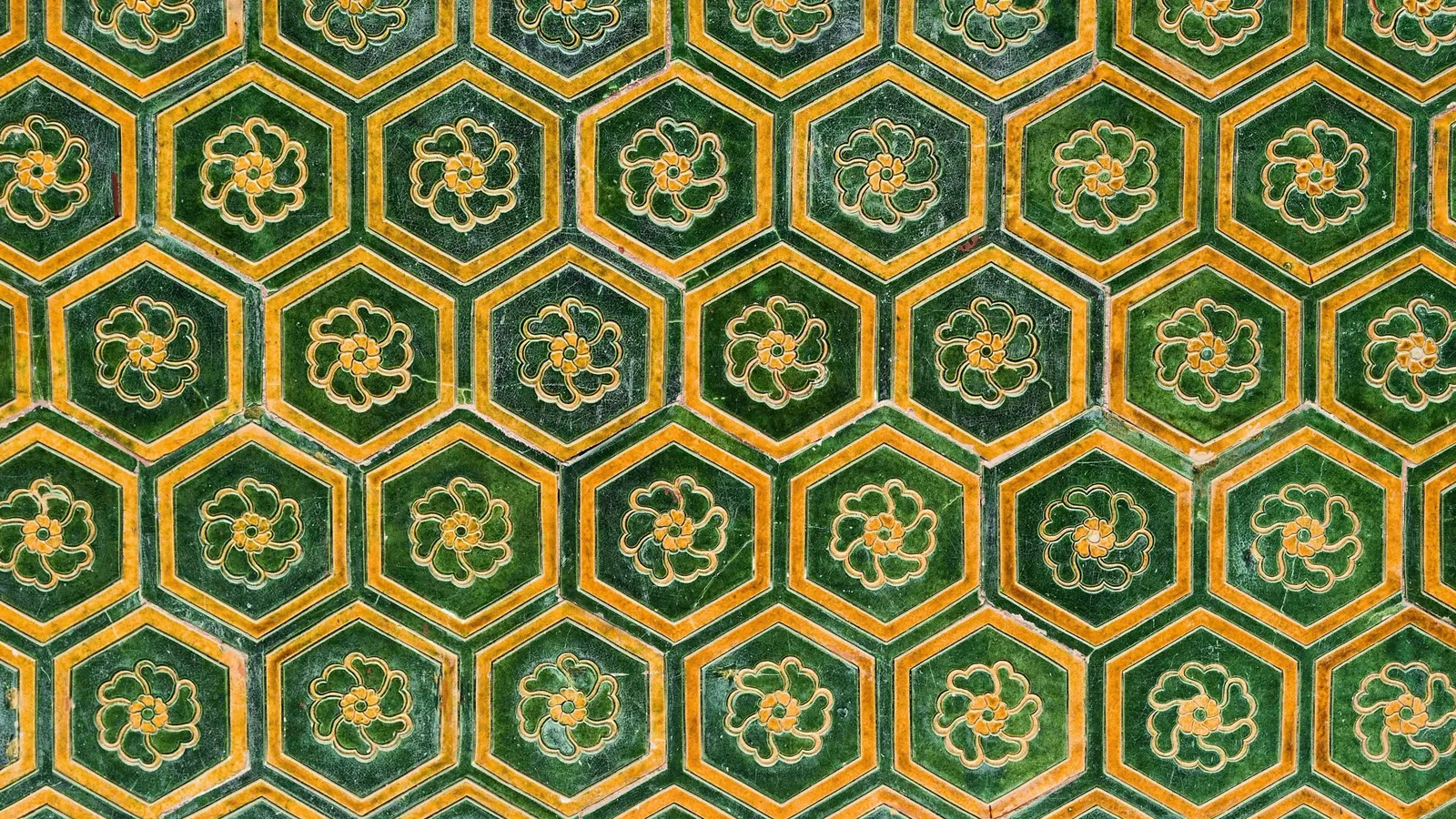
Those 6 neighbours sit at the corners of a regular hexagon with side 50 cm. That is why the pattern is often described as hexagonal.
The next-nearest points are not at 2 × 50 = 100 cm, as many students guess. They are at 50 × √3 ≈ 86.6 cm, across the shared edge of two neighbouring triangles.
So a cell does not tell the rat "you are here". It says "you are on one of these points". Because neighbouring cells have shifted grids and different cells have different spacings, the combined pattern across many cells pins down a single position.
Why does it matter beyond rats?
The press release notes that brain imaging and studies of patients having neurosurgery have given evidence that place and grid cells exist in humans. In Alzheimer's disease, the hippocampus and entorhinal cortex are often affected early, and patients often lose their way. Understanding the positioning system may help explain that loss of spatial memory. Brain anatomy at this level goes beyond the school syllabus, but it builds on the neuron basics in our guide to neural control and coordination.
What can a student take from their way of working?
Look next door. The Mosers were studying the hippocampus when they found the pattern in the cortex beside it. When stuck on a topic, check the chapter just before or after it.
Let the data show its shape. A hexagonal grid was not what anyone expected. Plot your own results, such as test scores by chapter, and see what shape appears.
Build a team over years. Their lab moved, grew and kept a long research line. Steady work on one subject compounds.
Connect subjects. Grid cells sit where biology meets geometry. Using maths you know to explain a biology idea makes both stick.
Some ideas, like a triangular lattice that shifts from cell to cell, are easier to see than read. The Fermi Simulation Lab has interactive simulations for ideas easier to see than read, so you can build intuition before writing explanations.
Next step: draw an equilateral triangle grid with 2 cm sides, mark one point, and measure its 6 nearest and 6 next-nearest neighbours.


