

On this page
On 18 November 1989 NASA launched the Cosmic Background Explorer, or COBE, to study the faint microwave glow that fills the whole sky. John Mather and George Smoot, who led its two key measurements, shared the 2006 Nobel Prize in Physics. Here is what they found, and how to check their headline number with one formula from your Class 11 syllabus.
What did the COBE satellite discover?
COBE carried three instruments, according to NASA's LAMBDA archive for the mission. FIRAS compared the spectrum of the cosmic microwave background (CMB) with a precise blackbody. DMR mapped how its temperature changes from one direction to another. DIRBE searched for the cosmic infrared background radiation.
The Royal Swedish Academy of Sciences gave the 2006 prize to Mather and Smoot "for their discovery of the blackbody form and anisotropy of the cosmic microwave background radiation" (Academy press release). The same release says Mather, at NASA Goddard Space Flight Center, coordinated the project and was responsible for the blackbody measurement. Smoot, at the University of California, Berkeley, led the measurement of the small temperature variations. More than 1,000 researchers, engineers and others worked on COBE, the release adds.
The first spectrum came quickly. The Academy says COBE recorded a perfect blackbody spectrum after just nine minutes of observations, and the curve got a standing ovation when it was shown at an astronomy conference. The team published it in 1990 as a preliminary measurement in The Astrophysical Journal (Mather and colleagues).
What does a "perfect thermal spectrum" mean?
Any object at a steady temperature gives off light with a typical spread of wavelengths. An ideal absorber and emitter, called a blackbody, gives off a spread that depends only on its temperature. That is the Planck curve you meet in the thermal radiation chapter.
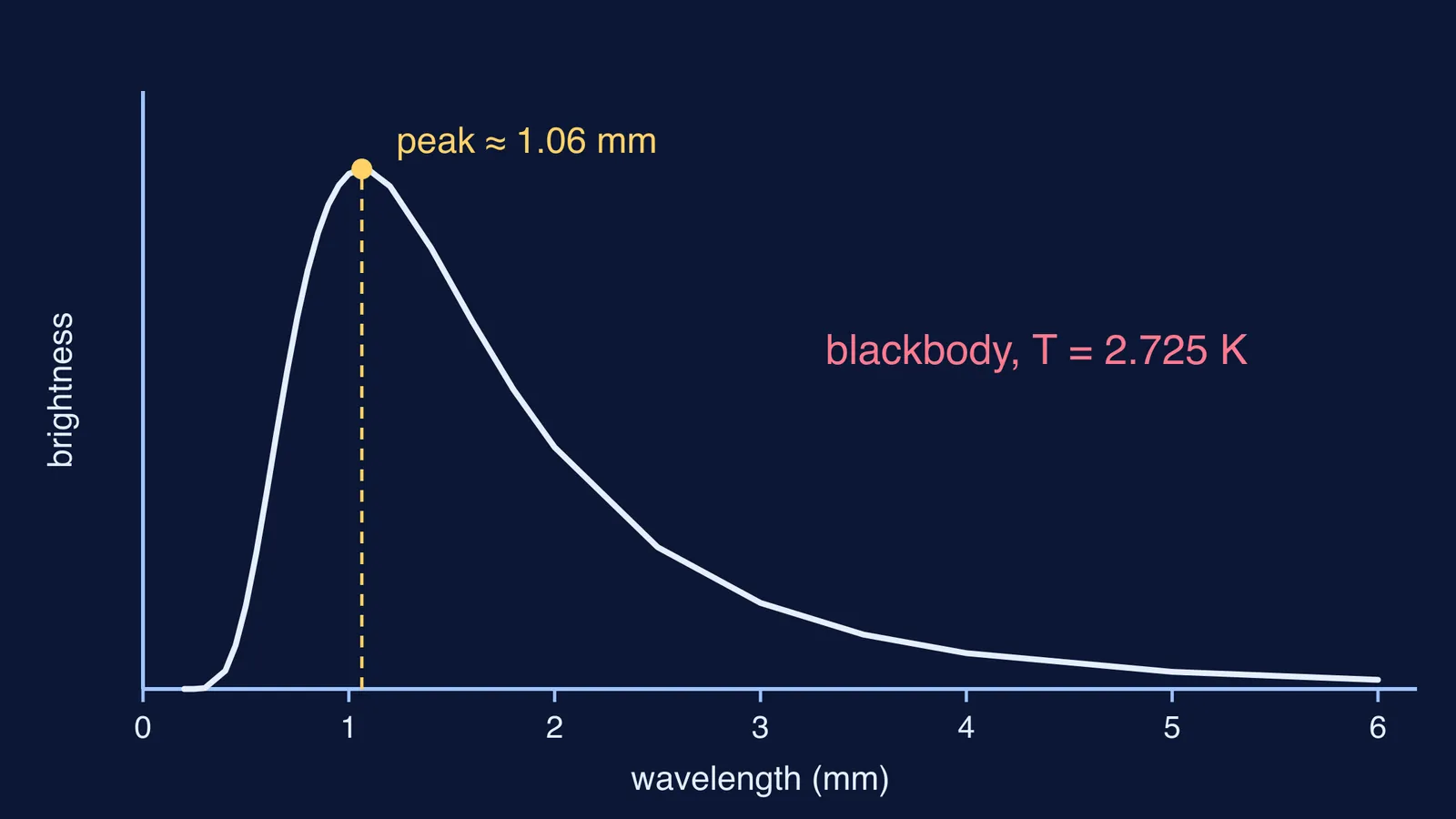
The CMB spectrum is a nearly perfect blackbody with a temperature of 2.725 ± 0.002 K, according to NASA's FIRAS overview.
Why does that matter? A perfect blackbody needs matter and light that were once mixed together and in balance at one temperature. That fits a universe that began hot and dense. The Academy's release notes that when this light was set free, the universe was at almost 3,000 degrees Celsius. Today it corresponds to barely 2.7 degrees above absolute zero.
Why do the tiny ripples matter?
A perfectly smooth early universe would have given gravity nothing to pull together: no galaxies, stars or planets. So astronomers expected the CMB to be slightly warmer in some directions and slightly cooler in others.
COBE's DMR found intrinsic anisotropy in the CMB for the first time, at a level of about one part in 100,000 (NASA DMR overview). Smoot's team reported it in 1992 in Structure in the COBE differential microwave radiometer first-year maps. The Academy describes the variations as being in the range of a hundred-thousandth of a degree, and says they offer an important clue to how the galaxies came into being.
To get a feel for one part in 100,000, picture a 20-metre strip of floor with bumps a fifth of a millimetre high. A tiny effect, but COBE measured it from orbit.
How can you check COBE's numbers yourself?
Wien's displacement law says the wavelength at which a blackbody shines brightest is λmax = b / T. NIST lists the constant as b = 2.897771955 × 10⁻³ m·K (NIST CODATA value). Try it in three steps:
Today's CMB: λmax = 2.898 × 10⁻³ / 2.725 ≈ 1.06 × 10⁻³ m, about 1 millimetre. That is in the microwave band, which is why it is called the microwave background.
When it was released: take the Academy's almost 3,000 °C as about 3,270 K. Then λmax ≈ 2.898 × 10⁻³ / 3,270 ≈ 8.9 × 10⁻⁷ m, around 890 nm, just past visible red light.
Compare the two: 1.06 mm ÷ 890 nm is roughly 1,200. The expanding universe has stretched this light's wavelength by about that factor, which is also why its temperature fell by the same factor.
Step 1 is the same kind of calculation that turns up in thermal radiation questions in school and JEE Main papers. If λ = b/T still feels like a formula with nothing behind it, the Fermi Simulation Lab has interactive simulations for ideas that are easier to see than to read.
What can students take from Mather and Smoot?
Precision is a discovery tool. A difference of one part in 100,000 was the whole result (NASA DMR overview).
Big science is teamwork. The Nobel went to two leaders of a team of more than 1,000 people (Academy press release).
Textbook formulas reach a long way. Planck's law and Wien's law, which you study for boards, are the same tools used to read the oldest light in the universe.
If you want more practice, the Fermi Problem Library has worked problems with a step-by-step solver that explains the reasoning rather than printing an answer.


