On this page
Masatoshi Koshiba's Kamiokande detector was originally designed to look for proton decay, a very rare event predicted by theories of the early universe. It did not find that. Instead, on 23 February 1987, the detector recorded a burst of neutrinos from a dying star.
This event provided the first direct empirical evidence of how a core-collapse supernova works. It proved that neutrinos carry away almost all of the energy when a massive star dies, opening the entirely new field of neutrino astronomy. For this achievement, Masatoshi Koshiba shared the 2002 Nobel Prize in Physics.
What was the Kamiokande detector?
Neutrinos are famously elusive particles. They carry no electric charge and have almost zero mass, allowing them to pass through planets and stars without colliding with anything. To catch them, you need a massive target and a very quiet environment.
The Kamioka Nucleon Decay Experiment (Kamiokande) was built 1,000 metres underground in the Mozumi zinc mine in Japan. The deep rock shielded the experiment from the constant rain of cosmic rays on Earth's surface.
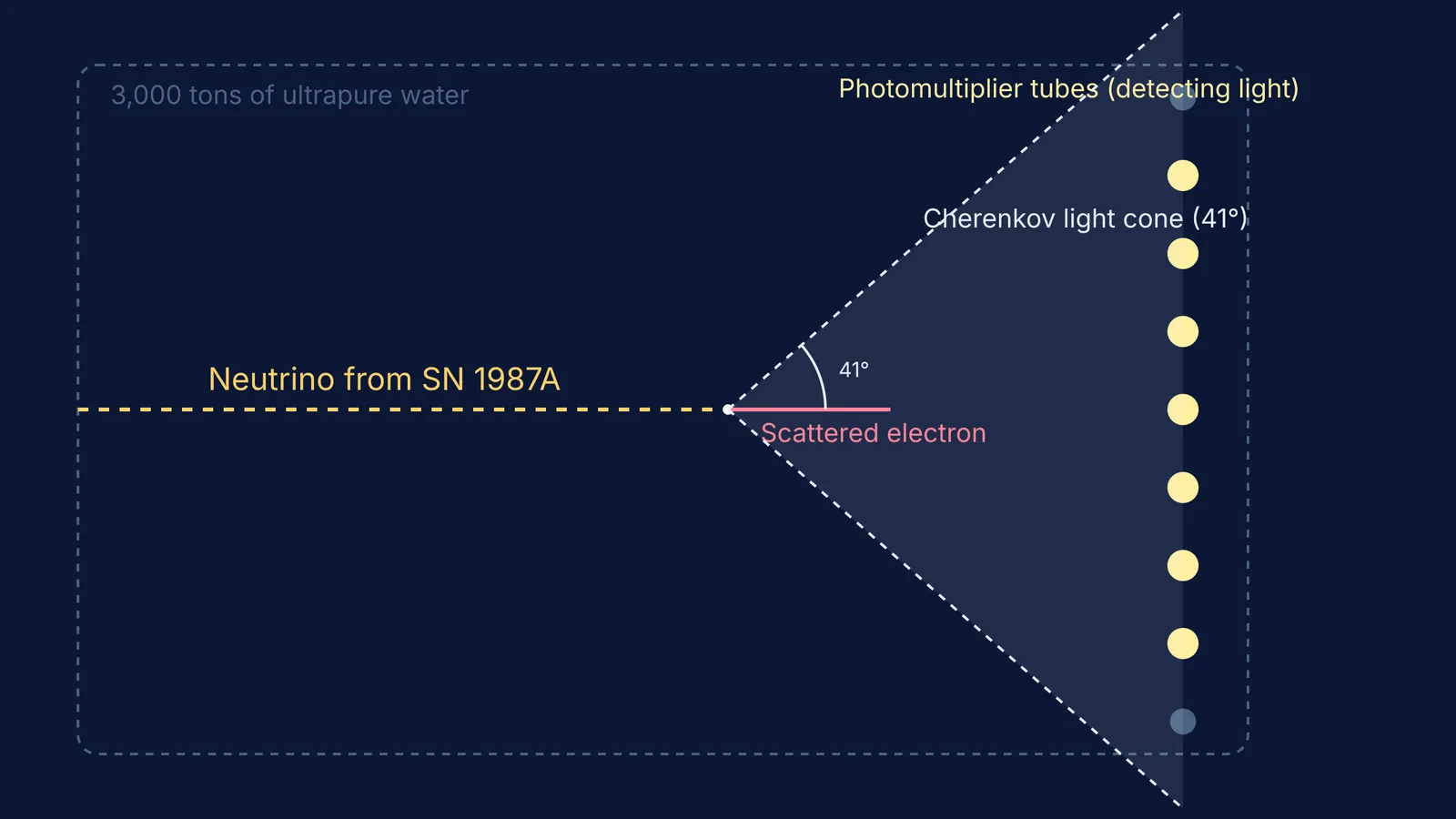
The detector itself was a cylinder holding 3,000 tons of ultrapure water. The inner walls were lined with 1,000 large photomultiplier tubes, each 20 inches across. These tubes were extremely sensitive light bulbs working in reverse, designed to turn faint flashes of light into electrical signals.
The Kamiokande detector looked for Cherenkov radiation. When a neutrino rarely struck an electron in a water molecule, it kicked the particle to an extremely high speed. If that electron moved faster than the speed of light in water, it emitted a cone of faint blue light, much like the sonic boom of a supersonic jet. The photomultiplier tubes recorded this specific flash.
Hard-to-picture ideas like Cherenkov radiation are sometimes best learned by seeing them in action. In the Fermi Simulation Lab, you can manipulate variables and watch interactive simulations for the physical ideas that are easier to see than to read.
How did Kamiokande detect supernova 1987A neutrinos?
When a massive star exhausts its nuclear fuel, its core collapses into a dense neutron star, releasing an immense amount of gravitational potential energy. Theoretical models predicted that this energy is carried away by an intense burst of neutrinos.
On 23 February 1987, the light from Supernova 1987A in the Large Magellanic Cloud—about 160,000 light-years away—finally reached Earth. However, the neutrinos arrived first.
The Kamiokande-II detector recorded 11 neutrino events in just 13 seconds. The recorded energies ranged from 7.5 to 36 MeV. The first two events in the burst pointed directly back toward the Large Magellanic Cloud, confirming their source.
The neutrinos reached Earth roughly three hours before the first visible light of the supernova was spotted. This is because neutrinos interact so weakly with matter that they escaped the collapsing core of the star immediately. The visible light was delayed because the shockwave had to physically travel outward and tear through the star's outer layers before it could shine brightly in the sky.
This detection provided the first experimental proof of the core-collapse model.
Why does Kamiokande matter today?
Koshiba's vision turned a failed search for proton decay into an entirely new way to look at the universe, a legacy celebrated by his Nobel Prize. Before 1987, astronomers could only study the cosmos using the electromagnetic spectrum. Kamiokande opened a new window: neutrino astronomy, allowing us to "see" directly into the heart of the Sun and the cores of exploding stars.
The success of this burst led to the construction of the much larger Super-Kamiokande. This successor experiment continued Koshiba's legacy, later proving that neutrinos oscillate and have mass—a discovery that led to another Nobel Prize for his student, Takaaki Kajita, in 2015. Koshiba's work proved that building immense, highly sensitive experiments deep underground is a viable way to answer fundamental questions about the cosmos.
When you study conservation of momentum and energy in such particle interactions, the algebra can get complicated. If you get stuck on a calculation, the Fermi Problem Library provides a step-by-step solver that explains the reasoning rather than just printing an answer.
A four-part framework for understanding experiments
Whenever you read about a physics experiment for your exams, use this checklist to remember how it works:
The Source: What particle is being measured, and where does it originate? (e.g., neutrinos from a supernova 160,000 light-years away).
The Target: What is the particle supposed to hit? (e.g., 3,000 tons of ultrapure water).
The Detector: What instrument catches the result of the hit? (e.g., 1,000 photomultiplier tubes looking for light).
The Signal: What is the actual physical event recorded? (e.g., flashes of Cherenkov radiation).
Using this structure will help you learn physics from first principles rather than memorising the text.