

On this page
In mathematics, some problems are easy to state but take centuries to solve. In 2016, Ukrainian mathematician Maryna Viazovska posted a paper that proved the absolute best way to pack spheres in 8-dimensional space. This breakthrough earned her the Fields Medal in 2022.
What is the sphere packing problem?
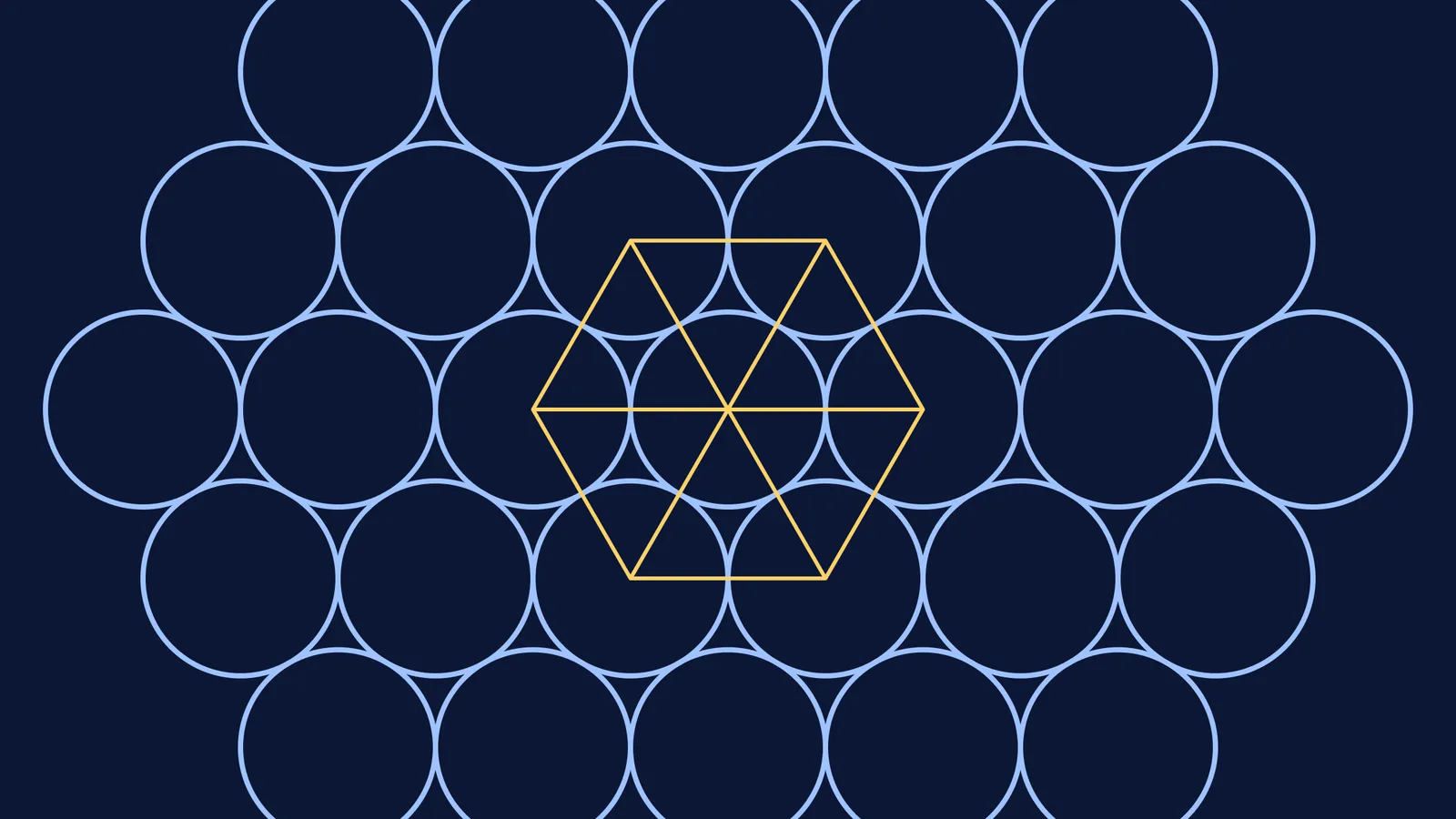
If you have ever seen a pile of oranges at a grocery store, you have seen a solution to the sphere packing problem. The familiar pyramid shape—where each orange sits in the hollow created by the oranges below it—is the densest possible way to arrange spheres in three dimensions.
But mathematicians did not stop at three dimensions. They wanted to know the densest packing in four, five, and higher dimensions. In these spaces, our standard intuition breaks down. A sphere in 8 dimensions is simply a set of points, but the geometric rules change. The spheres have more directions to move, and the gaps between them behave strangely, meaning the densest arrangements are completely different from what we see in three dimensions.
Why do 8 dimensions matter?
You might wonder why anyone cares about arranging imaginary spheres in a space we cannot see. The answer lies in the unique symmetries of mathematics, which show up in the real world as error-correcting codes. These codes are how mobile phones, internet connections, and spacecraft transmit data without losing information to noise. When a signal is sent, it can be thought of as a sphere in a high-dimensional space; if the spheres are packed densely without overlapping, the system can correct more errors efficiently.
For decades, mathematicians suspected that in exactly 8 dimensions, a highly symmetrical arrangement called the E8 lattice was the ultimate packing method. Similarly, in 24 dimensions, another perfect structure called the Leech lattice seemed unbeatable.
Researchers knew they needed to find a specific "magic function" to prove these bounds perfectly. They knew the mathematical properties this function had to possess, but for a long time, nobody could construct it.
How did Maryna Viazovska find the answer?
After collaborating on other projects, Viazovska decided to tackle the 8-dimensional problem alone. She spent several years pondering it. As she told Quanta Magazine, the problem "felt as if it belonged to her," and she couldn't stop thinking about it even when her initial attempts failed.
She found her answer by looking at modular forms, which are highly symmetric functions. She realized that a specific type of quasimodular form—one with slight errors in its symmetry—was the key to constructing the magic function.
In 2016, she published her proof showing exactly how the E8 lattice is optimal. The mathematical community was amazed by her method, which pinpointed the magic function theoretically. Mathematician Peter Sarnak called it an "absolutely stunning" paper.
Over a single intense week following this, Viazovska teamed up with other mathematicians and used similar methods to prove that the Leech lattice is the densest packing in 24 dimensions. Like Grigori Perelman and the proof of the Poincaré conjecture or Dan Shechtman and quasicrystals, her work resolved a massive open question by bringing a fresh perspective to existing tools.
What can you learn from her approach?
Viazovska's journey offers a powerful lesson in how to approach hard problems in your own studies.
Persist through the block. Viazovska worked on the problem for several years even when others moved on. Breakthroughs often require holding onto a problem long after the initial excitement fades.
Find the right tool. She creatively applied quasimodular forms to a geometry problem. When a problem feels insurmountable, Fermi's AI tutor can work out what you already know and build a plan for the session, so you sit down to a clear next step.
Know when to let go of intuition. She noted that in higher dimensions, our visual intuition is often misleading. Sometimes you have to trust the rigorous rules and equations over what you can easily picture in your head.
Mathematics is not just about computing numbers quickly; it is about holding a line of reasoning until the pieces fit. Viazovska showed that with persistence and the right tools, even the hardest mysteries can be untangled.


