

On this page
In the late 19th century, New York City was choking on its own progress. Heavy coal smoke from factories and locomotives created a persistent dark cloud over Manhattan, causing respiratory issues and property damage (Wikipedia). Mary Walton, an inventor running a boarding house near the elevated railway, patented a solution in 1879: an early pollution control device that washed smoke with water.
Her mechanical "smoke-consumer" was a precursor to the modern wet scrubbers used in industrial smokestacks today. It was an early milestone in environmental protection, predating later breakthroughs like the discovery of the Antarctic ozone hole or the use of diatoms as indicators of river health.
How did Mary Walton's smoke reducing chimney device work?
On November 18, 1879, Walton was granted U.S. Patent No. 221,880 for an "Improvement in locomotive and other chimneys" (Google Patents). The invention aimed to stop sparks, soot, and noxious gases from escaping into the open air.
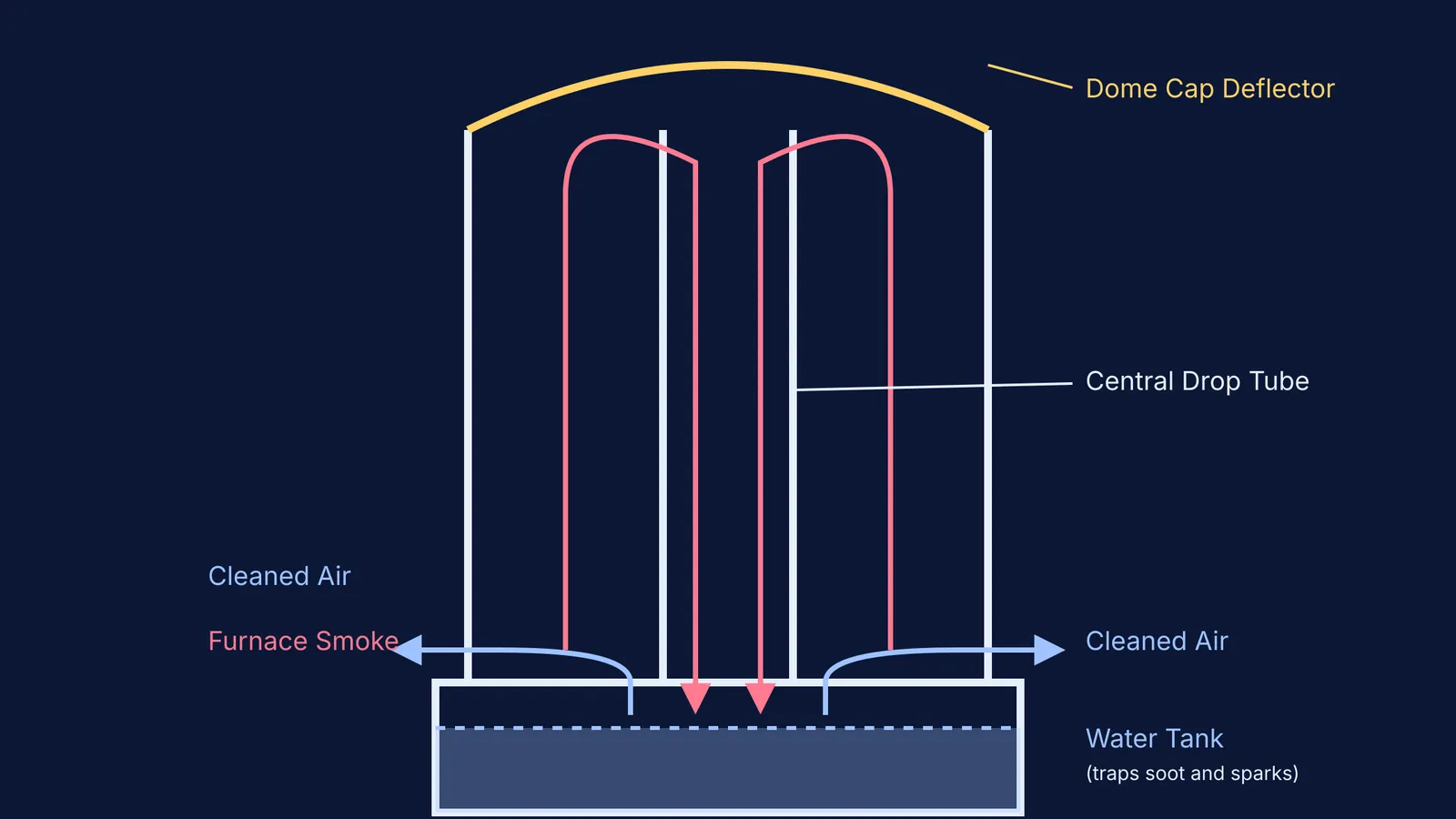
Her design used a clever deflection system. A dome-shaped cap and a downward-pointing conical tube were fitted inside the chimney. As hot smoke and gases rose from the furnace, they hit the cap and were forced down into a central concentric tube. A draft of cool air helped push the heavy smoke down into a tank of water located at the base.
The water acted as a filter. As the smoke bubbled through it, the soot, sparks, and foul gases were trapped in suspension. The cleaned air was then allowed to escape, while any stubborn gases were recirculated until they dissolved.
What is a wet scrubber in modern chemistry?
Today, the principle Walton used is standard practice in chemical plants and power stations. A wet scrubber removes particulate matter and acidic gases from industrial exhaust by bringing the gas into contact with a scrubbing liquid, usually water (Wikipedia). The liquid traps the pollutants, and the cleaned gas passes through a mist eliminator to remove excess moisture before being released into the atmosphere.
If you are exploring the chemistry of mixtures, suspensions, and how we separate pollutants from gases, you can trace the principles step by step in the Fermi Concept Library.
A framework for solving separation problems
Walton's invention is a classic example of separating a mixture (pollutants from air) using physical properties. When faced with a separation problem in chemistry, use this three-step framework:
Identify the phases: Are you separating a solid from a gas (like soot from smoke), a gas from a gas, or two liquids?
Find the difference in properties: Walton used the fact that soot and sparks are heavy and can be suspended in a liquid, while air is not. Look for differences in boiling point, solubility, density, or state.
Choose the mechanism: Use gravity (deflection downward), temperature (cooling air), and a solvent (water tank) to pull the unwanted material out of the mixture.
How did she solve the "El" train noise pollution?
Walton did not stop at air pollution. In the early 1880s, the screeching noise of New York's expanding elevated railway (the "El") was linked by medical professionals to nervous breakdowns, a problem that even Thomas Edison had failed to solve (Wikipedia).
After spending three days riding the trains (Wikipedia), Walton observed that the noise was amplified by the wooden supports under the tracks. She built a model railway in her basement to test different materials, and on February 8, 1881, she received Patent No. 237,422 for a vibration isolation system.
She cradled the rails in a wooden box painted with tar, lined with cotton, and filled with sand. The sand absorbed the vibrations before they could resonate through the rigid wooden supports. This works because sand is a granular material that dissipates sound energy through friction between the grains, converting the intense acoustic waves into tiny amounts of heat.
The Metropolitan Railroad of New York bought the rights to her invention for $10,000 (Wikipedia), a massive sum for a female inventor at the time. Today, her principles of vibration isolation laid the foundation for modern rail transit systems and seismic building designs.
From filtering the air to dampening sound waves, Walton proved that practical observation could solve problems that had stumped the era's leading theorists. If you are studying how waves and vibrations travel through different materials, the Fermi Problem Library has worked problems with a step-by-step solver that explains the reasoning rather than printing an answer.


