

On this page
Radio waves from space are millions of times longer than light waves, so a radio telescope sees a blurry sky unless it is enormous. Martin Ryle's answer was not to build one enormous dish but to fake one, using a few small aerials, the rotation of the Earth and a computer. This post explains the idea, works through the numbers Ryle himself used, and shows the diffraction physics you already know behind it.
Who was Martin Ryle?
His Nobel Prize facts page records that Ryle was born on 27 September 1918 in Brighton and died on 14 October 1984 in Cambridge. In his Nobel biography he says he graduated from Oxford in 1939, then spent the war developing radar and radio systems for the RAF, which taught him engineering but made him forget "most of the physics I had learned." In 1945 he joined J. A. Ratcliffe's group at the Cavendish Laboratory in Cambridge to study radio emission from the Sun. Cambridge appointed him to a new Chair of Radio Astronomy in 1959, and in 1972 he was appointed Astronomer Royal.
The 1974 Nobel Prize in Physics was shared with Antony Hewish, "for their pioneering research in radio astrophysics: Ryle for his observations and inventions, in particular of the aperture synthesis technique, and Hewish for his decisive role in the discovery of pulsars."
Why do radio telescopes need to be so big?
In his Nobel lecture, Ryle starts from the problem. Radio wavelengths are about a million times longer than light. To get a radio picture as sharp as the unaided eye, about 1 arc minute, he estimated you would need a dish about 1 km across working at a 50 cm wavelength, with a surface accurate to a few centimetres. Building that was out of reach.
The physics is the same as single-slit diffraction: an opening of width D spreads a wave by an angle of about λ/D. Our post on single-slit diffraction covers the derivation, and the JEE Main 2026 syllabus lists diffraction due to a single slit and the width of the central maximum.
Worked example: Ryle's numbers
Angle in radians. θ ≈ λ / D = 0.50 m / 1,000 m = 5.0 x 10^-4 rad.
Convert to arc minutes. Multiply by 180/π to get degrees, then by 60: 5.0 x 10^-4 x 57.3 x 60 = 1.7 arc minutes.
Compare. That is the same order as the 1 arc minute Ryle quotes. The exact figure depends on how you define the limit of resolution, which is why he wrote it as approximate.
How does aperture synthesis work?
Ryle's lecture gives the principle. A dish adds up the radio waves arriving over its whole surface. You could get the same total by sampling small patches of the wavefront one at a time, if you knew their relative phase. His trick was to keep one small aerial as a phase reference while a second aerial moved to different positions. A computer then combines the measurements, using a Fourier transform, into the map a large dish would have made.
The catch was time. With elements of size d covering an aperture of size D, he needed about 2(D/d)² separate arrangements. For D/d of about 50 that is 2 x 50² = 5,000 arrangements. Moving one aerial once a day would take 5,000 days, or about 13.7 years, which he called "too long for a graduate student's thesis!"
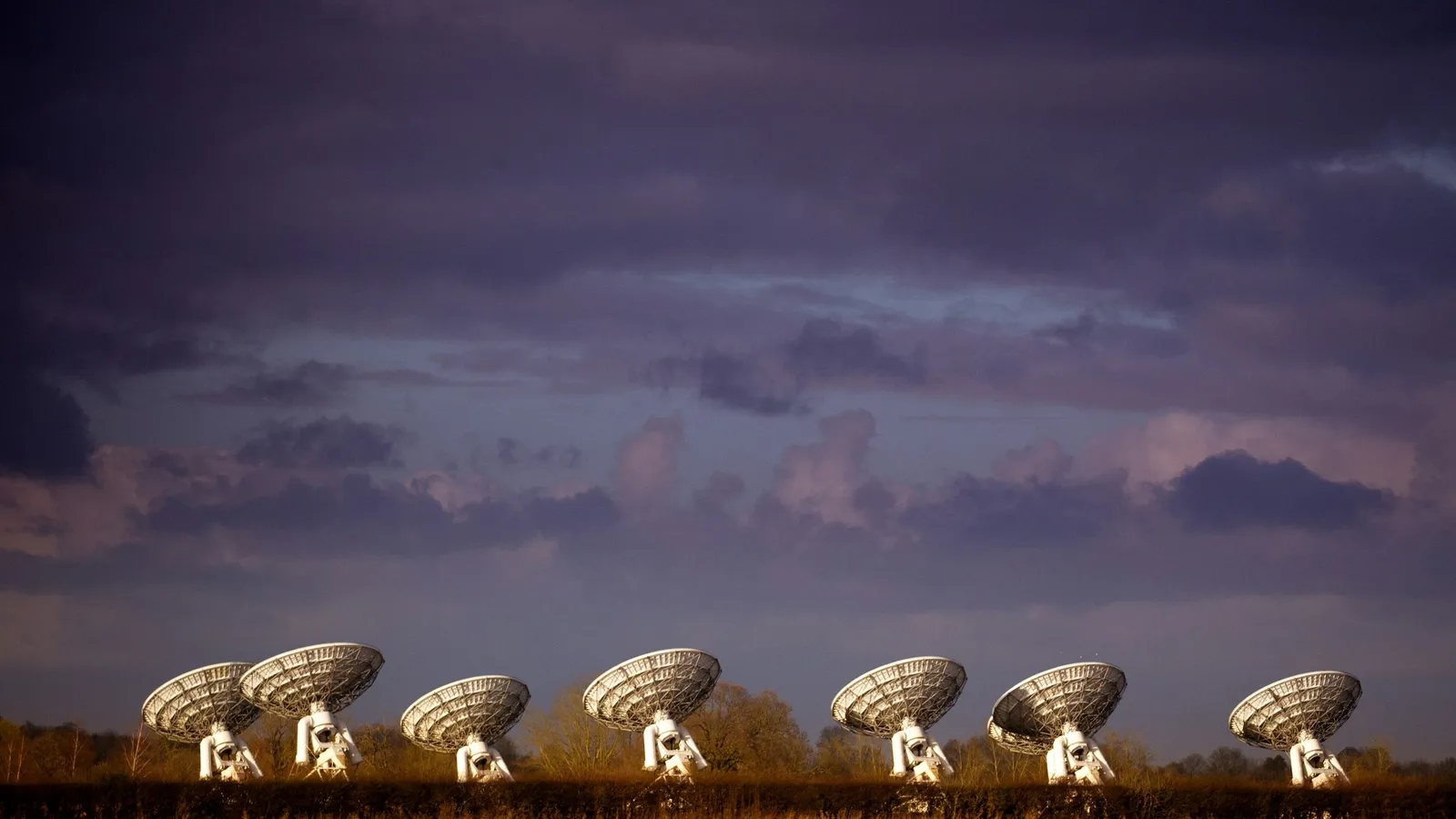
The fix was the planet itself. As the Earth turns, two aerials on an east-west line trace out, as seen from the source, a ring of a much larger aperture. Observing for 12 hours at each spacing and changing the spacing on, say, 50 successive days synthesises the full aperture. Ryle and Ann Neville tested this in 1960 and 1961, synthesising an instrument with an effective diameter of 1 km.
Why did it need computers?
Ryle says the idea was in his notebook in 1954, but no computer then could do the two-dimensional Fourier inversion. The faster EDSAC II, and a fast Fourier transform developed by David Wheeler at Cambridge, made trials possible by 1961. The One-Mile Telescope began observing in 1964, followed by Half-Mile and 5 km instruments. The Nobel press release compared the final sharpness to seeing the details of a postage stamp on the Moon.
India's Giant Metrewave Radio Telescope also combines many dishes spread over kilometres, and our post on Karl Jansky covers where radio astronomy began.
Which mistakes does this help you avoid?
Thinking a bigger dish only collects more signal. Size sets sharpness through λ/D as well as sensitivity.
Forgetting the wavelength. The same dish is far sharper at 1 cm than at 1 m.
If you want to watch how the spread of a diffracted beam changes as you vary the opening and the wavelength, the Fermi Simulation Lab has interactive simulations for ideas that are easier to see than to read.
What can a student take from Ryle's way of working?
Change the question. He stopped asking how to build a huge dish and asked how to get its result without one.
Use what is already moving. Earth's rotation did work no motor could afford.
Wait for the tools, then move fast. He had the idea in 1954 and built it as soon as computers caught up.
Try it now: work out the resolution, in arc minutes, of a 5 km synthesised telescope at a wavelength of 6 cm.


