

On this page
Mario Capecchi, a geneticist at the University of Utah, worked out how to change one chosen gene in a living mouse. Switch a gene off, watch what goes wrong, and you learn what that gene was doing. For this work he shared the 2007 Nobel Prize in Physiology or Medicine with Martin Evans and Oliver Smithies.
What is gene targeting in mice?
Gene targeting is a way to make a planned change to one specific gene in the mouse genome, often to inactivate it, as the Nobel Assembly's 2007 press release describes. A mouse with one gene switched off this way is called a knockout mouse.
It relies on homologous recombination: an incoming piece of DNA lines up with its matching stretch of chromosome, and the two break and rejoin so one version replaces the other, as the Lasker Foundation's account explains. Capecchi bet he could use this to swap a working gene for a broken copy built in the lab.
How did Capecchi make knockout mice?
The steps below follow the Nobel committee's scientific background document:
Capecchi injected DNA into cell nuclei with a fine glass pipette and showed that the injected copies were joined head to tail by homologous recombination. Mammalian cells have the machinery.
He asked the US National Institutes of Health to fund a test of gene targeting. Reviewers turned it down, judging it extremely unlikely that the added DNA would find its matching sequence. He carried on anyway.
His lab repaired a defective drug-resistance gene in about one cell per 1,000 injected.
He moved the method into mouse embryonic stem (ES) cells, which Evans had grown from early embryos.
Targeted ES cells were injected into early embryos, and the resulting mosaic mice were mated; offspring that inherited the change carried it in every cell. The first gene-targeted mice were reported in 1989.
Worked example: how do you find one right cell in a thousand?
In ES cells, added DNA landed at a random place about 1,000 times more often than at the intended gene, a ratio of 1/1,000 quoted in the Nobel background document.
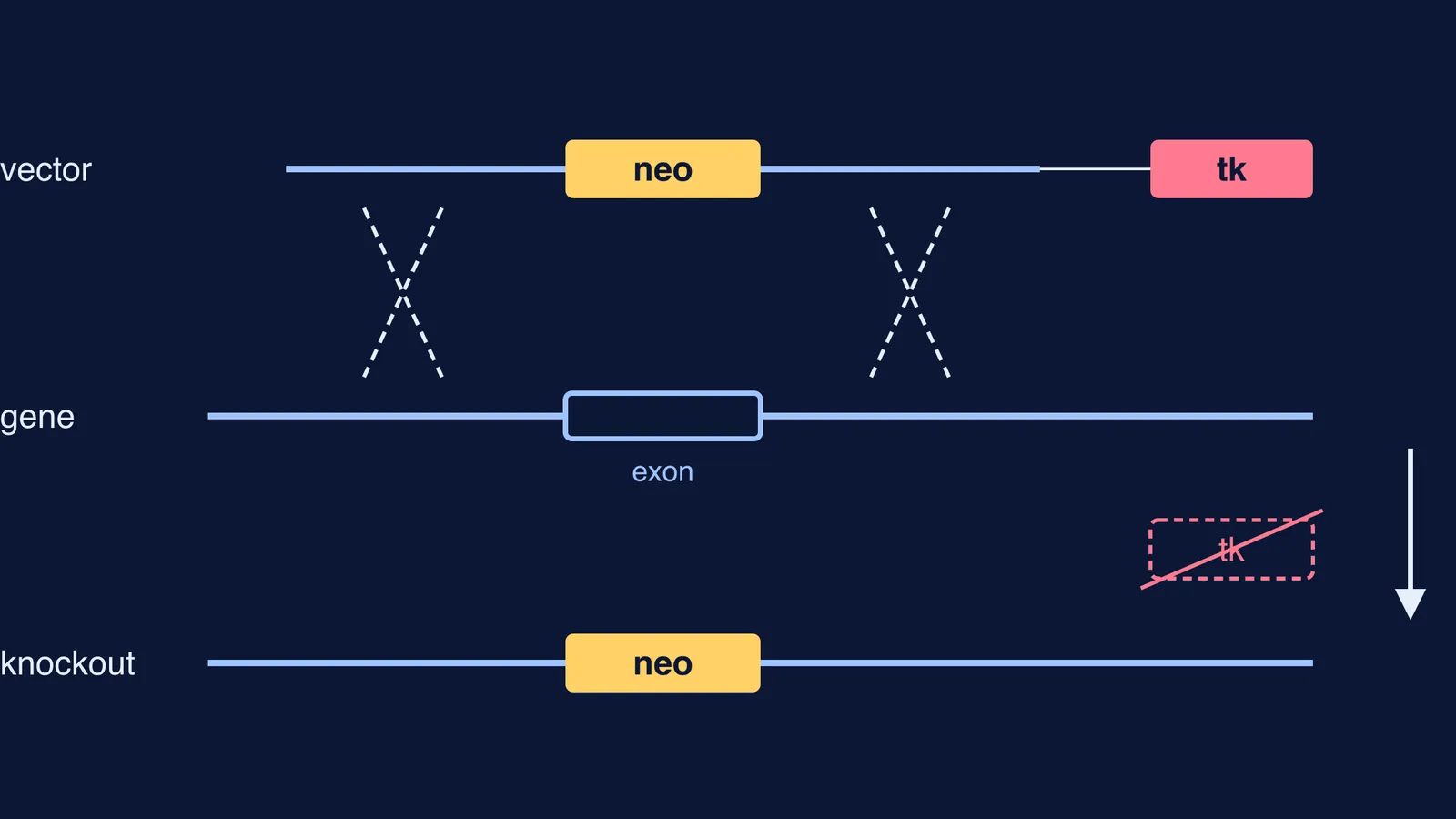
Capecchi's answer, published in Nature in 1988, was positive-negative selection. The DNA you add carries two marker genes:
neo sits inside the gene you want to break and makes cells drug-resistant, so cells that took up the DNA survive (the positive step).
tk sits at the far end, outside the matching stretch. A correct swap leaves it behind; a random insertion usually carries it in, and a second selection removes those cells (the negative step).
Now put numbers on it. Say 1,001 cells survive the first drug: 1,000 random insertions and 1 targeted cell. The 1988 paper reports that the procedure enriched about 2,000-fold for targeted cells. As a rough illustration, read as a change in odds, 1 to 1,000 becomes about 2 to 1: roughly two of every three surviving colonies are the ones you want, so you check three colonies instead of a thousand.
What did knockout mice teach us?
By 2007, more than ten thousand mouse genes, about half of the genes in the mammalian genome, had been knocked out, according to the Nobel press release. The same release counts more than five hundred mouse models of human disorders, including cardiovascular and neurodegenerative diseases, diabetes and cancer.
In one study from Capecchi's lab, every mouse lacking a gene called Hoxb8 groomed itself so much that it pulled out hair and caused skin lesions (Greer and Capecchi, Neuron, 200200564-5)). The team could detect no skin or peripheral nerve abnormality to explain it, and found the gene active in regions of the central nervous system linked to grooming.
What can students learn from Capecchi's story?
In his Nobel autobiography, Capecchi writes that at four and a half he set off on his own in wartime Italy, sometimes living in the streets and in orphanages. In the United States, he started third grade the day after he arrived.
The habit you can borrow is the knockout question: take one thing away and see what breaks. Try it on any textbook experiment:
What single thing was changed?
What is it compared with?
What changed in the result, and in how many animals or samples?
What else could explain it? Greer and Capecchi checked skin and nerves before pointing to the central nervous system.
What can you not conclude? A gene may matter only at one age or in one organ, which is why later versions of the method switch genes off at chosen times or in chosen tissues, as the Nobel press release notes.
If a term here, such as homologous recombination or stem cell, feels shaky, the Fermi Concept Library has a lesson for every concept in biology, each with its place in the map. And if you are not sure where to start, Fermi's AI tutor works out what you already know and builds a plan for the session.
Next time you read "mice lacking gene X", ask the five questions above.


