On this page
Prime numbers are the building blocks of mathematics, divisible only by 1 and themselves. Among them, a rare type has captured the attention of mathematicians for centuries: Mersenne primes. These are prime numbers of the form 2^p − 1. Today, the search for them pushes the limits of modern computing, but the story begins with a French friar in 1644.
What are Mersenne primes and their history?
In 1644, Marin Mersenne, a French monk and polymath, published a book called *Cogitata Physico-Mathematica*. In it, he made a claim about which powers of two would yield prime numbers. Mersenne asserted that for exponents p ≤ 257, the number 2^p − 1 is prime only for a specific list of values: 2, 3, 5, 7, 13, 17, 19, 31, 67, 127, and 257.
Mersenne's list provided a map for number theorists, much like S. S. Pillai and Waring's problem gave direction to later algebraic work. However, verifying his claims by hand was incredibly difficult. It took mathematicians over 300 years to fully check and correct his original list.
They found that Mersenne had made mistakes. He incorrectly included 67 and 257, which turned out to be composite numbers. He also missed three prime exponents: 61, 89, and 107. Despite these errors, the numbers that take this form bear his name today. If you find yourself staring at complex number theory proofs without knowing where to start, Fermi's AI tutor can work out what you already know and build a plan for the session, so you sit down to a clear next step.
How did Frank Nelson Cole prove Mersenne wrong?
The most dramatic correction to Mersenne's list happened at an October 1903 meeting of the American Mathematical Society. The mathematician Frank Nelson Cole gave a presentation titled "On the Factoring of Large Numbers".
Cole walked to the chalkboard without saying a word. On one side, he calculated the value of 2^67 − 1, writing out the 21-digit result: 147,573,952,589,676,412,927. On the other side of the board, he manually multiplied two numbers: 193,707,721 and 761,838,257,287.
The product of his multiplication exactly matched 2^67 − 1. With that single, silent calculation, Cole proved that Mersenne's 67 was a composite number, not a prime. The audience gave him a standing ovation. When later asked how long it took him to find those factors, Cole replied that it had cost him "three years of Sundays". For modern students facing tough calculations, the Fermi Problem Library has worked problems with a step-by-step solver that explains the reasoning rather than just printing an answer.
Why do we still search for Mersenne primes today?
Long after the era of chalkboard multiplication, the hunt for Mersenne primes has become a benchmark for computing power. The Great Internet Mersenne Prime Search (GIMPS) is a collaborative project where volunteers pool their computer resources to test massive numbers. Much like the distributed efforts of Paul Erdős and collaborative mathematics, it relies on a global network.
On October 12, 2024, researcher Luke Durant discovered the 52nd known Mersenne prime: 2^136279841 − 1. This number has 41,024,320 digits, making it the largest known prime number of any kind. Unlike previous records found on standard CPUs, Durant's discovery used a cloud supercomputer of thousands of graphics processing units (GPUs) spread across 17 countries.
The quest for these primes tests the hardware and algorithms that keep our digital world secure. Just as Julia Robinson and Hilbert's tenth problem showed the boundaries of computation, finding these primes proves that our machines are working flawlessly.
How do you test Mersenne numbers?
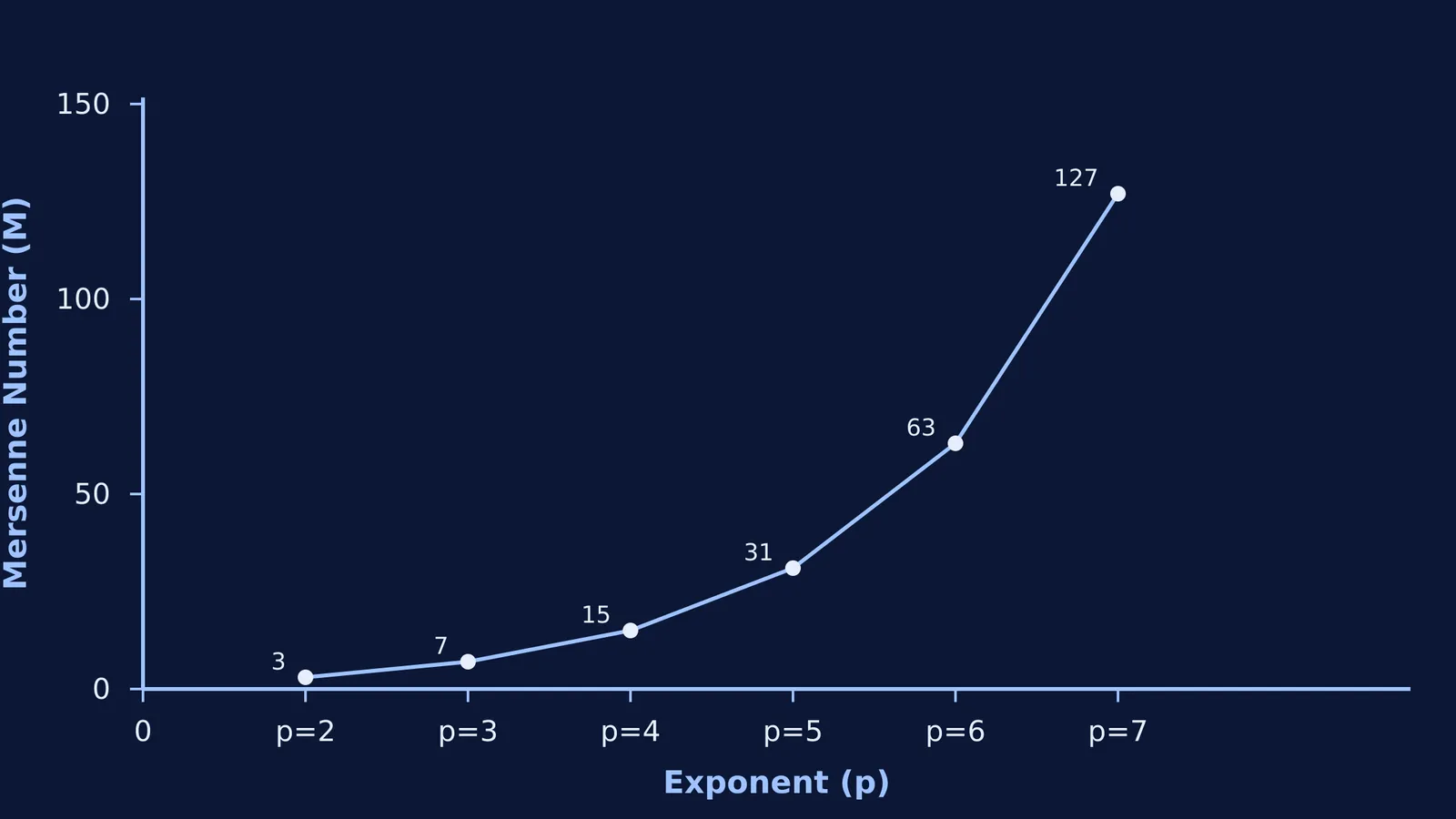
If you want to see how the math works on a smaller scale, here is how you can test the first few powers of two.
Test p = 2:
Calculate 2² − 1 = 4 − 1 = 3. The result is 3, which is prime.
Test p = 3:
Calculate 2³ − 1 = 8 − 1 = 7. The result is 7, which is prime.
Test p = 4 (A composite exponent):
Calculate 2⁴ − 1 = 16 − 1 = 15. The result is 15, which factors into 3 × 5. This shows why a composite exponent cannot yield a Mersenne prime.
Test p = 5:
Calculate 2⁵ − 1 = 32 − 1 = 31. The result is 31, which is prime.
Notice how quickly the numbers grow. By the time you reach p = 11, you are testing 2¹¹ − 1 = 2047, which factors into 23 × 89. The simple rule of powers becomes a massive computational challenge, one that began with a friar's list in 1644 and continues on supercomputers today.