

On this page
In 1666, a French self-taught chemist named Marie Meurdrac published a practical textbook titled *La Chymie Charitable et Facile, en Faveur des Dames* (*Charitable and Easy Chemistry, for the Benefit of Ladies*). At a time when universities firmly excluded women from scientific education, Meurdrac's work democratised laboratory knowledge.
Her treatise is widely regarded by scholars as the first chemistry or alchemy book written by a woman since late antiquity. It was exceptionally successful, running to at least eight French editions by 1787 according to publication histories and seeing translations into both German and Italian. Meurdrac operated her own laboratory, experimenting with high-temperature furnaces and testing every remedy she published, which required special permission from the King.
Like Jane Marcet and the chemistry book that inspired Faraday over a century later, Meurdrac wrote with the intent to make science accessible to a broader audience. Similar to how Elizabeth Fulhame and the first idea of how catalysts work showed the power of rigorous observation, Meurdrac insisted on verifying her results before printing them.
Why did Marie Meurdrac write La Chymie Charitable?
Meurdrac originally wrote her notes for her own satisfaction, to preserve the knowledge she had acquired through "long toil" and repeated experiments. However, when she considered publishing her work, she faced an inner struggle. She knew that teaching was not considered a woman's profession in 17th-century France. Women of the era were expected to remain silent on academic matters.
Marie Meurdrac confronted this prejudice directly, writing that it would be "a sin against Charity to hide the knowledge that God has given me". She justified her publication with a famous assertion about intellectual equality: "I prided myself that I am not the first woman to have placed something under the press, that mind has no sex, and if the minds of women were cultivated like those of men, and if we employed as much time and money in their instruction they could become their equal" in her original dedication letter.
Her book was so culturally significant that some historians suggest it influenced the playwright Molière, whose 1672 satirical play *Les Femmes Savantes* (*The Learned Ladies*) openly ridiculed the growing movement of scientifically educated women in France. Despite the mockery from the literary elite, Meurdrac offered private lessons and practical demonstrations in her own laboratory to women who wanted to learn the discipline firsthand.
What was in La Chymie Charitable et Facile?
The book bridged the gap between traditional alchemy and early modern chemistry, focusing heavily on practical laboratory work rather than obscure theory. It included a table of 106 alchemical symbols detailed in her text and explicit instructions on how to use laboratory equipment.
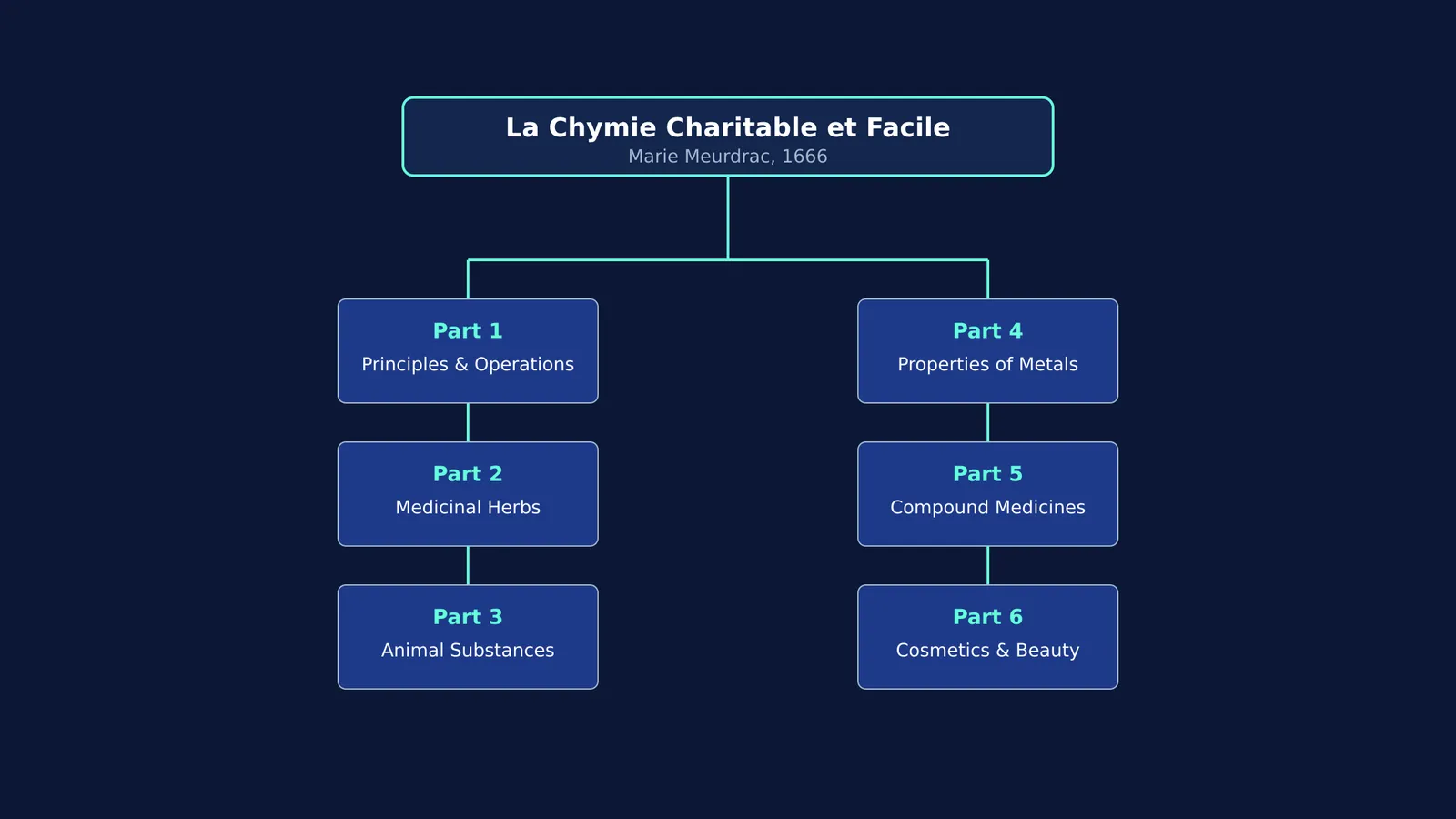
The text was systematically divided into six parts:
Principles and Operations: An introduction to laboratory vessels, furnaces, weights and fundamental techniques like distillation.
Medicinal Herbs: How to extract useful compounds from plants, detailing the processes for creating tinctures.
Animal Substances: Remedies derived from animal sources, which were common in early apothecary medicine.
Metals: The properties, extraction and reactions of inorganic metals.
Compound Medicines: Methods for making complex pharmaceutical preparations by combining multiple ingredients.
Cosmetics: A section directed explicitly at her female audience, covering methods for making beauty products.
How can you use Meurdrac's framework for your own study?
Meurdrac's systematic approach to chemistry still applies to students today. You can build a solid foundation by adapting her curriculum into a modern study plan:
Know your apparatus first: Before memorising complex reactions, Meurdrac taught her students the tools of the trade. Whether you are looking at an alembic or a modern titration burette, understanding the physical setup prevents mistakes in the theory.
Master the separate domains: Meurdrac separated plant, animal and metal chemistry. Today, we divide these into organic, biochemistry and inorganic chemistry. Treat them as distinct systems with their own unique rules and behaviours.
Verify through practice: She warned readers that she only published remedies she had tested herself. In modern study, this means working through numerical problems and mechanisms rather than just reading the textbook passively.
If you get stuck on a reaction mechanism or how a laboratory setup works, Fermi's AI tutor can work out what you already know and build a plan for the session. Instead of simply printing an answer, it teaches—holding a line of reasoning, drawing the figure and checking your understanding as it goes.
When you need to review the properties of specific elements or compounds, you can explore the Fermi Concept Library for every concept in physics, chemistry, biology, mathematics and computing, each with its own lesson and its place in the map.


