On this page
Michael Faraday is famous. The writer who first taught him chemistry is much less so. Her name was Jane Marcet, and her book, Conversations on Chemistry, taught thousands of readers in Britain and America before school chemistry textbooks were common. This post covers who she was, how her book worked, what Faraday himself said about it, and how you can borrow her method for your own study.
Who was Jane Marcet?
According to historian M. Susan Lindee's study in Isis (1991), Jane Haldimand Marcet (1769-1858) was born in London to a prosperous Swiss family. At thirty she married Alexander Marcet, a London physician and chemist who later taught chemistry at Guy's Hospital. Their circle of friends included the chemists Humphry Davy and J. J. Berzelius and the physicist Auguste de la Rive.
Lindee notes that Marcet published anonymously until 1837, so her books were often credited to other people. After Conversations on Chemistry came Conversations on Political Economy (1817), Conversations on Natural Philosophy (1820) and Conversations on Vegetable Physiology (1829).
Why did she write chemistry as a conversation?
In her preface, as Lindee quotes it, Marcet explained that she had attended Davy's public lectures and at first found them confusing. Once the basic ideas were explained to her in "familiar conversations", she could follow the lectures. She concluded that conversation was a useful way to learn this kind of subject.
So she wrote the book as dialogue. Mrs. B. is the teacher. Emily is serious and asks the important questions. Caroline is impetuous and sceptical, and, in Lindee's words, "somewhat more interested in explosions than in fundamentals of science."
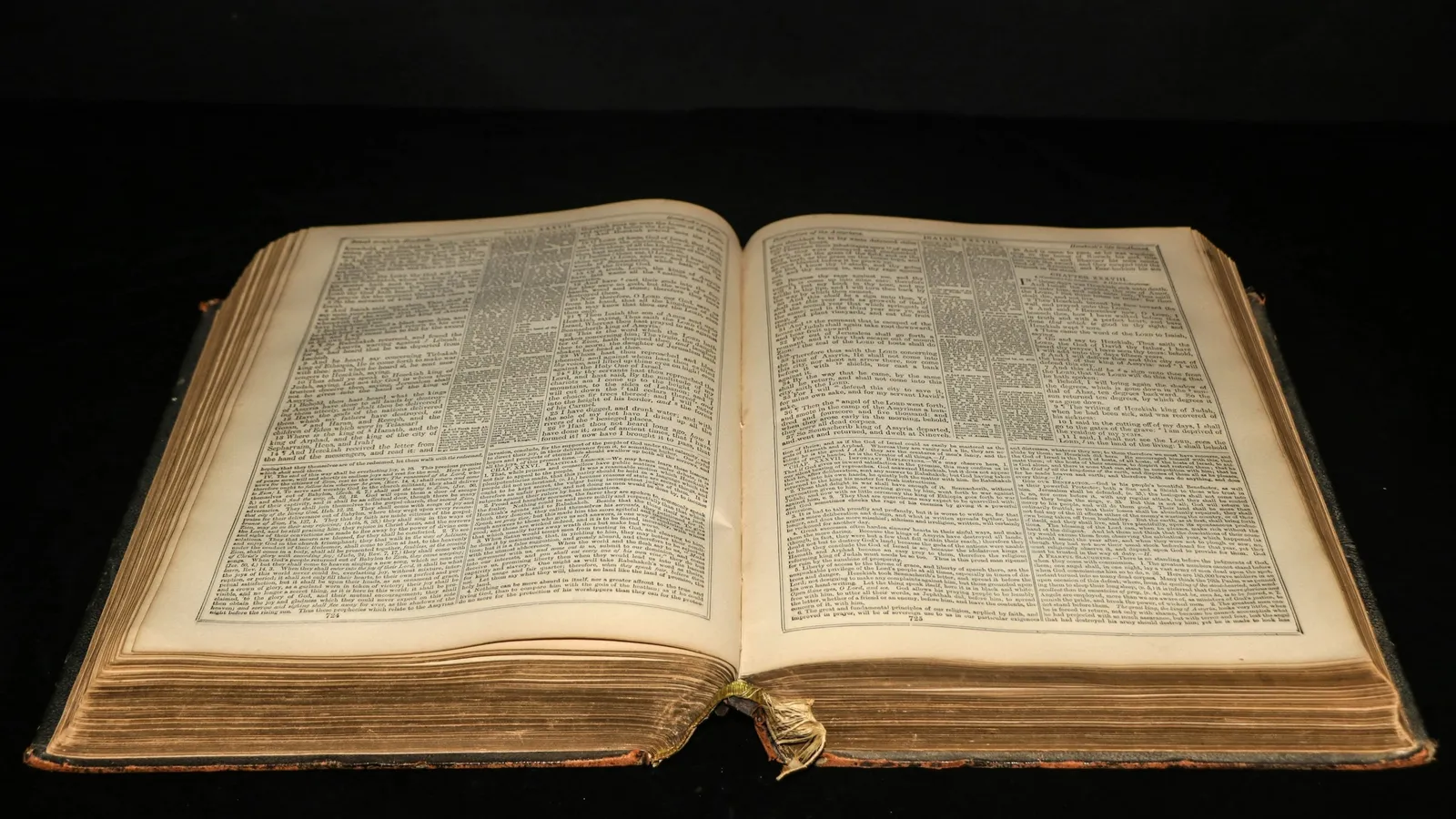
You can read the second volume of the 1806 first edition on the Internet Archive. Its title page says it explains the elements of chemistry "familiarly" and illustrates them "by experiments". The volume opens with Conversation XII, on the "attraction of composition", the old name for the force that makes substances combine.
What did Faraday actually say about her book?
In September 1858, after Marcet died, de la Rive wrote to Faraday. Her children had asked him to write a short biography of her, and he wanted to know whether it was true that her book had first drawn Faraday to chemistry. Faraday's reply of 2 October 1858 survives in the Epsilon collection of his letters.
Faraday wrote that he entered the shop of a bookseller and bookbinder "at the age of 13, in the year 1804, remained there 8 years". Two books helped him most: the Encyclopaedia Britannica for electricity, and "Mrs. Marcets conversations on chemistry, which gave me my foundation in that science." He added that "her book came as the full light in my mind."
Then he described how he read it. "I could trust a fact,- but always cross examined an assertion." He questioned Marcet's book "by such little experiments as I could find means to perform", found it true to the facts as far as he understood them, and "felt that I had got hold of an anchor in chemical knowledge."
For the rest of Faraday's story, from bookbinder to the Royal Institution and his idea of field lines, read our post on Michael Faraday and field lines.
How far did the book travel?
A 2017 paper in the Bulletin for the History of Chemistry describes Conversations on Chemistry as one of the most successful books of its kind, going through sixteen editions over about fifty years and widely copied, adapted and translated. Lindee found that American publishers printed twenty-three editions, plus twelve editions of an imitation, and that the book was widely used in the new American women's seminaries after 1818.
Numbers like these deserve the same cross-examination Faraday gave the book itself. A popular figure says 160,000 copies were sold in America. Lindee traced it to an 1874 book that counted 160 impressions (print runs) and assumed 1,000 copies each:
160 impressions × 1,000 copies = 160,000 copies.
Lindee found records of only 32 impressions. With the same assumption, 32 × 1,000 = 32,000 copies.
The true number is unknown. What the arithmetic shows is that a famous figure can rest on an assumption, and that checking the assumption changes the answer by a factor of five.
What can a student take from Marcet's way of working?
Marcet learned a hard subject by talking it through, then wrote the conversation down so others could learn the same way. Her characters model good questions: Emily asks why, Caroline doubts. And her most famous reader shows what to do with a book: test it.
You can use the same method this week.
Write a three-voice dialogue. Take one topic, such as types of chemical reactions. Write a page where a teacher explains it, one student asks "why?" at each step, and another student raises a doubt. Our guide to chemical reactions and equations for Class 10 gives you material to start from.
Find your gaps. Wherever you cannot answer your own "why?" in the dialogue, mark it. Those marks are your revision list.
Cross-examine one claim. Pick one statement from your textbook and ask what observation supports it. If your school lab has the experiment, ask your teacher to help you see it. Do chemistry experiments only under supervision.
When your "why?" questions keep landing on the same missing idea, the Fermi Concept Library covers every concept in physics, chemistry, biology, mathematics and computing, so you can revise the one idea that is blocking you.
Start tonight: write a ten-line conversation between Mrs. B., Emily and Caroline about one reaction from your syllabus.