

On this page
The Chemical Revolution of the late 18th century transformed chemistry from a qualitative art into a rigorous, quantitative science. Much of this shift is credited to Antoine Lavoisier, but the movement had a vital second architect. Marie-Anne Paulze Lavoisier was the intellectual partner who translated papers, recorded data and drew the intricate apparatus that made the new chemistry reproducible worldwide.
Her work shows why science relies on clear communication. A breakthrough is only useful if others can understand and repeat it.
What was Marie-Anne Paulze Lavoisier's contribution to chemistry?
Marie-Anne Paulze Lavoisier (1758–1836) was a central figure in what historians call the Chemical Revolution (Wikipedia). Her husband, Antoine, is famous for proving the law of conservation of mass and identifying oxygen's role in combustion. But Marie-Anne provided the linguistic and artistic skills that brought his work to an international audience.
She acted as his laboratory companion, working daily to run experiments and document the results. She studied chemistry formally and trained in drawing under the Neoclassical painter Jacques-Louis David. This combination of skills allowed her to become a scientific translator and a technical illustrator, two roles that were essential for replacing the old theories of chemistry with new ones.
Why were her scientific translations important?
In the 18th century, many chemists believed in the phlogiston theory—the idea that a fire-like element called phlogiston was released during combustion. To defeat this theory, the French chemists needed to read and dismantle the arguments of their British rivals.
Because she was fluent in English and Latin, Marie-Anne translated several crucial scientific works. Her most important translation was the Irish chemist Richard Kirwan's *Essay on Phlogiston* (Wikipedia). She did not simply translate the text; she added her own critical footnotes, pointing out chemical errors in Kirwan's logic. This critique gave Antoine the exact data he needed to prove that combustion requires oxygen, eventually forcing Kirwan to renounce his own theory.
When you study chemistry today, evaluating different arguments is still a powerful way to learn. You can explore the modern understanding of these reactions in the Fermi Concept Library, which contains every concept in physics, chemistry, biology, mathematics and computing, each with its own lesson and its place in the map.
How did she record the laboratory data?
Modern chemistry relies on precise measurement. Marie-Anne kept strict records of the procedures followed in the laboratory, logging the daily data and managing the experimental notes (Science History Institute). This rigorous documentation gave validity to the findings Lavoisier published. If you want to read about other early rigorous experiments, you can look at the work of Mikhail Lomonosov and the sealed-flask test of conserved mass.
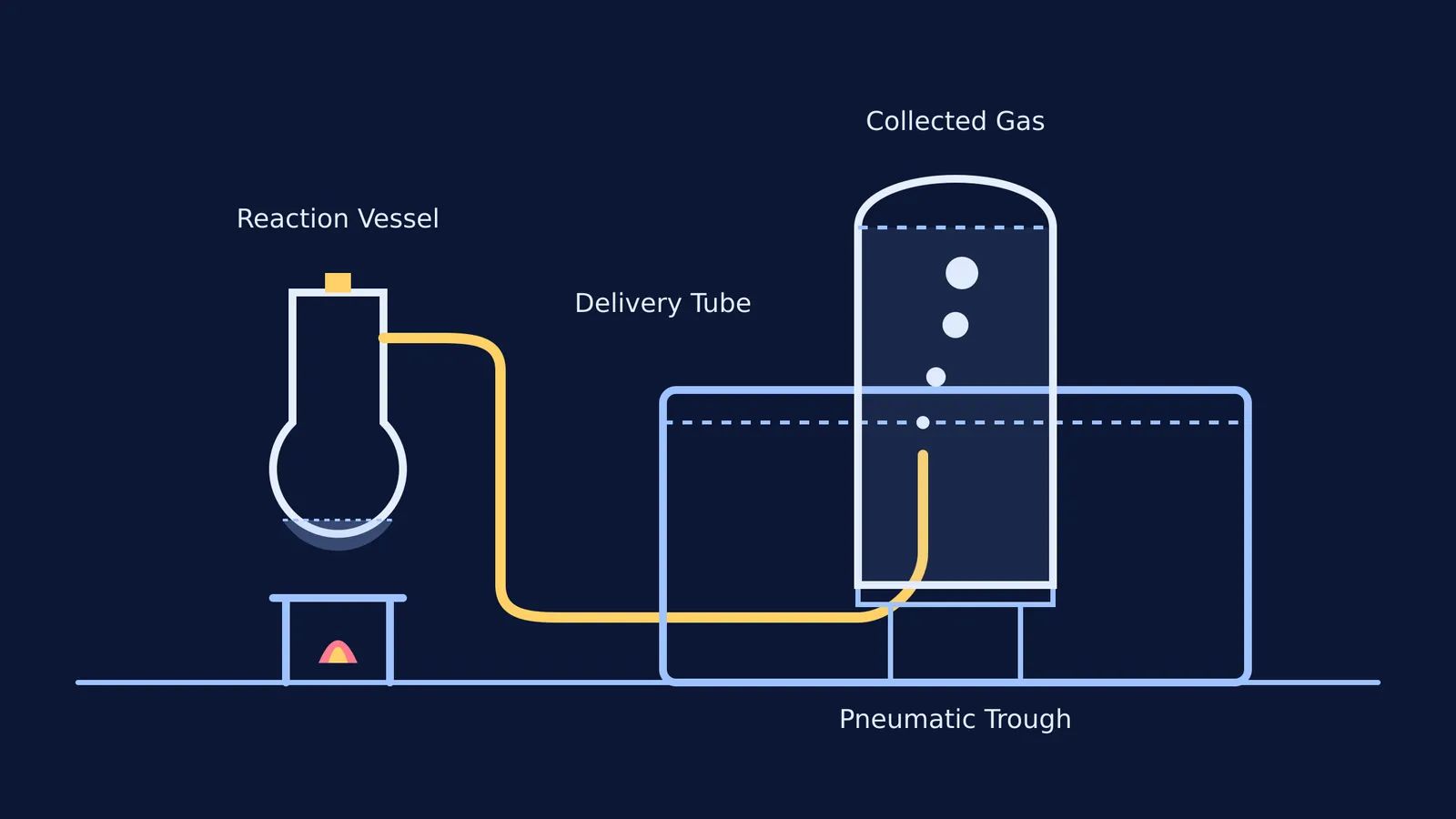
Beyond the numbers, her 13 engravings for the *Traité Élémentaire de Chimie* were vital because they acted as blueprints (Wikipedia). Instead of vague, artistic sketches, she drew the gasometers, balances and pneumatic troughs with exact proportions. This meant that scientists across Europe could build identical apparatuses and reproduce the experiments.
Her focus on breaking down a complex setup into clear, reproducible steps is exactly how students should tackle difficult mechanics or chemistry questions today. The Fermi Problem Library provides worked problems with a step-by-step solver that explains the reasoning rather than printing an answer.
What do her methods teach us about active learning?
Marie-Anne Paulze Lavoisier's role was highly active. She did not just watch experiments; she translated, critiqued, recorded and drew. This is the essence of active learning.
When studying a complex topic, passive reading is rarely enough. To truly understand a system, try to draw it. Sketching a physics setup or writing out a chemical mechanism forces your brain to process the relationships between the parts. Another pioneer who used clear explanation to teach the public was Jane Marcet and the chemistry book that inspired Faraday.
When a written description is hard to picture, interactive visualisations can bridge the gap. The Fermi Simulation Lab provides interactive simulations for the ideas that are easier to see than to read.
The next time you are stuck on a difficult topic, take a page from Marie-Anne Paulze Lavoisier's notebooks. Put down the highlighter, pick up a pencil, and start drawing the problem.


