

On this page
In 1941 the United States did not have enough penicillin to treat a single patient, according to a history of penicillin in Emerging Infectious Diseases. Within a few years, factories were producing it in bulk. Part of the reason is a chemical engineer from Houston, Margaret Hutchinson Rousseau, who helped work out how to grow the mould in huge tanks instead of shallow dishes.
Her story shows that a discovery is not the same as a medicine. Someone has to make it, reliably and in enormous amounts.
Who was Margaret Hutchinson Rousseau?
Rousseau was born in Houston, Texas, on 27 October 1910, studied chemical engineering at the Rice Institute and earned her Sc.D. from MIT in 1937, according to her Wikipedia biography. She was the first woman to earn a doctorate in chemical engineering at MIT, as AIChE's ChEnected notes.
She worked at E.B. Badger and Sons, a Boston engineering firm that built petroleum and petrochemical plants. During the war she also worked on high-octane aviation fuel, and she developed improved distillation column designs and plants for ethylene glycol. In 1945 she became the first woman member of the American Institute of Chemical Engineers (AIChE), and in 1983 the first woman to receive its Founders Award, its highest honour (ChEnected).
Why was penicillin so hard to make in bulk?
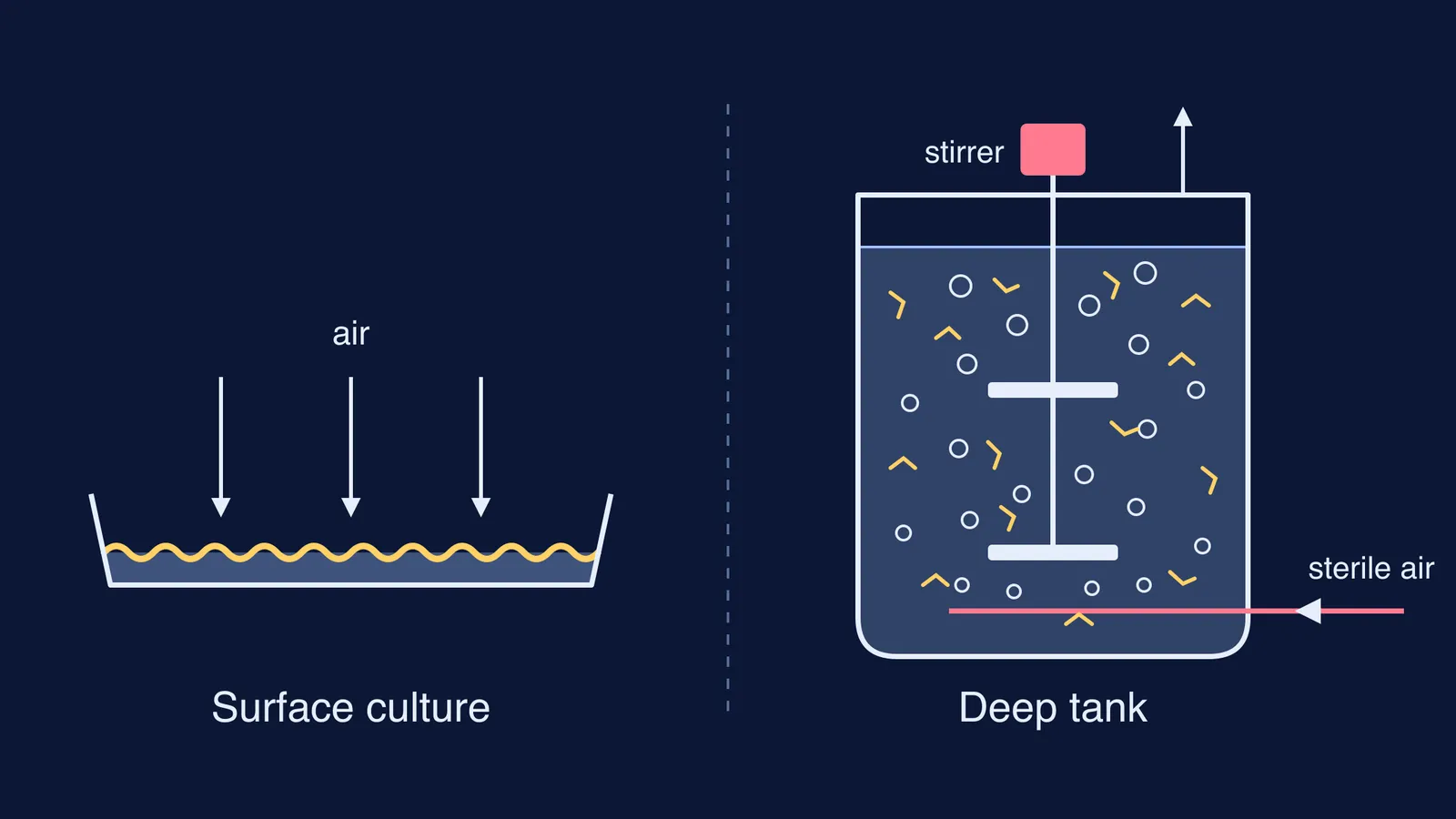
Penicillin is made by a mould, and the mould needs air. Early producers grew it on the surface of a few centimetres of broth in milk bottles (The Chemical Engineer) and shallow dishes (Gaynes, 2017). Only the surface did any work, and contamination was so common that whole batches had to be thrown away.
Biology helped first. A strain of *Penicillium chrysogenum* found on a mouldy cantaloupe produced 6 times more penicillin than Fleming's strain (Gaynes, 2017). Even so, at the end of 1942 there was enough penicillin for fewer than 100 patients. Production needed a new kind of plant.
The answer was deep-tank fermentation: the mould grows throughout a large tank of broth while air is bubbled through and an electric stirrer keeps it mixed (The Chemical Engineer). The hard part is engineering: pushing enough air through thousands of litres while keeping it sterile and the temperature steady.
What did Rousseau's deep-tank plant change?
Rousseau designed the first large-scale plant to produce penicillin by fermentation during the war, and her design produced over 2.3 million doses for US soldiers in 1944, according to the University of Wisconsin–Madison chemical engineering department. The American Society for Microbiology describes her working with Pfizer to develop the deep fermentation tanks.
The sources we checked do not say whether Pfizer's Brooklyn factory was built to her design, but it shows the scale deep tanks made possible. Pfizer turned an old Brooklyn ice plant, which already had refrigeration, into a penicillin factory that opened on 1 March 1944 (American Chemical Society release, via OH&S). It held fourteen 7,500-gallon tanks, and the company soon made more penicillin in one month than in all of 1943. Most of the penicillin that went ashore with Allied forces on D-Day came from that Brooklyn plant, according to the same release.
The Chemical Engineer credits Pfizer's Jasper Kane and Alexander Finlay with the aeration method and chemical engineer John McKeen with converting the ice plant. The team effort began in Oxford, where Norman Heatley improvised penicillin extraction with bedpans before production moved to America.
Why does a deep tank beat a shallow dish?
Here is a worked example. Each 7,500-gallon tank held about 28,400 litres (The Chemical Engineer).
Picture a surface tray 1 m by 1 m, filled 2 cm deep. It holds 1 × 1 × 0.02 = 0.02 m³, which is 20 litres.
To hold one tank's 28,400 litres in trays like that, you need 28,400 ÷ 20 = 1,420 trays.
That is 1,420 square metres of broth surface to fill, sterilise, keep at the right temperature and protect from stray microbes, for just one tank.
A deep tank packs the same volume into one sealed vessel. The cost moves to a new problem: getting oxygen into every litre, which is why stirring and air bubbling matter.
That swap of one hard problem (too much surface) for another (mass transfer of oxygen) is chemical engineering in one line. If gas dissolving in liquid or surface-to-volume ratios feel shaky, the Fermi Concept Library has a lesson for each concept in chemistry and biology, with its place in the map.
What can a student take from her career?
Rousseau's MIT thesis was on gas absorption (Wikipedia): how a gas gets into a liquid, the same problem an aerated tank has to solve. A few habits follow from her story.
Learn the basics deeply. Unglamorous topics like mass transfer end up deciding whether a medicine reaches patients.
Ask scale-up questions: what changes when this is a thousand times bigger?
If you are told a field is not for people like you, remember she was the first woman member of her profession's institute.
If this kind of problem appeals to you, read what you study in chemical engineering and where bioprocess engineers work.


