

On this page
Most of the atoms in your body were not made in the Big Bang. Instead, they were forged over vast stretches of time in the crushing heat of stellar cores. We know this largely because of a 1957 paper by Margaret Burbidge, Geoffrey Burbidge, William A. Fowler and Fred Hoyle.
The paper, "Synthesis of the Elements in Stars", was published in *Reviews of Modern Physics* in 1957 (source). It is so famous in astrophysics that it is simply called B²FH, after the authors' initials. At the time, many physicists believed that all elements were created in the first few minutes of the universe. B²FH proved that the Big Bang made mostly hydrogen and helium, while stars built the rest (source).
Decades earlier, Cecilia Payne discovered that stars are mostly hydrogen, and Hans Bethe laid the groundwork by explaining the nuclear reactions that make stars shine. But it was Margaret Burbidge and her team who finally mapped out the exact pathways that turn hydrogen into the rest of the periodic table.
What is the B²FH paper?
Margaret Burbidge was the lead author of B²FH and provided its critical observational evidence. As a spectroscopist, she used the telescopes at the Mount Wilson Observatory to capture the light of distant stars, spreading it out into a spectrum of colours crossed by dark absorption lines (source).
By measuring the width and darkness of these lines—using a mechanical planimeter and a hand-cranked calculating machine—Burbidge could read a star's chemical "fingerprint". She found that older stars had fewer heavy elements than younger ones. This meant elements were not created all at once, but were being cooked over time.
How do stars make elements?
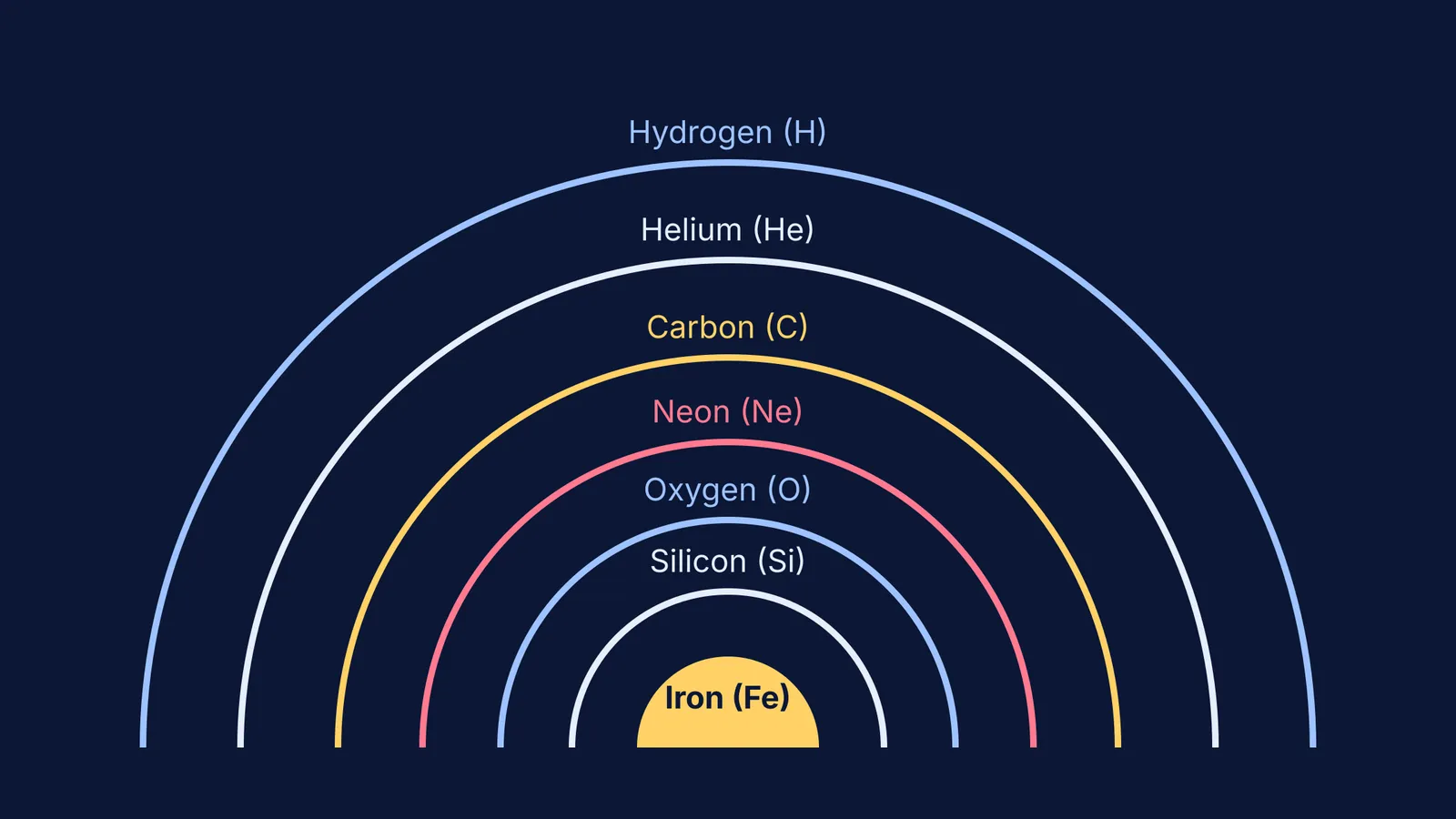
A star is a nuclear reactor held together by its own gravity. Fred Hoyle had earlier proposed how stars make carbon and heavier elements, and B²FH expanded this into a complete sequence of processes that fuse lighter elements into heavier ones:
Hydrogen burning: Hydrogen fuses to helium, powering young stars like our Sun.
Helium burning: Three helium nuclei combine to form carbon (the triple-alpha process), and carbon captures another helium to make oxygen.
The alpha process: Helium nuclei keep adding on, forging even-numbered elements like neon, magnesium and silicon.
The e-process: At extreme temperatures, silicon fuses into the iron group (iron, nickel and cobalt).
Iron is the end of the road for normal fusion. It takes more energy to fuse iron than the reaction gives out, so the star's core eventually collapses.
If you are trying to picture how different elements fuse inside a star's core, the Fermi Concept Library has a dedicated lesson for these nuclear reactions.
Where do gold and uranium come from?
If normal fusion stops at iron, how do we get heavier elements like barium, gold or uranium? Burbidge's observations of "peculiar" stars helped prove the existence of two more mechanisms described in B²FH:
The s-process (slow neutron capture): In aging red giants, nuclei slowly absorb free neutrons, turning into heavier elements over long periods. This produces elements like strontium and barium.
The r-process (rapid neutron capture): In violent events like supernovae, nuclei are bombarded with neutrons so quickly they do not have time to decay. This creates heavy, neutron-rich elements like gold and uranium.
When you are solving nuclear physics and radioactive decay problems, the Fermi Problem Library explains the reasoning behind each step of a decay chain rather than just printing an answer.
How did Burbidge overcome barriers?
Burbidge did not just have to solve the origin of the elements; she had to fight to do her work. Mount Wilson Observatory had a strict ban on women observers. Burbidge gained access by posing as her husband Geoffrey's assistant, operating the telescope herself while he stayed in the darkroom (source).
William Fowler later won the 1983 Nobel Prize in Physics for his work on stellar nucleosynthesis. Many scientists felt the prize should have been shared with Burbidge and Hoyle. Nevertheless, Margaret Burbidge's legacy as the astronomer who read the stars and proved we are made of star stuff remains a cornerstone of modern astrophysics.


