

On this page
In the early 1880s, electric power was strictly local. When Thomas Edison opened his Pearl Street station in New York in September 1882, direct-current dynamos supplied 110 V through underground conductors, as documented in historical accounts of early electric power transmission. Because transmission lines suffer resistive heating, low-voltage direct current could only travel about 1 to 2 km before voltage drop wiped out usable power. Most engineers assumed electrical grids would remain permanently fragmented, requiring a steam-powered generator on almost every city block.
Why was long-distance power transmission thought impossible?
The primary obstacle for early power networks was Joule heating. When electric current passes through a conductor of resistance R, energy dissipates as heat according to Joule's law. Because resistance scales with line length (R = ρL/A), a circuit stretching between distant cities inevitably carries hundreds or thousands of ohms of resistance.
Many 19th-century electricians assumed that overcoming this resistance required impractically thick copper cables to keep R low, making intercity power distribution financially impossible. Others feared that raising the voltage would simply multiply heat loss, confusing generator potential with the voltage drop across the wire itself. French engineer Marcel Deprez challenged this view, proving mathematically that raising voltage was the only practical way to transmit power over long distances through thin conductors, as recorded in biographical studies of Marcel Deprez.
How did Marcel Deprez send power 57 km from Miesbach to Munich?
In 1882, Oskar von Miller organized the Munich Electricity Exhibition and invited Deprez to test his theory publicly. Deprez accepted, placing a generator at the Knorrschacht coal mine in Miesbach, 57 km south of Munich, as detailed in historical records of the Miesbach–Munich power transmission.
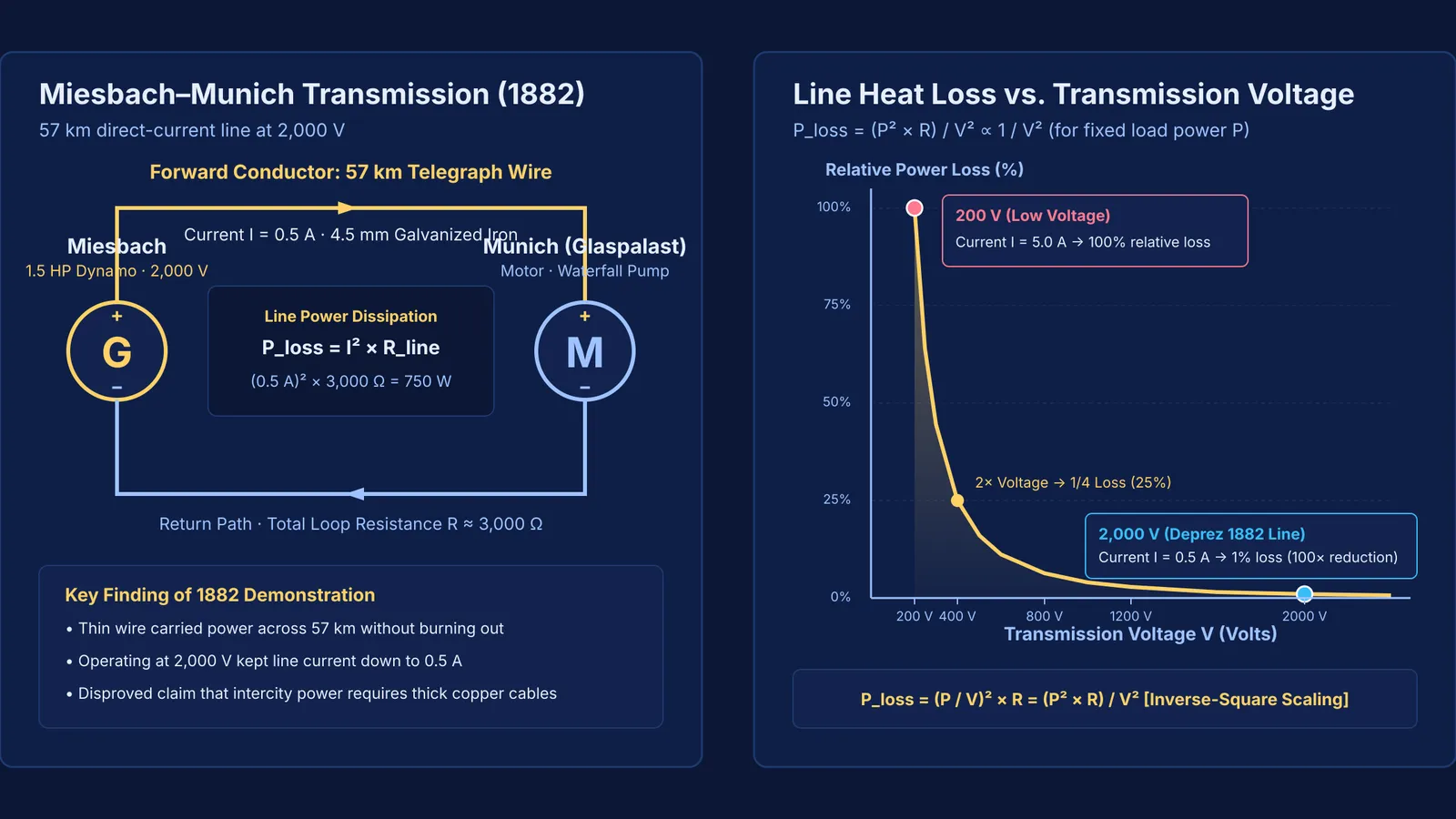
At Miesbach, a steam engine drove a 1.5-horsepower Gramme dynamo to generate direct current at roughly 2,000 V. Rather than using an expensive copper cable, Deprez routed the current through an ordinary galvanized iron telegraph wire 4.5 mm in diameter running along the railway, with a total loop resistance of about 3,000 Ω. In Munich's Glass Palace, the current reached an identical Gramme machine acting as a motor at roughly 0.5 A.
The motor drove a centrifugal pump that raised water 2.5 metres to supply an artificial waterfall inside the exhibition hall. The system achieved an overall efficiency of roughly 25% to 38%, as recorded in contemporary evaluations published in Revue des Deux Mondes. While the dynamo suffered damage after eight days of operation, halting the demonstration, the trial settled the core principle: high voltage allowed useful mechanical power to bridge intercity distances without thick copper cables.
Why does high voltage cut transmission losses?
The physics behind Deprez's success rests on the relationship between power, current, and line dissipation, as analyzed in Marcel Deprez's formulation of electrical work.
Power delivery: The electric power P delivered to a load at voltage V is P = V × I.
Current scaling: For a required load power, line current is I = P / V.
Line heat dissipation: Power lost as heat across wire resistance R is P_loss = I² × R.
The inverse-square law: Substituting current gives P_loss = (P / V)² × R = (P² × R) / V².
Transmission power loss is inversely proportional to the square of voltage (P_loss ∝ 1 / V²). Doubling the voltage cuts current by half and drops line loss to one-fourth. Increasing voltage tenfold—from 200 V to 2,000 V—reduces resistive line loss by a factor of 100 for the same wire.
Worked example: how much power does raising voltage save?
Consider delivering P = 1,000 W (1 kW) of electrical power across a transmission line with total resistance R = 250 Ω, similar to early test circuits described in historical power transmission archives.
Case A: Low voltage at 200 V
Line current: I = P / V = 1,000 W / 200 V = 5.0 A.
Line power loss: P_loss = I² × R = (5.0 A)² × 250 Ω = 25 × 250 = 6,250 W.
Outcome: Line loss is more than six times the delivered power, proving low-voltage long-distance transmission impossible.
Case B: High voltage at 2,000 V
Line current: I = P / V = 1,000 W / 2,000 V = 0.5 A.
Line power loss: P_loss = I² × R = (0.5 A)² × 250 Ω = 0.25 × 250 = 62.5 W.
Fractional loss: (62.5 W / 1,000 W) × 100% = 6.25%.
Outcome: Over 93% of the power reaches the load, slashing energy loss by a factor of 100.
What did Deprez's demonstration leave for future grids?
Although Deprez proved the square law, high-voltage direct current had practical limits in 1882. Early dynamos used mechanical commutators that sparked violently under high voltage, and direct current could not easily be stepped down for household appliances.
These obstacles paved the way for alternating current. Step-up and step-down transformers allowed utilities to generate electricity at moderate voltages, boost it for cross-country transit, and reduce it locally. Nikola Tesla's alternating current work and induction motors turned this architecture into the global standard, while later pioneers like Edith Clarke's power transmission calculations formalized grid stability.
Understanding the link between potential difference and the heating effect of current is a core topic in JEE physics. When students get stuck on circuit relations, the Fermi Problem Library offers worked problems with a step-by-step solver that explains the reasoning rather than just printing an answer. For concepts easier to grasp visually, the Fermi Simulation Lab provides interactive simulations for ideas that are easier to see than to read, letting students test how voltage and line resistance govern power flow.


