

On this page
In January 1933, the Mexican physicist Manuel Sandoval Vallarta and Georges Lemaître published "On Compton's Latitude Effect of Cosmic Radiation" in Physical Review (Crossref record). It treated cosmic rays as charged particles steered by Earth's magnetic field, using the force on a moving charge you meet in Class 12.
Who was Manuel Sandoval Vallarta?
Vallarta was born in Mexico City in 1899 and earned his physics degree (1921) and PhD (1924) at MIT. A 1927 Guggenheim Fellowship took him to Berlin and Leipzig, where he learned from Einstein, Planck, Schrödinger and Heisenberg (biography on Wikipedia). At MIT he mentored Richard Feynman and co-wrote Feynman's first scientific publication, a 1939 letter on cosmic rays scattered by a galaxy's stars (Physical Review record). By 1946 he had chosen to stay full-time at UNAM in Mexico City. His co-author is known for Lemaître's work on the expanding universe.
How does Earth's magnetic field bend cosmic rays?
A charge moving through a magnetic field feels the force F = qv × B, at right angles to its motion. It changes the particle's direction but not its speed, so a proton from deep space curls into an arc. Earth's field is roughly a dipole that fades fast with distance. At the surface it ranges from about 25,000 to 65,000 nanotesla (NOAA geomagnetism FAQ).
The Norwegian Carl Störmer had already traced charged-particle paths in a dipole field while studying the northern lights (UCLouvain archives). Lemaître and Vallarta linked those paths to what a detector counts. A 1975 tribute to Vallarta by the physicist H. Elliot says the key step was applying Liouville's theorem, which leads to the conclusion that "for a cosmic ray flux that is isotropic and homogeneous at infinity the intensity in allowed directions at the earth is the same as that at infinity and is zero in all other directions" (Elliot, Revista Mexicana de Física, 1975).
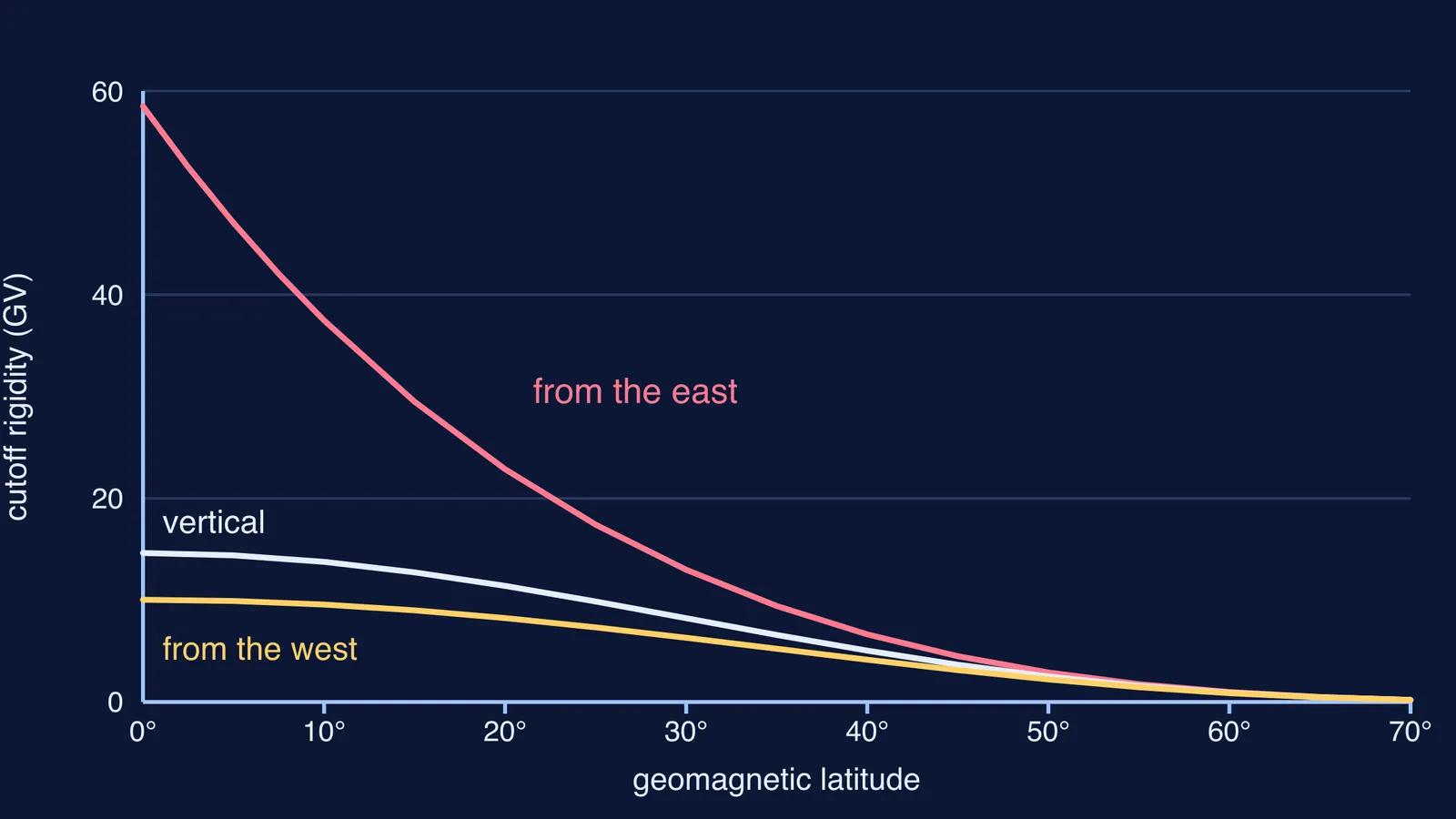
The question became: from which directions can a particle of given momentum reach you? Near the magnetic poles, particles can come in along the field lines. Near the equator they have to cross the field, so only the more energetic ones get through. That is the latitude effect.
Why do more cosmic rays arrive from the west?
For positive particles, the theory's cone of forbidden directions extends toward the east; for negative ones, toward the west. So if cosmic rays are positive, more should arrive from the western sky. Bruno Rossi had already predicted this east-west effect in 1930 (Wikipedia). Elliot notes that at ground level it shows up only near the equator and grows with altitude, which made the Valley of Mexico a fitting test site (Elliot, 1975).
At Vallarta's prompting, Luis Alvarez went to Mexico City, and Thomas Johnson and Serge Korff made a similar trip. In May 1933, Physical Review printed Johnson's "The Azimuthal Asymmetry of the Cosmic Radiation" (Crossref) and Alvarez and Compton's "A Positively Charged Component of Cosmic Rays" (Crossref). According to Elliot, these results, later confirmed by Rossi and de Benedetti in Eritrea, showed that the primary cosmic rays are mostly positive.
India has its own chapter: read about Piara Singh Gill's cosmic-ray research.
Worked example: how sharply does the field bend a cosmic-ray proton?
Take a proton crossing the field at right angles near the equator, with B = 3 × 10^-5 T (30,000 nT, inside the 25,000 to 65,000 nT range in the NOAA geomagnetism FAQ).
Choose a momentum: p = 5.3 × 10^-18 kg m/s (about 10 GeV/c).
Set the magnetic force equal to the centripetal force: qvB = mv²/r, so r = p/(qB).
Substitute: r = 5.3 × 10^-18 / (1.6 × 10^-19 × 3 × 10^-5) = 1.1 × 10^6 m, about 1,100 km.
Earth's mean radius is 6,371 km (NASA Earth fact sheet), so the circle's radius is about one-sixth of the planet's.
At one-tenth the momentum, r is about 110 km, a tight curl. At ten times the momentum, r is about 11,000 km, a much gentler curve.
The field weakens with height, so this is only a scale. To watch the radius change, try predicting a charged particle's circle in a magnetic field.
How can you use this story when you study magnetism?
Three habits for JEE Main and board numericals:
Find the direction of qv × B with the right-hand rule before you put in any numbers.
Use r = p/(qB). In the same field, the radius grows with momentum per unit charge, the quantity cosmic-ray physicists call rigidity.
Flip the sign of the charge and check that every deflection flips too. That was the whole logic of the east-west test.
If curling paths are hard to picture, the Fermi Simulation Lab has interactive simulations for ideas that are easier to see than to read. If you keep getting directions wrong, the Fermi Problem Library has worked problems with a step-by-step solver that explains the reasoning rather than printing an answer.
Next time a numerical asks for a radius, try it with a cosmic-ray proton and Earth's own field.


