On this page
Many familiar vaccines use a whole germ, killed or weakened. Manuel Elkin Patarroyo, a Colombian immunologist, tried something different for malaria: he joined short chains of amino acids made in a lab, copying small pieces of the parasite's proteins. The result, called SPf66, was tested in thousands of people across three continents. It also became a clear lesson in why one promising trial is not enough.
Who was Manuel Elkin Patarroyo?
Patarroyo worked for many years on chemically synthesised vaccines in Colombia. In 1994 he received the Prince of Asturias Award for Technical and Scientific Research, whose jury called his work the result of "many years of original, rigorous and persevering effort". He died on 9 January 2025, aged 78, as the University of La Laguna noted when it remembered him as an honorary doctor of that university.
What was SPf66 and how was it made?
In March 1988, Patarroyo's team reported in Nature three synthetic peptides, named 83.1, 55.1 and 35.1 and copied from proteins of the malaria parasite's merozoite stage, had already protected Aotus monkeys. Joined into long chains, which the paper calls polymeric synthetic hybrid proteins, they could "delay or suppress the development of parasitaemia" in immunised human volunteers.
SPf66 is a synthetic protein whose amino-acid sequences come from both the liver-invading (pre-erythrocytic) and blood stages of *Plasmodium falciparum*, as the Gambian trial report91321-1) describes it. If those stage names are hazy, our walk through the malaria and the Plasmodium life cycle shows where sporozoites and merozoites fit.
The appeal was practical. A vaccine made by chemistry, not by growing parasites, could in principle be made cheaply and identically, batch after batch.
What did the SPf66 field trials find?
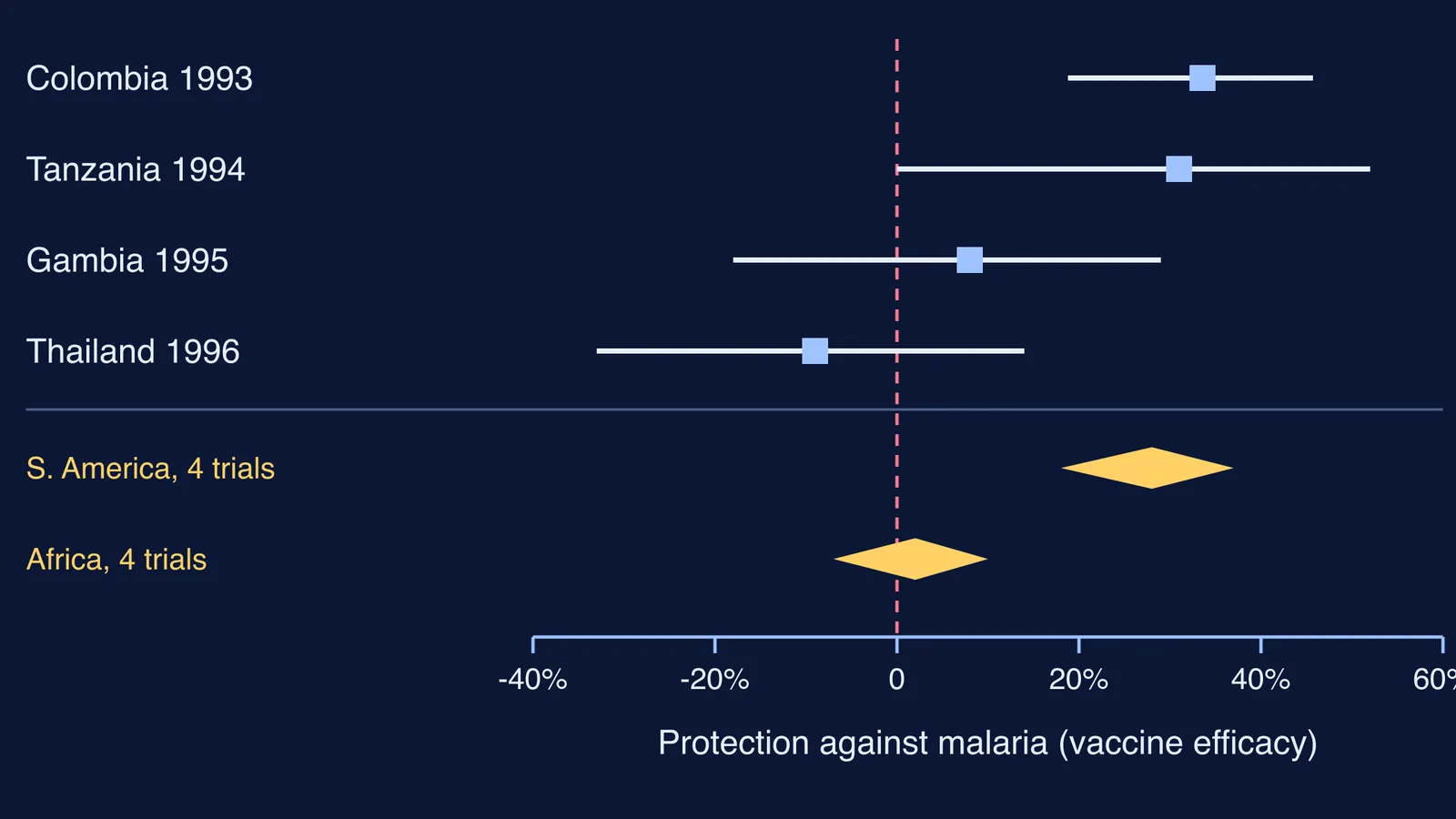
A phase III trial ran in La Tola, Colombia. In 1,548 people aged over one year, SPf66 gave 33.6% protection against a first or only malaria episode (95% CI 18.8 to 45.7), according to Valero and colleagues in The Lancet, 199390483-w).
In Idete, southern Tanzania, 586 children aged 1 to 5 took part, and the estimated protection against clinical malaria was 31% (95% CI 0 to 52), reported by Alonso and colleagues in 199490505-3).
Then the results faded. In The Gambia, 630 infants aged 6 to 11 months were enrolled, and protection against a first or only episode was 8% (95% CI -18 to 29), which was not significant, per D'Alessandro and colleagues, 199591321-1). In northwestern Thailand, 1,221 children aged 2 to 15 showed an efficacy of -9% (95% CI -33 to 14); the authors concluded that SPf66 "does not protect against clinical falciparum malaria" (Nosten and colleagues, 199604465-0)).
The 2006 Cochrane review by Graves and Gelband pooled 10 efficacy trials with 9,698 participants. It found no protection in four African trials or one Asian trial, a 28% reduction in first attacks in four South American trials, and concluded there was "no justification for further trials of SPf66 in its current formulation."
How do you read a vaccine efficacy number?
Efficacy compares how often disease strikes the vaccinated group with how often it strikes the placebo group: efficacy = 1 - (rate in vaccinated / rate in placebo).
Worked example from the Tanzanian trial90505-3): clinical malaria struck 0.25 times per child per year in the vaccine group and 0.35 in the placebo group. So 1 - 0.25/0.35 = 1 - 0.71 = 0.29, about 29%. The paper reports 31% from its own statistical analysis, so this quick crude estimate differs slightly.
When you meet any vaccine headline, run this four-step check:
What was counted? First episode, all episodes, or severe disease can give very different numbers.
Does the confidence interval cross zero? If yes, the result is compatible with no effect.
Who was tested, and where? Gambian infants are not the same group as Colombian volunteers of all ages.
Has it been repeated by independent teams? SPf66 looked good in two trials and failed in two others.
For more practice, see how to read Gagandeep Kang's rotavirus vaccine trial numbers. If calculations like this trip you up, the Fermi Problem Library has worked problems with a step-by-step solver that explains the reasoning rather than printing an answer.
What came after SPf66?
Malaria vaccines did arrive, decades later. WHO recommended RTS,S/AS01 in 2021 and R21/Matrix-M in October 2023; in areas with highly seasonal malaria, R21 cut symptomatic cases by 75% over 12 months after three doses, according to WHO.
SPf66 is one chapter in a long story that includes Ronald Ross tracing malaria to mosquitoes in India. Its lesson is about evidence: a bold idea, tested honestly in several countries, told scientists what did not work. If terms like antigen, adjuvant or merozoite still feel loose, the Fermi Concept Library gives each biology concept its own lesson and its place in the map.
Next time you see a vaccine percentage in the news, try the four-step check before you share it.