

On this page
What did Louis Dollo discover about evolution?
In 1878, coal miners in Bernissart, Belgium, unearthed multiple intact *Iguanodon* skeletons. While reconstructing these fossils, Belgian palaeontologist Louis Dollo recognized that lineages adapted to new environments never roll back the clock to regain ancestral anatomical forms.
In 1893, Dollo published his findings in the *Bulletin de la Société belge de géologie, de paléontologie et d'hydrologie*. He stated that an organism cannot return, even partially, to an ancestral state already realized in its lineage. As Stephen Jay Gould clarified in 1970 in the *Journal of the History of Biology*, Dollo's law is a principle of statistical improbability: because complex anatomical organs require thousands of coordinated developmental steps, the odds of reversing that entire sequence in identical order are effectively zero.
Why can organisms not re-evolve lost organs?
At its core, Dollo's law reflects genetic decay and historical contingency. When a complex organ like an eye, wing, or limb is lost, the genes orchestrating its development are freed from stabilizing selection. Mutations—such as insertions, deletions, and premature stop codons—freely accumulate in those non-functional sequences.
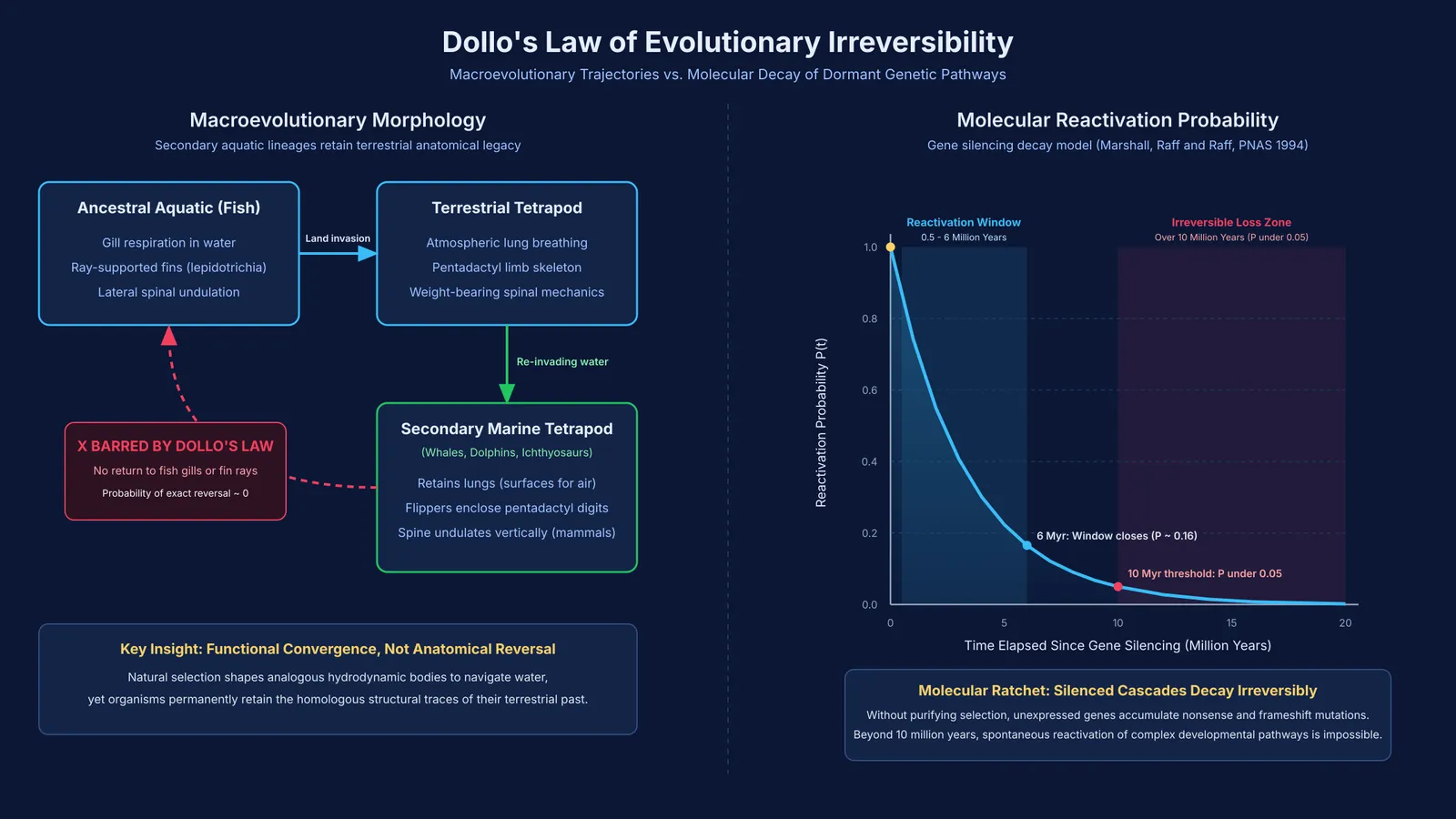
In the *Proceedings of the National Academy of Sciences*, Charles R. Marshall, Elizabeth C. Raff, and Rudolf A. Raff modeled this mutational decay. They found that while silenced genes have a realistic probability of reactivation over 0.5 to 6 million years, unexpressed developmental pathways dormant for more than 10 million years accumulate fatal mutations that make resurrection impossible.
Recent molecular work reveals an even stricter physical constraint: the epistatic ratchet. In *Nature*, Jamie T. Bridgham, Eric A. Ortlund, and Joseph W. Thornton resurrected 450-million-year-old corticosteroid receptors to test whether hormone specificity could be reversed. While two key mutations shifted receptor function, five subsequent restrictive mutations stabilized the new structure while destabilizing elements required for the ancestral state. Reverting the two functional mutations caused the receptor to misfold into an inactive protein. To reverse direction, the molecule had to revert restrictive mutations that offered no selective advantage alone. Evolution had burned its bridges.
What happens when land animals return to the sea?
The clearest macroevolutionary test of Dollo's law occurs when terrestrial animals re-invade aquatic environments. Lineages of reptiles and mammals—including ichthyosaurs, plesiosaurs, and whales—returned to the sea, yet none re-evolved ancestral fish gills or rayed fins.
Instead, marine tetrapods retain clear signatures of their land ancestry:
Cetaceans breathe atmospheric air with lungs and must surface regularly.
Whales swim by flexing their spine vertically up and down, preserving the running posture of terrestrial mammals rather than the side-to-side swimming of fish.
Whale flippers enclose homologous pentadactyl limb bones—humerus, radius, ulna, and digits—rather than regenerating fish fin rays.
Just as Georges Cuvier's proof of species extinction showed that vanished species do not return, Dollo proved that lost anatomical complexes leave permanent structural signatures. For students mapping homologous and vestigial structures, distinguishing ancestral traits from secondary adaptations requires connecting anatomy across lineages. The Fermi Concept Library maps every concept in evolutionary biology, each with its own lesson and its place in the broader tree of life.
Can evolution ever run in reverse?
Apparent reversals, known as atavisms, occasionally appear in living species. However, genetic analysis typically confirms Dollo's core premise.
Consider the marsupial frog *Gastrotheca guentheri*. Almost all living frog species lack lower jaw teeth, having lost them more than 200 million years ago. Yet *Gastrotheca guentheri* possesses true mandibular teeth. In *Evolution*, John J. Wiens evaluated this apparent exception: frogs had continuously retained teeth on their upper jaw throughout those 200 million years. Because the dental developmental machinery remained active in the upper jaw, re-expressing teeth on the lower jaw required reactivating an existing pathway rather than reconstructing tooth development from scratch.
True reversals of lost complex traits do not emerge anew. Either the genetic machinery was maintained elsewhere by pleiotropy, or natural selection built an analogous structure that superficially mimics the lost organ under directional and disruptive selection.
How to evaluate evolutionary irreversibility in biology problems
When solving questions on vestigial organs and evidence for evolution, apply this diagnostic checklist:
Assess Trait Complexity: Does the structure require multiple coordinated genes (like an eye or limb)? Complex organs cannot re-evolve identically once lost. Single-gene traits, such as enzyme point mutations, can readily revert.
Examine the Timeline: Did the lineage lose the trait over 10 million years ago? According to Marshall, Raff, and Raff's molecular model, unexpressed cascades degrade within 10 million years, making re-emergence impossible without an intact blueprint.
Check for Shared Pathways: Was the developmental program preserved elsewhere in the body? If patterning pathways were maintained for another organ, re-expression in a new site is biologically viable.
Inspect the Architecture: Is the structure homologous to the ancestral form or an analogous convergence? A whale's flipper functions like a fish's fin, but its internal skeletal architecture proves it is a modified mammalian forelimb.
To test your understanding of phylogenetic trees and character states, the Fermi Problem Library offers worked problems with a step-by-step solver that explains the reasoning rather than printing an answer.


