

On this page
Most physics lessons explain the right idea and hope the wrong one fades. Lillian McDermott, a physicist at the University of Washington, spent her career showing that the wrong idea often stays, and building lessons that bring it into the open first.
Who was Lillian McDermott?
McDermott (1931 to 2020) earned a PhD at Columbia University, specialising in experimental nuclear physics, and founded the Physics Education Group (PEG) at the University of Washington, according to her obituary from the American Association of Physics Teachers. The AAPT calls PEG the first organised physics education research group to provide access to a PhD in physics for that research. She joined the university in 1967, retired in 2019 and was lead author of *Physics by Inquiry* and *Tutorials in Introductory Physics*, the UW Department of Physics notes. She won the AAPT's Oersted Medal in 2001, and in 2021 the AAPT renamed its Millikan award the Lillian McDermott Medal.
What did McDermott find about how students learn physics?
A recurring finding of her group's research was uncomfortable: students can finish a physics course with an incorrect mental model still in place. In her 2001 Oersted Medal lecture she took the view that teaching is “a science as well as an art”, and that research by physicists who teach can be the key to improving it (American Journal of Physics, 2001).
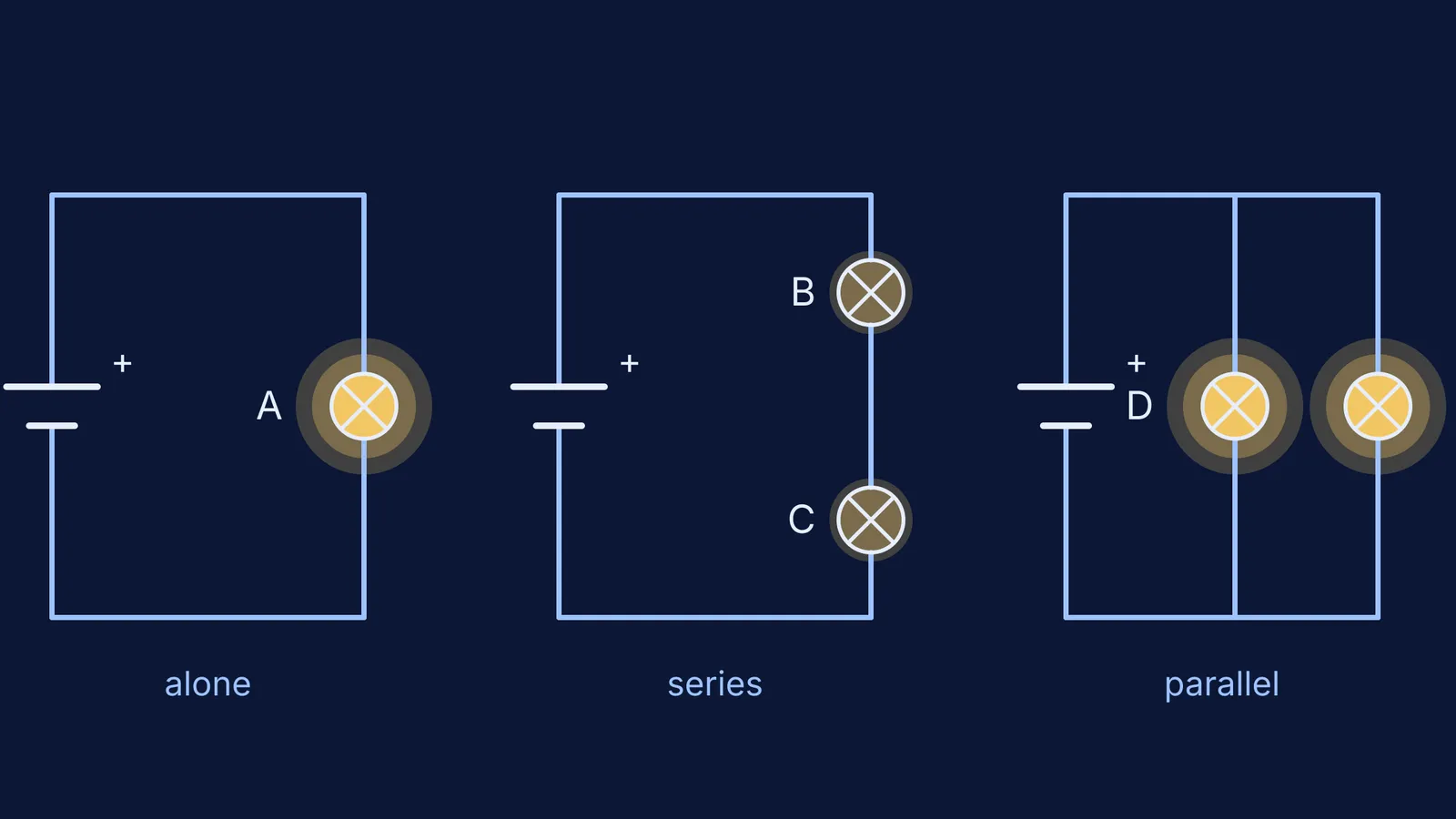
Two 1992 papers with Peter Shaffer described how PEG's research on student understanding of electric circuits guided instruction (Part I, Part II). One task from this research is known as the five-bulb question. Identical bulbs sit on identical batteries: bulb A alone, bulbs B and C in series, bulbs D and E in parallel. Rank all five by brightness.
The correct ranking, for ideal batteries and bulbs, is A = D = E > B = C. Yet data from the University of Washington show that typically only 15% of students answer the question correctly, even after instruction, as Michael Wittmann and John Thompson summarise it. Among the common incorrect responses they list are “current used up” and “battery provides constant current” answers.
How do McDermott's physics tutorials work?
Members of PEG describe each tutorial sequence as beginning with a short pretest designed to elicit student ideas, using qualitative questions that require explanations of reasoning (Scherr, Shaffer and Vokos). Small groups then work through a worksheet of carefully sequenced questions; tutorial homework and later exam questions test the reasoning again.
At the University of Maryland, a test site for the UW framework, the pieces were a 10-minute ungraded pretest, a 50-minute tutorial session in groups of three or four, and a homework assignment (Steinberg, Wittmann and Redish). Teaching assistants act as facilitators who ask questions.
The UW group loosely characterises one of its strategies as a series of steps: elicit, confront, resolve.
Elicit: give a situation that exposes a tendency to make a particular mistake.
Confront: help you recognise a discrepancy between your ideas and the actual behaviour of the system.
Resolve: guide you through the reasoning that removes the inconsistency.
How can you use elicit, confront, resolve at home?
Here is a 25-minute session, plus a 5-minute retest, built on the five-bulb question.
Elicit (5 minutes). Draw the three circuits. Ask for a written ranking with one sentence of reasoning per bulb.
Name the model (5 minutes). Read the reasons back. Is current being used up? Is the battery giving a fixed amount?
Confront (10 minutes). Ask questions the model cannot survive. “D is connected straight across the battery, just like A. What voltage does D get?” “If B used up current, where did the charge go?” With a torch battery, wires and identical bulbs, build it and look; a real battery's internal resistance can make D and E slightly dimmer than A.
Resolve (5 minutes). Reason with voltage. A, D and E each get the full battery voltage, so they glow equally. B and C get half each; treating bulb resistance as fixed, each carries half the current and a quarter of the power (P = V²/R). The parallel circuit's battery delivers twice the current of the single-bulb one, which the “constant current” model cannot explain.
Retest (5 minutes, a week later). Draw one bulb in series with a parallel pair and start again.
Still unsure? Read why all bulbs go off when one fuses in series, then compare it with what happens when one bulb is removed in parallel.
No bulbs at home? The Fermi Simulation Lab has interactive simulations for ideas that are easier to see than to read; write your prediction first, then run it. When the same mistake keeps returning in numericals, the Fermi Problem Library has a step-by-step solver that explains the reasoning rather than printing an answer, so you can find the step where your model broke. Our guide on using AI to understand mistakes, not get answers shows what to ask next.
Pick one topic that bothered you this week, write a prediction tonight, and test it tomorrow.


