

On this page
It is a classic physics question and a common practical problem: if a single bulb blows out or is unscrewed, what happens to the rest of the lights in the circuit?
The answer depends entirely on how those bulbs are connected to the power source. Electric charge needs an uninterrupted, closed path to travel from the battery and back again. How you design that path—whether in a single line or branching out—changes everything about how the circuit behaves when a component goes missing.
What happens if you remove one bulb in parallel?
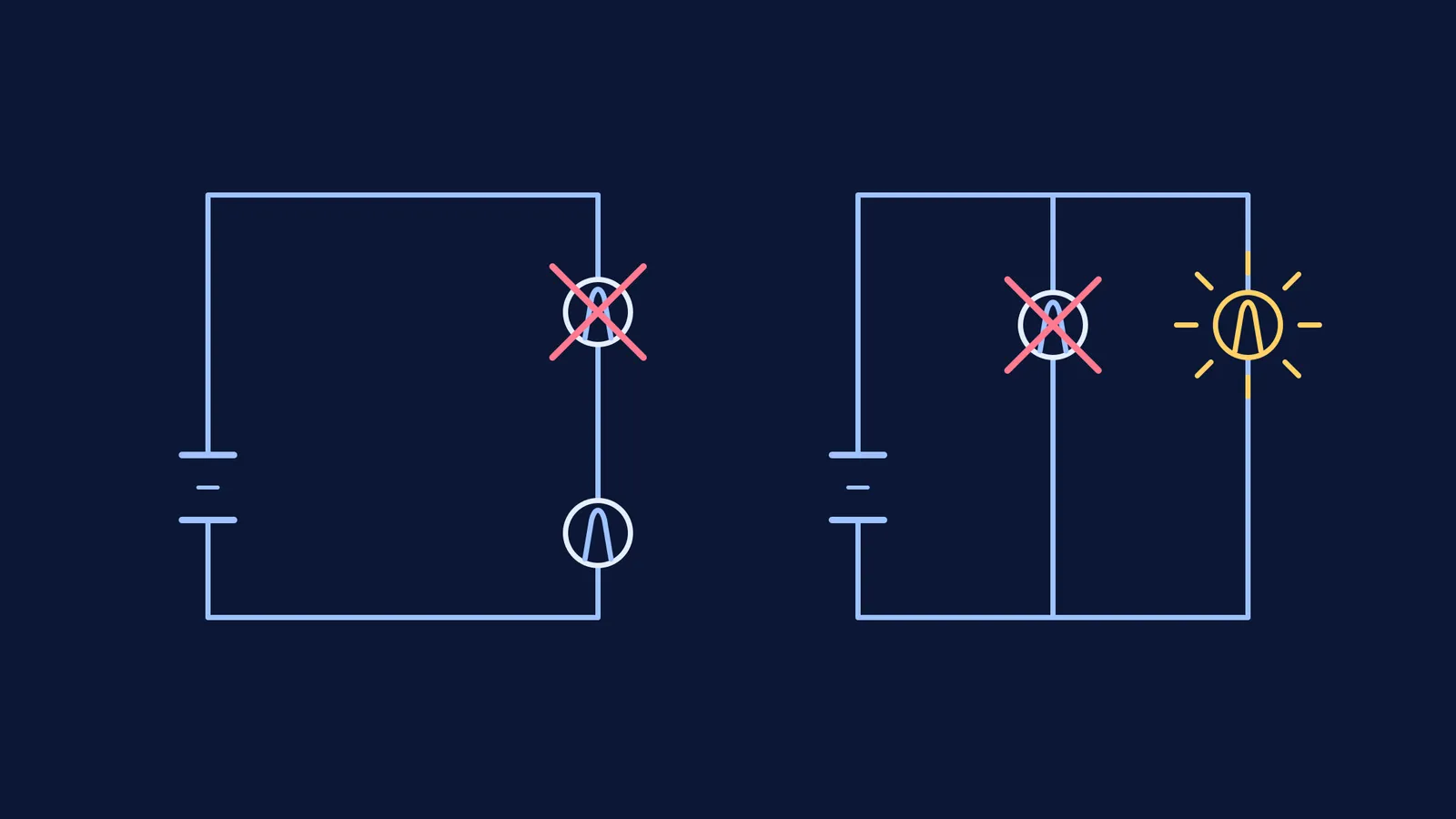
If you remove a bulb from a parallel circuit, the other bulbs continue to glow normally.
In a parallel circuit, the wiring splits into multiple branches, placing each electrical device on its own separate path. Current flows from the power source and divides among these branches. Because each branch provides an independent route back to the battery, removing one bulb only breaks the flow for that specific path. The current simply continues to flow through the remaining closed branches without any interruption (The Physics Classroom).
Moreover, the brightness of the remaining bulbs does not change. In an ideal parallel circuit, the voltage across each branch is exactly equal to the voltage supplied by the battery. Even when one branch is removed, the remaining branches still experience that full potential difference, so they draw the same amount of current as before. This consistent potential difference across branches is exactly why solving circuits by assigning voltages at each parallel node is such a reliable method for complex problems.
While the individual brightness stays the same, the total current drawn from the battery actually decreases because there is now one fewer path for electricity to flow through, which increases the total resistance of the circuit.
What happens if you remove a bulb in a series circuit?
If you remove a bulb from a series circuit, every other bulb instantly goes out.
A series circuit forms a single, continuous loop. Every single charge that leaves the battery must pass through every resistor or bulb in the line in order to complete its journey. When you unscrew one bulb, you break the only pathway available for the electric current (The Physics Classroom). With the circuit broken, the current drops to zero everywhere simultaneously, and all the lights go dark.
This is why older sets of decorative string lights were so notoriously frustrating: one burnt-out filament meant testing every single light on the string to find the culprit. Once you move beyond simple single loops, you will find that even advanced, highly complex setups—like finding the equivalent resistance of an infinite ladder of resistors—are just clever combinations of these fundamental series and parallel rules.
How to test this yourself
Physics is always easier to grasp when you can see it in action. You can build a simple test setup at home to verify the theory and get a feel for how the current behaves:
Gather your materials: You will need a fresh battery, a few lengths of copper wire with alligator clips, and three small LED bulbs.
Test Series: Connect the battery to the first bulb, the first bulb to the second, the second to the third, and finally the third back to the battery. Once they all light up (though they might be dim since the voltage is shared), disconnect the middle bulb. You will see the other two go out instantly.
Test Parallel: Connect the positive terminal of the battery to one side of all three bulbs, and the negative terminal to the other side of all three. Once they are shining brightly, disconnect the middle bulb. You will observe that the other two stay exactly as bright as they were.
If you do not have wires and bulbs lying around, you can build and break circuits digitally. The Fermi Simulation Lab has interactive simulations for ideas easier to see than read. You can drag and drop batteries, resistors and bulbs, wire them in parallel or series, and watch the current reroute itself when you remove a component. This is a great, mess-free way to confirm your predictions before an exam.


