

On this page
Where the Min River rushes out of the Longmen Mountains toward the Sichuan Basin, it historically posed a severe engineering dilemma. Melting Himalayan snow and summer monsoon rains triggered catastrophic floods that inundated Chengdu's plains. In winter and spring, the flow dwindled, leaving crops parched. Building a conventional dam was impossible: the steep mountain torrent carried massive gravel and boulder bedloads that would have silted up a reservoir within seasons, precipitating catastrophic failure.
When the Qin state appointed the hydraulic engineer Li Bing as governor of the Shu Commandery around 256 BCE, he chose an entirely different philosophy (UNESCO World Heritage Centre). Instead of attempting to block the river's kinetic energy with an impenetrable barrier, he decided to guide and divide its natural currents. Just as British engineer Arthur Cotton built the Godavari anicut over shifting river sand in nineteenth-century India, Li Bing turned to channel geometry rather than brute force.
How does Li Bing's three-part hydraulic design work?
The Dujiangyan system operates through three primary, dam-less structures that form a continuous self-regulating hydraulic circuit (UNESCO World Heritage Centre):
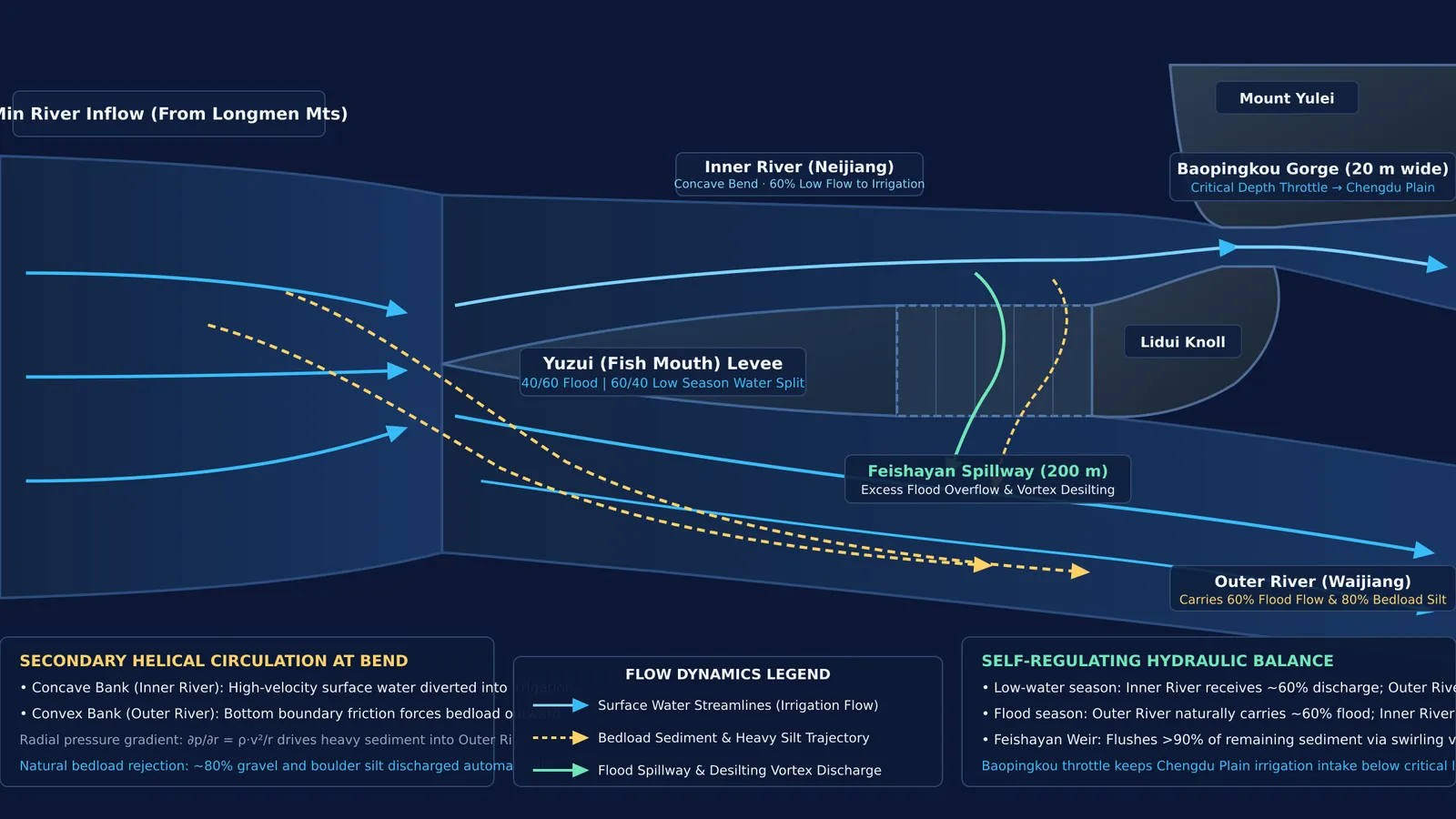
Yuzui (Fish Mouth Levee): An artificial dividing dyke built in the river bend that splits the Min River into an Inner River (*Neijiang*) for irrigation and an Outer River (*Waijiang*) for flood relief.
Feishayan (Flying Sand Weir): A 200-metre wide, low-crested spillway sitting 2 metres above the Inner River bed, connecting the Inner River back into the Outer River.
Baopingkou (Bottle-Neck Channel): A 20-metre wide channel cut through the rock of Mount Yulei, creating an isolated knoll named Lidui and throttling flow into the irrigation canals.
To cut through the mountain without gunpowder, Li Bing used thermal fracturing: workers built fires against the cliff and drenched the red-hot stone with cold river water, cracking the rock with thermal stresses. For the dykes, Li Bing devised *Zhuge*—cylindrical baskets of woven bamboo packed with river cobbles—supported by *Macha*, interlocking wooden tripods. These flexible structures absorbed hydrodynamic forces without brittle failure.
How does secondary flow clear river sediment automatically?
How does Dujiangyan control water allocation and sediment without gates? The secret lies in open-channel hydrodynamics and secondary helical circulation.
As analyzed by Shanghong Zhang and colleagues in the Journal of Hydraulic EngineeringHY.1943-7900.0000675), Li Bing placed the Yuzui dividing levee at a natural river bend:
In the dry spring season when crops need water, the deeper bed of the Inner River draws roughly 60% of the river's flow for irrigation, leaving 40% in the Outer River.
In summer floods, the river rises, and the wider Outer River channel automatically carries about 60% of the flood discharge downstream, capping the Inner River intake at 40%.
Sediment management is equally elegant. As water rounds a bend, centrifugal acceleration creates a radial pressure gradient. The faster surface water sweeps toward the outer concave bank into the Inner River. Meanwhile, friction slows the bottom boundary layer, creating a transverse secondary circulation that drives heavy silt and pebbles toward the inner convex bank. Research by Zhang et al. (2013)HY.1943-7900.0000675) shows this bend effect sheds approximately 80% of total bedload sediment directly into the Outer River.
The remaining 20% of sediment enters the Inner River, where it meets a second clearing stage. When surging water reaches the narrow Baopingkou gorge, the restricted opening causes water to back up and overtop the Feishayan spillway. The sharp curve before the gorge sets up a swirling vortex that flings over 90% of the remaining sand across the weir and back into the Outer River, as modeled by Xiaogang Zheng and colleagues in Sustainability. Total sediment reaching the plains stays below 8%.
When students study fluid dynamics, visualizing how pressure differentials drive curved streamlines is often easier to see than to read. In the Fermi Simulation Lab, interactive simulations let you explore physical concepts that are easier to see than to read, showing how forces and gradients shape fluid motion.
What can modern engineering students learn from Dujiangyan?
To see the hydraulic principle of Baopingkou in action, consider a simplified open-channel throttling calculation based on the channel parameters documented by Zhang et al. (2013)HY.1943-7900.0000675).
Suppose the Baopingkou throat has width b = 20 m and normal irrigation depth h = 3.5 m with velocity v = 3.0 m/s. The discharge is: Q = b × h × v = 20 × 3.5 × 3.0 = 210 m³/s.
During summer floods, the stage upstream in the Inner River surges to h_flood = 5.5 m. If Baopingkou throttles flow near critical depth h_c ≈ (2/3) × h_flood ≈ 3.67 m with critical velocity v_c = √(g × h_c) = √(9.8 × 3.67) ≈ 6.0 m/s, maximum throughput is capped at: Q_max ≈ b × h_c × v_c = 20 × 3.67 × 6.0 ≈ 440 m³/s.
Surplus flood flow backs up upstream, spilling over the Feishayan weir. For a weir length L_w = 200 m, crest height 2.0 m (head H = 5.5 − 2.0 = 3.5 m), and discharge coefficient C_d ≈ 0.6, the spillway discharge is: Q_weir = (2/3) × C_d × L_w × √(2g) × H^(3/2) ≈ (2/3) × 0.6 × 200 × √(19.6) × (3.5)^(3/2) ≈ 2,320 m³/s.
The weir easily vents the excess flood volume back to the Outer River. Centuries before European scientists formalized the energy relations in Daniel Bernoulli's work on hydrodynamics, Li Bing had harnessed these dynamics in stone.
Many students confuse static head, velocity, and channel constriction, as explored in our guide to avoiding Bernoulli mistakes in fluid mechanics. When tackling fluid mechanics problems, the Fermi Problem Library provides worked problems with a step-by-step solver that explains the reasoning rather than printing an answer.
Today, Dujiangyan irrigates over 660,000 hectares of farmland across Sichuan (UNESCO World Heritage Centre). In 2008, when the magnitude 8.0 Wenchuan earthquake struck nearby, modern concrete dams cracked while Li Bing's ancient earth-and-stone works survived intact—proving that working with physics outlasts opposing it.


