

On this page
In October 1920, Russian physicist Lev Sergeyevich Termen (known in the West as Leon Theremin) invented something that seemed like magic: a musical instrument that you play by waving your hands in the air 1. Originally born out of Soviet government-sponsored research into proximity sensors, the theremin produces a distinctive, sliding tone that became the signature sound of 1950s science fiction films. It is the only widely used instrument played entirely without physical contact.
But the "magic" is just electromagnetism. The theremin uses the performer's own body as an electronic component, turning the space around the instrument into an invisible, variable circuit.
How does a theremin work without being touched?
A theremin typically has two metal antennas: a vertical rod for controlling pitch and a horizontal loop for controlling volume. Despite their name, these do not broadcast radio waves. Instead, they act as the plates of a capacitor.
In physics, a capacitor is formed by two conductive surfaces separated by an insulator (the dielectric). When you stand in front of a theremin, the antenna acts as one conductive plate and your body acts as the grounded second plate. The air between your hand and the antenna is the dielectric. As you move your hand closer to the antenna, the distance between the "plates" decreases, which increases the capacitance.
How does capacitance change the oscillator pitch?
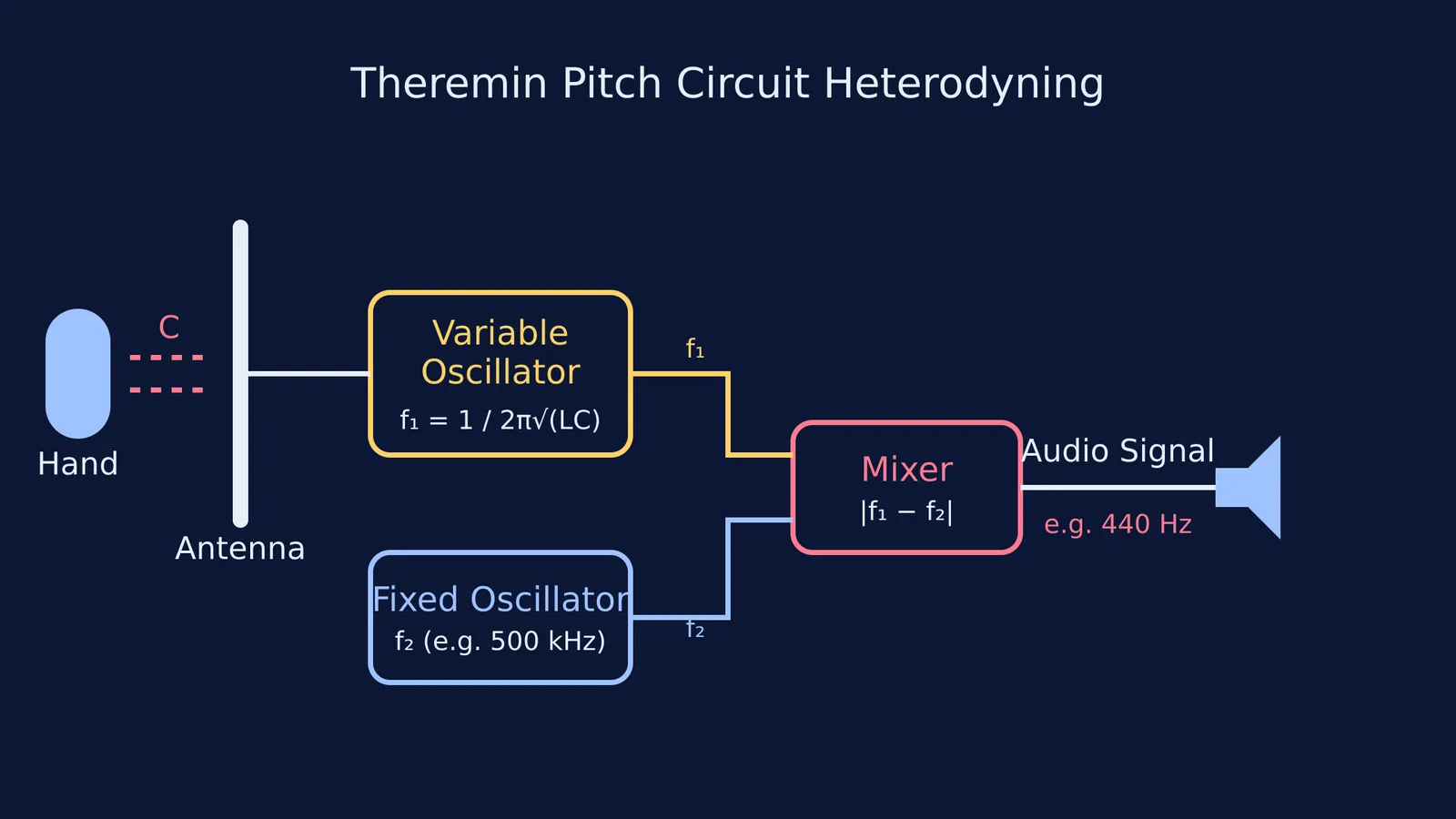
The theremin converts this tiny change in capacitance into an audible note using a principle called heterodyning. The pitch antenna is wired into a variable LC oscillator (a circuit containing an inductor and a capacitor).
The frequency f of this oscillator is given by the formula f = 1 / (2π√(LC)). Because your hand is part of the circuit's capacitance (C), bringing your hand closer to the antenna increases C, which forces the oscillator's frequency to drop.
However, this primary oscillator operates at a radio frequency well above the range of human hearing, usually set below 500 kHz 1. To make the sound audible, the theremin mixes this variable signal with a second, fixed-frequency oscillator. The interference between these two radio waves creates a beat frequency equal to the difference between them. If the fixed oscillator runs at 500,000 Hz and your hand shifts the variable oscillator to 499,560 Hz, the mixer outputs a 440 Hz tone—the concert A note you actually hear.
If LC circuits and beat frequencies feel abstract, the Fermi Simulation Lab has interactive simulations for the ideas that are easier to see than to read. You can tune an oscillator on the screen and watch how changing capacitance alters the final waveform in real time.
How do you control volume on a theremin?
Controlling the pitch is only half the performance. To separate notes or play a rest, a thereminist uses their other hand over the horizontal volume loop.
This loop works on a similar principle of variable capacitance but uses it to control the signal's amplitude rather than its frequency. The volume circuit is tied to a resonant LC circuit. When you lower your hand towards the loop, the extra capacitance detunes the oscillator from its resonant frequency. This drops the plate current, which effectively mutes the amplifier. In other words, bringing your hand closer to the loop makes the instrument quieter, requiring a delicate "pecking" motion to articulate individual notes.
A worked example: calculating the pitch shift
Understanding the scale of these changes helps explain why the theremin is so sensitive. Imagine a theremin's variable pitch circuit has an internal inductance L of 1 millihenry (10⁻³ H) and a base capacitance C of 100 picofarads (100 × 10⁻¹² F).
Find the resting frequency: Using f = 1 / (2π√(LC)), the oscillator's base frequency is roughly 503,292 Hz.
Add the human hand: If moving your hand closer adds just 0.5 picofarads to the circuit, the total capacitance becomes 100.5 pF.
Find the new frequency: Recalculating with 100.5 pF drops the frequency to roughly 502,039 Hz.
Calculate the beat: If the fixed oscillator is tuned to the base 503,292 Hz, the difference is 503,292 − 502,039 = 1,253 Hz.
By changing the circuit's capacitance by half a percent, you produce a soaring 1,253 Hz tone (about a D6 on a piano). For more on how energy is stored in these fields, explore capacitors and dielectrics.


