

On this page
In 1754, Austrian physician Leopold Auenbrugger began tapping the chests of patients at the Spanish Hospital (*Spanisches Spital*) in Vienna. As the son of an innkeeper in Graz, he had observed his father tapping wooden wine casks to check liquid levels; a hollow cask rang with clear resonance, while a full one produced a dull thud. Auenbrugger realized the human thorax behaved identically. As documented in Heart, he spent 7 years correlating percussion sounds in patients with post-mortem autopsies and fluid injections in cadavers. In 1761, he published his 95-page treatise, *Inventum Novum*, introducing direct chest percussion with outstretched fingers, as recorded in Acta Medico-Historica Adriatica.
Why does tapping the chest reveal internal disease?
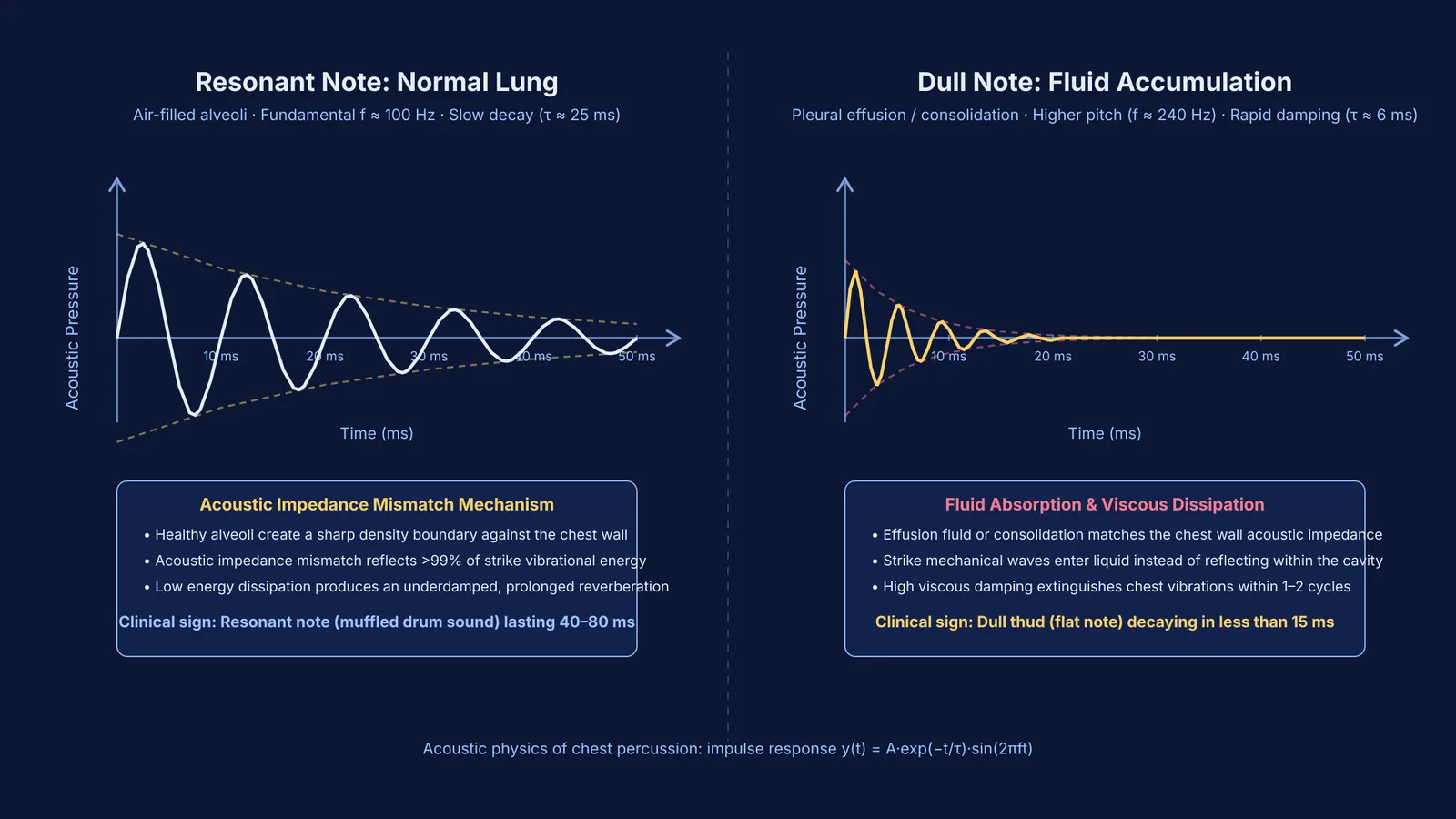
Thoracic percussion operates on acoustic resonance and impedance matching. When struck, the rib cage and underlying viscera vibrate. In healthy lungs, air-filled alveoli establish a sharp acoustic impedance mismatch against the dense chest wall, reflecting mechanical energy back into the thoracic cavity, as explained in the European Respiratory Journal. This underdamped system generates a resonant, low-pitched sound with fundamental frequencies typically between 80 Hz and 130 Hz in adults. Auenbrugger compared this note to a muffled drum. Exploring how acoustic waves reflect at gas-liquid boundaries connects directly to how displacement and pressure waves in sound form nodes at interfaces.
When fluid fills the pleural space or pneumonia consolidates alveolar tissue, the air-tissue boundary vanishes. Because water and muscle share similar acoustic impedance, strike energy dissipates into the liquid without resonance, as detailed in Clinical Methods: The History, Physical, and Laboratory Examinations. The vibration undergoes heavy damping, producing a dull thud with frequencies shifting up to 250 Hz that decays in less than one-third the duration of a resonant note.
How did chest percussion transform clinical diagnosis?
Vienna's medical establishment ignored *Inventum Novum* for nearly 5 decades, dismissing chest tapping as crude, as noted in Acta Medico-Historica Adriatica. The breakthrough survived because Napoleon's physician, Jean-Nicolas Corvisart, spent 20 years testing percussion at the Charité hospital in Paris, as documented in Heart. In 1808, Corvisart published a 440-page French translation that credited Auenbrugger fully.
Corvisart taught the method to René Laennec, who built upon acoustic chest assessment to invent the stethoscope in 1816; read how that unfolded in René Laennec and the paper tube that became the stethoscope. In 1826, Pierre Adolphe Piorry introduced the pleximeter plate for indirect percussion, and in 1824 John Forbes published the first English edition. A century later, Russian physician Nikolai Korotkov extended acoustic monitoring to arterial blood pressure, as detailed in Nikolai Korotkov and the sounds of blood pressure.
How do clinicians perform indirect chest percussion today?
Modern physical examination uses indirect (digitodigital) percussion, documented in medical textbooks such as Clinical Methods: The History, Physical, and Laboratory Examinations through a standardized sequence:
Position the pleximeter finger: The examiner firmly presses the distal interphalangeal joint of the non-dominant middle finger against an intercostal space parallel to the ribs, keeping the palm and other fingers raised off the chest to prevent dampening.
Strike with the plexor: The examiner flexes the dominant middle finger and delivers a crisp, perpendicular strike from a relaxed wrist onto the distal phalanx of the pleximeter.
Rebound immediately: The plexor finger bounces off immediately on impact so the strike does not damp the chest wall vibration.
Follow a symmetric ladder pattern: Clinicians percuss left and right thoracic regions side by side from apex to base to map changes in resonance.
Classify acoustic notes: Notes range from resonant over normal aerated lung, dull over consolidated tissue or the liver, stony dull over pleural effusion, to tympanic over gastric air pockets.
How to build an intuition for acoustic waves and physiology
Understanding how standing waves form in air cavities or how damping alters acoustic frequencies is much easier when you can visualize mechanical vibrations. The Fermi Simulation Lab provides interactive simulations for the ideas that are easier to see than to read, helping you explore wave reflection and attenuation under changing physical parameters.
To link acoustic physics with organ systems and respiratory anatomy, the Fermi Concept Library covers every concept in physics, chemistry, biology, mathematics and computing, each with its own lesson and its place in the map. When solving quantitative problems on sound propagation or fluid mechanics, the Fermi Problem Library offers worked problems with a step-by-step solver that explains the reasoning rather than printing an answer.


