

On this page
In June 1783, Antoine Lavoisier and Pierre-Simon Laplace presented their memoir on heat to the French Académie des Sciences, reprinted in Obesity Research. Before their experiments, natural philosophers considered animal heat an immaterial fluid or friction from blood circulation. Lavoisier and Laplace recognized that measuring animal heat required a container held at an unchanging temperature.
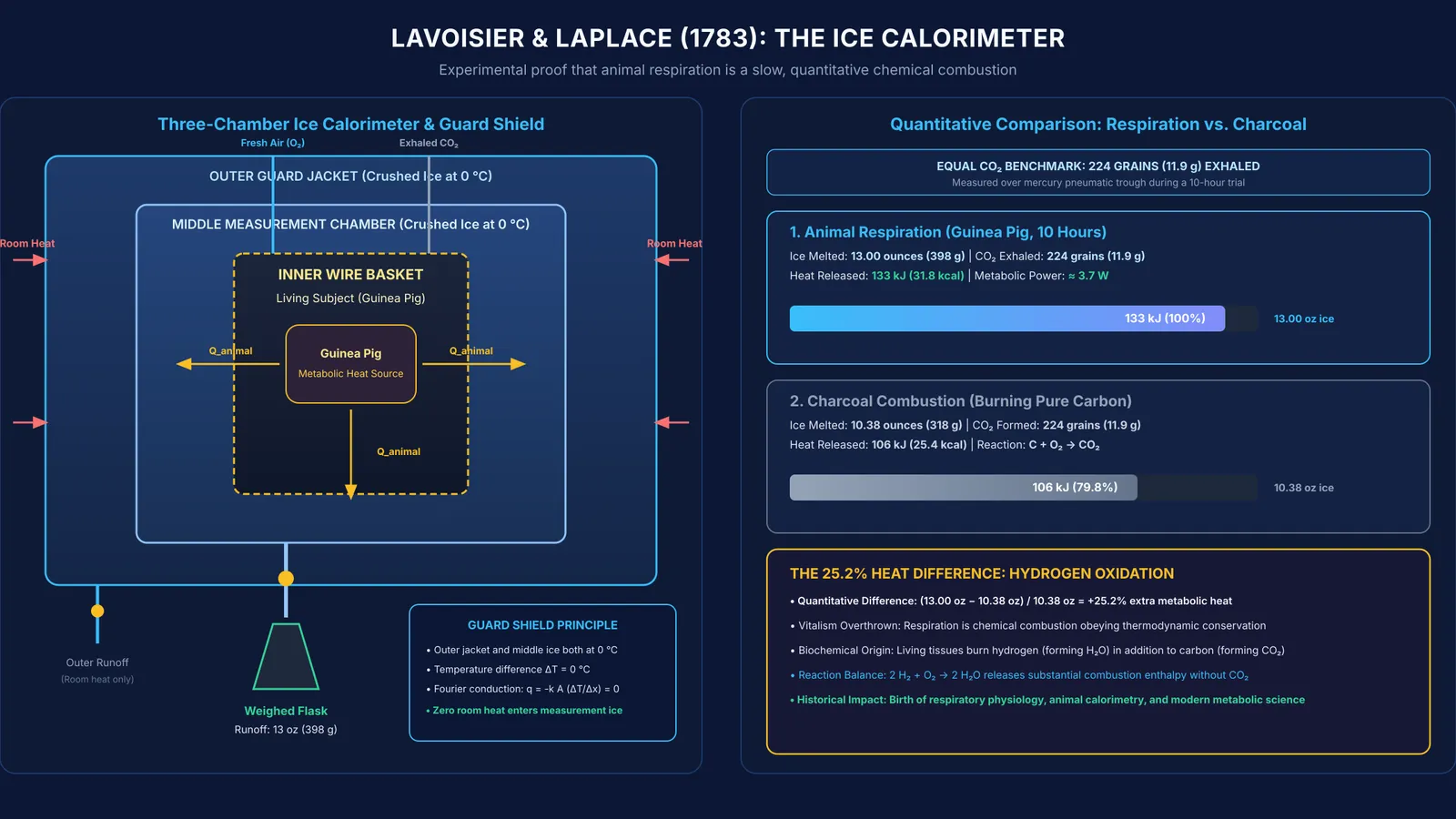
They built the world's first ice calorimeter using three concentric tin chambers. The test subject sat in the innermost wire cage, ventilated by intake and exhaust pipes. The middle chamber was filled with crushed ice at 0 °C. As heat radiated from the subject, it melted middle ice at constant temperature, draining runoff through a bottom stopcock into a weighed flask.
The outer jacket formed an insulating guard shield. Packed with ice at 0 °C, it absorbed external room heat. Because both the outer jacket and middle chamber stayed at 0 °C, the temperature gradient between them was zero (ΔT = 0), preventing heat leakage into the measurement chamber. As noted in the American Journal of Physiology, this guard shield achieved the first direct calorimetry on a mammal.
When visualizing thermodynamic boundaries, phase transitions, and heat transfer across concentric barriers, students can explore interactive simulations for ideas easier to see than read in the Fermi Simulation Lab.
Why did the guinea pig melt 13 ounces of ice in 10 hours?
In their primary biological trial recorded in the Obesity Research reprint, a guinea pig remained in the calorimeter for 10 hours. The animal's body heat melted 13 ounces (398 grams) of ice runoff.
Using Joseph Black's latent heat concept cited in The Journal of Nutrition, melting 1 gram of ice absorbs 80 calories (334 joules) at 0 °C. Over 10 hours, melting 398 grams of ice equaled roughly 31.8 kilocalories (133 kilojoules), yielding an average metabolic power of approximately 3.7 watts.
Concurrently, Lavoisier measured the guinea pig's gas exchange over mercury, as documented in Thorax. Over 10 hours, the guinea pig exhaled 224 grains (11.9 grams) of carbon dioxide.
How does charcoal combustion compare with animal respiration?
To test if breathing was slow combustion, Lavoisier and Laplace burned charcoal in the calorimeter, as analyzed in The Journal of Nutrition. Burning charcoal to release 224 grains of carbon dioxide melted 10.38 ounces of ice. The guinea pig had melted 13 ounces, releasing about 25% more heat than pure carbon combustion.
This 25% difference revealed that animals do not burn pure carbon. Living tissues oxidize nutrients containing both carbon and hydrogen. As Lavoisier clarified after synthesizing water in 1783–1784, hydrogen oxidation produces water (H₂O) and extra heat without releasing carbon dioxide. This insight underpins the respiratory quotient across different cellular fuels.
Tracking animal mass loss connected Santorio Santorio's early metabolic weighing experiments to measuring reaction energy in a modern bomb calorimeter.
Worked example: how do you calculate heat output from melted ice?
Here is how to calculate metabolic heat from Lavoisier and Laplace's 1783 data recorded in The Journal of Nutrition:
Record measurements: Ice mass m = 398 g (13 ounces), time t = 10 hours (36,000 seconds), latent heat L = 334 J/g (80 cal/g).
Calculate heat released (Q): Q = m × L = 398 g × 334 J/g = 132,932 J (133 kJ, or 31.8 kcal).
Calculate metabolic power (P): P = Q / t = 132,932 J / 36,000 s ≈ 3.69 W.
Compare with charcoal combustion: Charcoal yielding identical carbon dioxide melted 10.38 ounces (318 g), releasing 106 kJ. The roughly 25% difference reflects hydrogen oxidation to water.
For practice with calorimetry and phase changes, the Fermi Problem Library provides worked problems with a step-by-step solver that explains the reasoning rather than printing an answer.
How can students master thermal energy and respiration?
Lavoisier and Laplace established that living bodies follow universal physical laws. Students can master the connection across three areas:
Physics: Latent heat of fusion allows energy measurement at the ice melting point without temperature shifts.
Chemistry: Respiration is chemical oxidation, where carbon and hydrogen release predictable enthalpies of combustion.
Biology: Basal metabolic rate quantifies cellular fuel use and heat generation.
To review the foundational concepts connecting thermodynamics, chemical equations, and respiration, students can consult the Fermi Concept Library.


