

On this page
Kotaro Honda’s 1917 invention of KS steel changed the world of magnetism. Before his work, the best permanent magnets were made of tungsten steel, which had limited magnetic strength. Honda combined iron with cobalt, tungsten, chromium and carbon to create an alloy that was vastly superior.
Who was Kotaro Honda?
Born in the town of Yahagi (part of modern Okazaki, Aichi Prefecture) in 1870, Honda steadily worked his way through school and eventually graduated from Tokyo Imperial University. He studied physics under Hantaro Nagaoka, a pioneer of Japanese physics. It was Nagaoka who steered Honda toward the study of magnetism, a field that would dominate the rest of his life.
After studying in Europe, Honda returned to Japan with a vision. Together with the academic Tokiatsu Hojo, he established a research institute at Tohoku Imperial University, supported by the Sumitomo family. This institute would later be renamed the Metallic Materials Research Institute and become a premier hub for materials science.
His leadership and research in major scientific fields formed the basis for his position that Japan's industrial development must depend on basic research. In 1931, he was appointed president of Tohoku Imperial University, where he taught physics for several years, and he later served as the first president of the Tokyo University of Science from 1949. In 1932, his contributions to metallurgy earned him a nomination for the Nobel Prize in Physics, and he was among the first group of scientists to be awarded Japan's Order of Culture in 1937. Wikipedia
Why did Kotaro Honda invent KS steel?
During World War I, Japan found itself facing painful restrictions on imports from foreign countries, such as Germany. This shortage included the high-grade materials it desperately needed for industry, navigation and communications. Honda was motivated to study alloys to support domestic steel production. He believed that strong industrial products must come from deep basic research.
With financial backing from Kichizaemon Sumitomo—whose initials gave KS steel its name—Honda systematically studied how different elements affected the magnetic properties of iron. KS steel is an alloy composed of 0.4 to 0.8 percent carbon, 30 to 40 percent cobalt, 5 to 9 percent tungsten, and 1.5 to 3 percent chromium. Wikipedia By carefully adding these elements, he created a material that held its magnetism far better than anything else in existence.
What was the coercive force of KS steel?
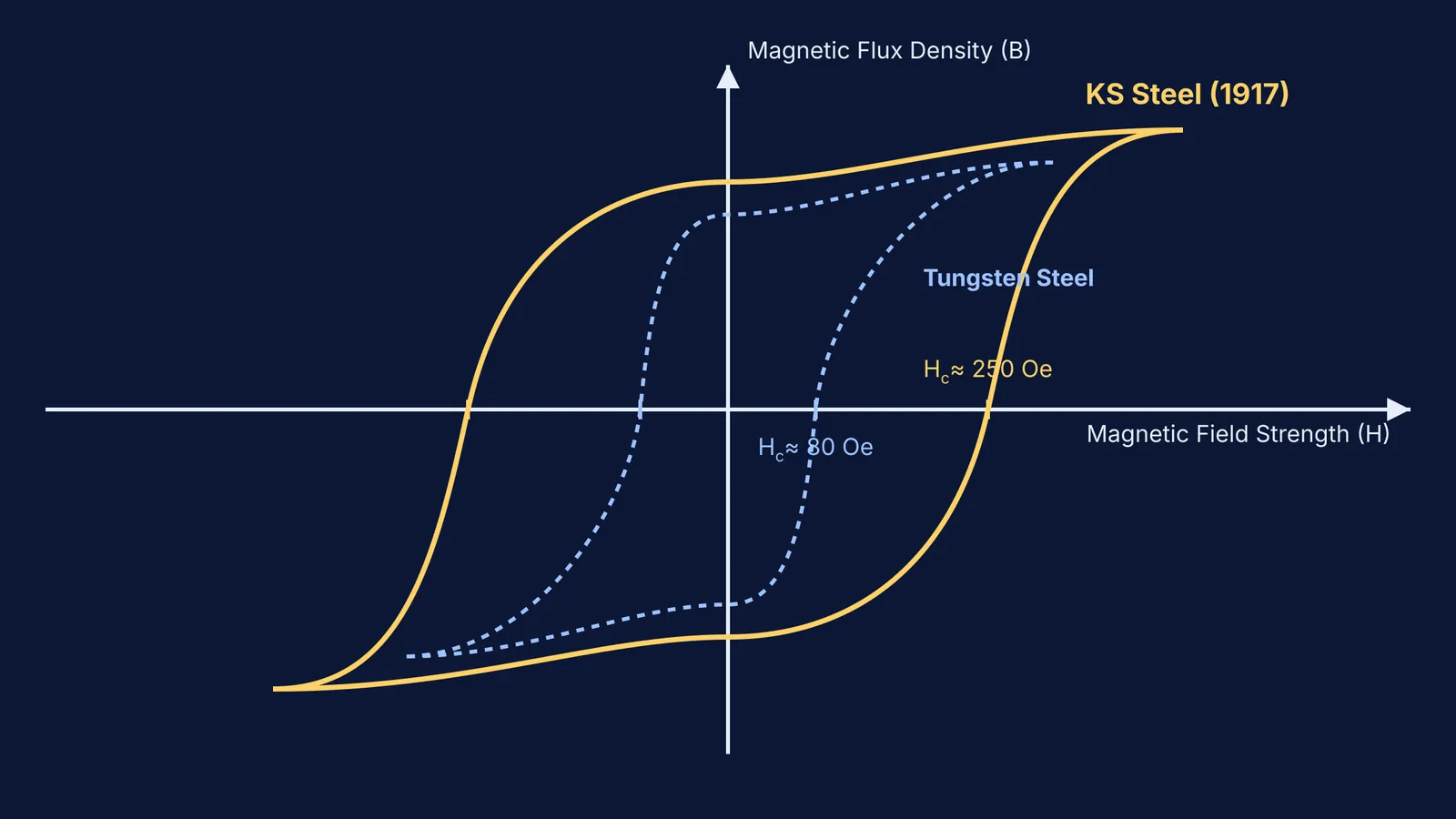
The defining feature of a permanent magnet is its coercive force, or coercivity. This is a measure of a material's ability to resist being demagnetised by an external magnetic field. KS steel reached a coercive force of approximately 250 oersteds. Wikipedia
This was a massive leap forward. Standard tungsten steel magnets had a coercive force only one-third as strong. Wikipedia Because KS steel was so resistant to losing its magnetic field, it allowed engineers to build much smaller and stronger magnets. This proved critical for early electrical equipment, telephones and precision meters. Honda would later go on to invent an even stronger material, NKS steel, in 1933, which had a magnetic resistance several times higher than that of KS steel. Wikipedia
While KS steel laid the groundwork for modern magnetic materials, the principles of magnetism stretch far and wide. They govern everything from the helical path of a charge in a magnetic field all the way up to the massive magnetic fields inside sunspots.
How can Fermi's AI tutor help you study magnetism?
Studying complex concepts like coercivity and magnetic reluctance requires a steady, unflinching approach. When you are preparing for exams like the JEE or NEET, this steady method is far more effective than frantic cramming.
Commit to daily progress: Make a small, achievable plan each morning and stick to it.
Go back to the basics: Secure your foundational concepts in physics and chemistry before rushing into hard numericals.
Use the right tools to get unstuck: When you do not know where to start, Fermi's AI tutor can work out what you already know and build a plan for the session, so you sit down to a clear next step instead of a blank page.
Test your knowledge: Theoretical knowledge must be tested in real-world practice. In study terms, you must test your reading against real problems in the Fermi Problem Library, a step-by-step solver that explains the reasoning rather than printing an answer.


