

On this page
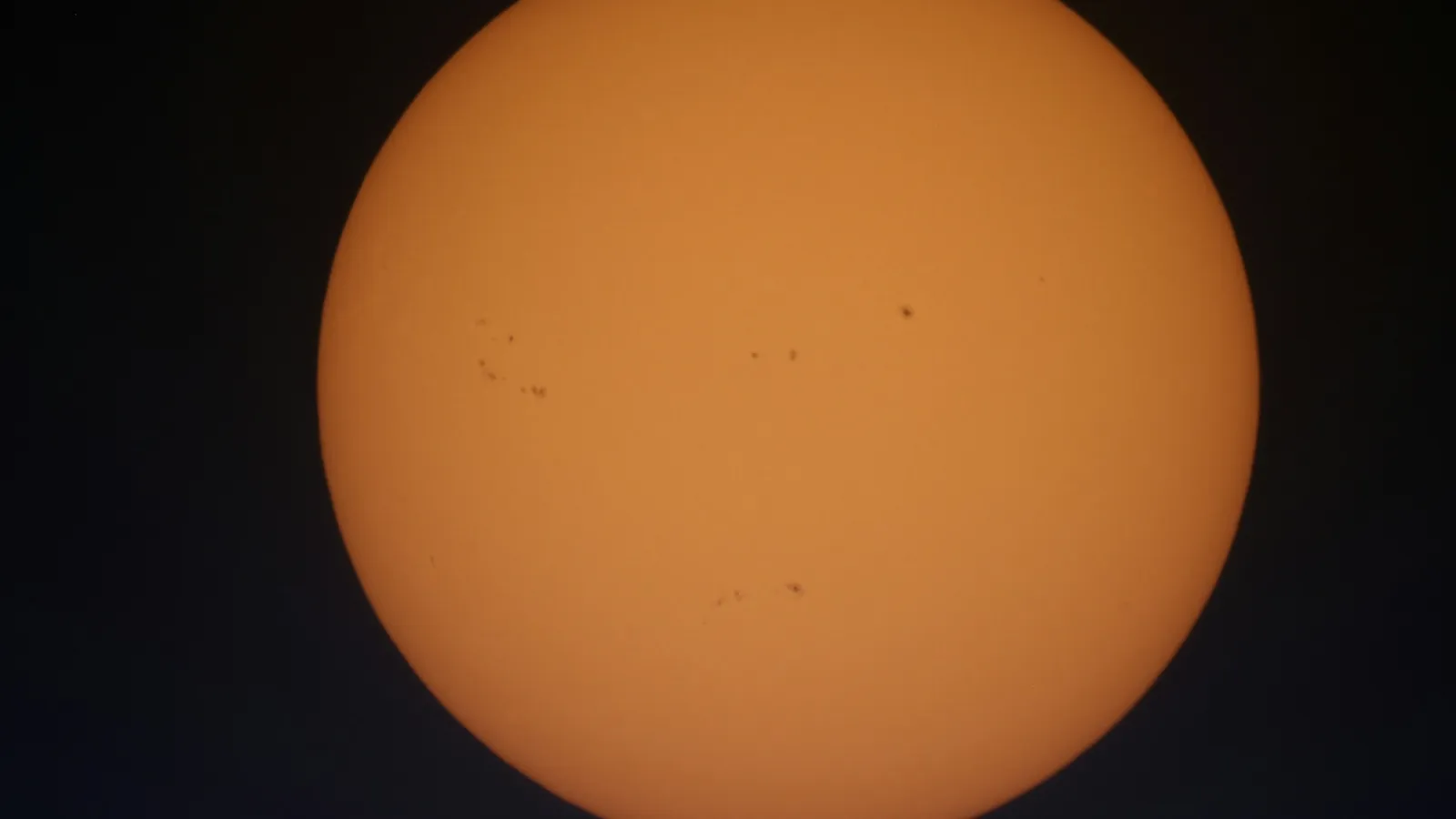
Sunspots had been drawn and counted for centuries, but nobody knew what they were. In 1908 George Ellery Hale found the first clear clue: sunspots are strongly magnetic. He did it without going anywhere near the Sun, by reading the light. This post covers who Hale was, how the 1908 measurement worked, a worked example using his own table, and the habits that made him one of the great builders of astronomy.
Who was George Ellery Hale?
Walter Adams's obituary of Hale in The Astrophysical Journal records that he grew up in Chicago, studied mathematics, physics and chemistry at the Massachusetts Institute of Technology from 1886 to 1890, and tried his first spectroheliograph, an instrument that photographs the Sun in the light of one spectral line, as a volunteer at Harvard College Observatory. He founded The Astrophysical Journal, founded and directed the Yerkes and Mount Wilson observatories, and conceived the 200-inch telescope. He died in Pasadena on 21 February 1938.
In notes written in 1933 and quoted by Adams, Hale explained his direction: "I was born an experimentalist, and I was bound to find the way of combining physics and chemistry with astronomy."
What made Hale suspect sunspots were magnetic?
His paper On the Probable Existence of a Magnetic Field in Sun-Spots begins with photographs in the red hydrogen line that showed whirling vortices around spots. Hale recalled Henry Rowland's experiment of 1876, in which a rapidly spinning charged disc deflected a magnetic needle. If the whirling gas in a spot carried more charge of one sign than the other, he reasoned, it should make a magnetic field, just as a current in a coil does.
He also knew how to look for one. Pieter Zeeman had shown that a magnetic field splits spectral lines. Viewed along the field, a line becomes a doublet whose two components are circularly polarised in opposite directions, and, as Hale wrote, "The distance between the components of a given doublet is directly proportional to the strength of the field." Our post on Pieter Zeeman explains the effect itself.
How did he test it?
Hale placed a Fresnel rhomb and a Nicol prism above the slit of his spectrograph, so that one circular polarisation could be blocked. His first attempt, on 24 June 1908, was not conclusive. On 25 June his photographs showed the relative brightness of the doublet components reversing when the Nicol was turned through 90°. He then made a second test: two spots, one in each hemisphere, whose vortices turned in opposite directions, showed opposite components with the prism in the same position, just as reversing the current in a laboratory magnet would.
He was careful with the conclusion. Since a strong magnetic field was the only known way to make such doublets, "it appeared probable that a sun-spot contains such a field".
How strong was the field? A worked example
Hale did not need the electron's charge or mass. He compared each spot line with the same line from an iron spark in a laboratory magnet of about 15,000 gauss, using the fact that splitting is proportional to field. Table I of his paper gives, for the iron line at 6213.14 Å, a laboratory separation of 0.703 Å and a sunspot separation of 0.136 Å.
Ratio of separations. 0.703 ÷ 0.136 ≈ 5.17.
Spot field. Since splitting ∝ field, B(spot) = 15,000 ÷ 5.17 ≈ 2,900 gauss.
Another line. For 6302.71 Å, 1.230 ÷ 0.252 ≈ 4.88, giving 15,000 ÷ 4.88 ≈ 3,070 gauss.
Hale's mean. His average ratio was 5.1, so 15,000 ÷ 5.1 ≈ 2,940 gauss, which he reported as "about 2900 gausses".
In SI units. The NCERT Class 12 chapter Magnetism and Matter gives 10⁴ G = 1 T, so 2,900 G = 0.29 T.
Hale warned in a footnote that the laboratory field "may be in error by 1000 gausses". That is about 7% of 15,000, so every spot value carries the same 7% uncertainty, roughly ±200 gauss.
Common mistakes:
Inverting the ratio. The spot field is the laboratory field divided by the ratio, because the spot lines are split less.
Mixing gauss and tesla. Convert once, at the end.
Ignoring the reference error. A proportional method can never be more accurate than its reference.
If proportional reasoning like this still feels slippery, the Fermi Concept Library covers every concept in physics, chemistry, biology, mathematics and computing, so you can revisit the idea before trying more problems.
What did Hale find next?
Adams's obituary describes the next step. In 1918 Hale and colleagues showed that the two main spots of a pair have opposite magnetic polarities, and that the order is reversed between the northern and southern hemispheres. By 1925, using 1,735 spot groups observed since 1908, Hale and Nicholson showed that the polarities reverse with each sunspot cycle, with only 41 exceptions, and Adams gives the full magnetic period as about twenty-three years.
What can a student take from Hale's way of working?
Build the instrument you need. The spectroheliograph came before the discovery it made possible.
Turn a hunch into a test. "Vortices might be magnetic" became "look for opposite circular polarisation".
Use ratios when constants are hard. Comparing with a known laboratory field avoided many unknowns.
Say "probable" when that is what you know. His title is a model of honest wording.
Next step: use Table I's line at 6301.72 Å (laboratory 0.737 Å, spot 0.138 Å) and check that it gives about 2,800 gauss.


