

On this page
If you feel like you are studying for an eternity to crack a tough exam, consider the patience of Kosuke Morita and his research team at RIKEN in Japan. Over a period spanning nine years, they spent a total of 553 days running an experiment to find a single new element. Their reward? Just three atoms of element 113, which they eventually named nihonium.
Who discovered element 113?
The discovery of element 113 is credited to a team of physicists led by Kosuke Morita at the RIKEN Nishina Center for Accelerator-Based Science in Wakō, Japan. While groups in Russia and the United States had seen signs of element 113 in different reactions, the International Union of Pure and Applied Chemistry (IUPAC) awarded the discovery to the RIKEN team in December 2015 because their data was the most conclusive.
According to Wikipedia's records, the team recorded their first atom on 23 July 2004, their second on 2 April 2005, and finally, after an additional 450 days of running the experiment, they found the crucial third atom on 12 August 2012. Why did they need a third atom after already finding two? The first two atoms decayed through a chain of lighter elements, but the exact isotopes they produced at the end of the chain were not well known. By 2012, Morita's team observed a decay path that anchored perfectly to known isotopes of seaborgium and rutherfordium, completely removing any doubt that element 113 had been created.
How did Kosuke Morita make nihonium?
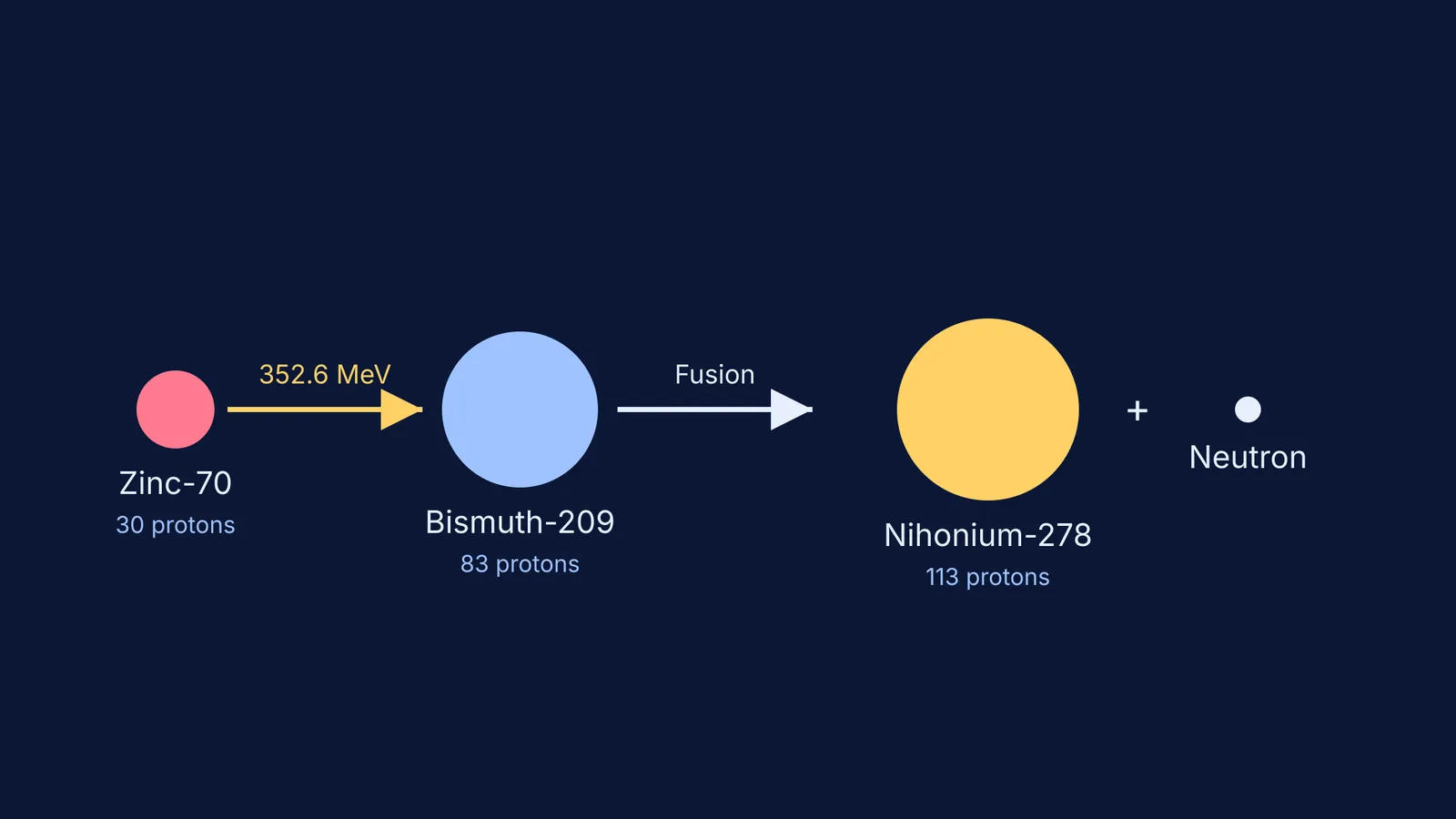
Elements heavier than uranium do not exist in nature; they must be created by fusing lighter nuclei together in a laboratory. Morita's team used a technique called cold fusion. They took a target made of bismuth-209 (element 83) and bombarded it with a beam of zinc-70 (element 30) ions.
To make the nuclei fuse, the zinc beam was fired with an energy of 352.6 MeV. This specific energy level was chosen carefully: if the zinc ions were too slow, they would bounce off the bismuth target due to electrostatic repulsion; if they were too fast, the resulting compound nucleus would be so energetic that it would immediately blow apart. When a zinc-70 nucleus successfully fused with a bismuth-209 nucleus, it ejected one neutron to shed excess energy and form a relatively stable atom of nihonium-278. Finding this needle in a haystack was incredibly rare: the team ran the beam for 553 days in total, sifting through countless collisions to find just three atoms.
Why was element 113 named nihonium after Japan?
Because the RIKEN team was the first to conclusively prove they had created element 113, they earned the right to name it. On 30 November 2016, IUPAC officially approved the name nihonium, with the symbol Nh.
The name comes from *Nihon*, which is one of the two Japanese words for Japan and translates to "the Land of the Rising Sun". This was a historic moment, as nihonium became the very first element on the periodic table to be discovered and named by a team from an Asian country. Prior to this, all elements had been discovered by scientists in Europe or the Americas. Morita noted that the name was meant to celebrate the support of the Japanese people and to inspire the next generation of scientists.
What can we learn from this experiment?
Morita's success came down to extreme patience and an understanding of the fundamental concepts. We can apply this approach to any difficult exam preparation:
Define the target: Morita knew exactly what he was looking for (element 113). Know the syllabus you need to master.
Control the energy: Just like the zinc beam needed the exact right energy, you need to study with focus rather than just burning yourself out.
Persist through failures: They ran the beam for 450 more days between the second and third atom. Don't give up when a mock test goes poorly.
Anchor to the known: Morita proved his discovery by tracking the decay chain back to known elements. When learning new concepts, tie them back to the basics you already understand.
If you are fascinated by how the periodic table was built, you might also read about Clemens Winkler and the missing 7% that revealed germanium or how Lothar Meyer and the atomic volume curve of the elements shaped our understanding of atomic mass.
When you are stuck on a physics or chemistry problem, guessing the answer rarely works. If you find yourself hitting a wall, the Fermi Problem Library has worked problems with a step-by-step solver that explains the reasoning rather than printing an answer. And if you need to brush up on the atomic physics behind nuclear fusion, the Fermi Concept Library contains every concept in physics, chemistry, biology, mathematics and computing, each with its own lesson and its place in the map.


