

On this page
In the late nineteenth century, infectious diseases were poorly understood, and treatments were largely experimental. When a massive epidemic of dysentery swept through Japan in 1897, it caused over 90,000 reported cases with a mortality rate of nearly 30% (Trofa et al., 1999). It was against this backdrop that a young physician named Kiyoshi Shiga made a breakthrough that advanced microbiology.
How did Kiyoshi Shiga discover the dysentery bacillus?
At the time, Shiga was working as an assistant at the Institute for the Study of Infectious Diseases under Kitasato Shibasaburō, who was already famous for his work on tetanus. (You can read more about his mentor in our post on Shibasaburo Kitasato and the pure tetanus culture.)
During the 1897 outbreak, Shiga systematically examined patients and applied Koch's postulates to find the pathogen. If you are studying microbiology, Koch's framework for linking a microbe to a disease is an important concept to master:
Find it: The microorganism must be found in abundance in all organisms suffering from the disease, but not in healthy organisms.
Grow it: The microorganism must be isolated from a diseased organism and grown in pure culture. (Techniques for this are explored in Julius Petri and the dish that changed microbiology.)
Cause it: The cultured microorganism should cause disease when introduced into a healthy organism.
Re-isolate it: The microorganism must be re-isolated from the inoculated, diseased experimental host and identified as being identical to the original specific causative agent.
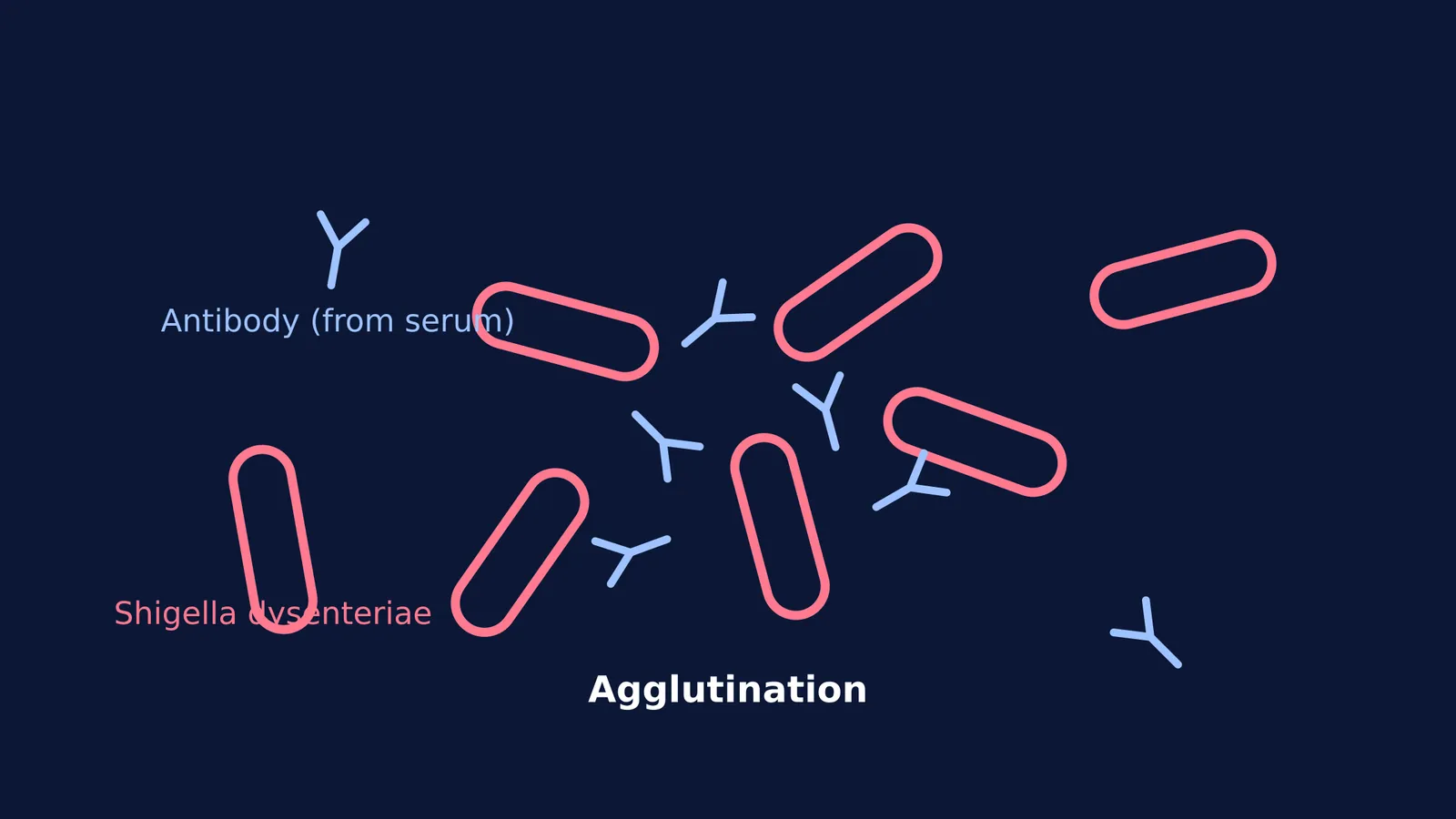
Shiga isolated a microorganism from the intestinal tracts of infected individuals and used the agglutination technique. By exposing the isolated bacteria to the blood serum of recovering patients, he observed that the antibodies in the serum caused the bacteria to clump together. This proved that the specific organism was the cause of the disease.
He used the staining method developed by Hans Christian Gram to confirm it was a Gram-negative bacillus. (This foundational technique is covered in Hans Christian Gram and the stain that sorts bacteria.) Shiga originally named his discovery *Bacillus dysenteriae*, but the scientific community later renamed it *Shigella dysenteriae* to honour his work (Wikipedia).
What is the Shiga toxin?
Identifying the bacterium was only the first step. Shiga also discovered that the severe symptoms of the disease—which distinguish bacillary dysentery from amoebic dysentery—were caused by a potent exotoxin produced by the bacteria.
This substance, now known as the Shiga toxin, damages the lining of the intestines and can lead to severe systemic complications. Understanding how toxins and antibodies interact at a molecular level is often difficult for students because the processes are invisible to the naked eye. If you find these ideas hard to picture, the Fermi Simulation Lab provides interactive simulations for the ideas that are easier to see than to read, such as antigen-antibody agglutination and cell membrane transport.
Did Kiyoshi Shiga develop a dysentery vaccine?
After identifying *Shigella dysenteriae*, Shiga dedicated himself to finding a cure. He attempted to develop a vaccine, initially creating a heat-killed bacterial strain. Dedicated to his research, he tested this early vaccine on himself. Unfortunately, the trial caused severe local reactions and proved ineffective. Later attempts at creating a passive immunity vaccine using horse serum also fell short of expectations (Wikipedia).
Although Shiga's vaccines did not become the standard treatment for dysentery, his methodical research set a high standard for future microbiologists. By distinguishing bacillary dysentery from the amoebic form, he enabled doctors to pursue targeted therapies rather than relying on guesswork. His later work took him to Germany, where he collaborated with renowned scientists like Paul Ehrlich to research chemotherapy for infectious diseases such as trypanosomiasis (Wikipedia).
For students studying microbiology or tackling university-level biology, moving beyond memorisation is essential. When you are stuck on complex physiological pathways or microbial genetics, Fermi's AI tutor works out what you already know, builds a plan for the session, and teaches through it — writing on a board, drawing the figure, running the simulation, and checking your understanding as it goes. This step-by-step reasoning helps you understand the "why" behind the science, just as Shiga sought the "why" behind the 1897 epidemic.


