On this page
Few lab objects are as famous as the Petri dish. It is so simple that it is hard to imagine microbiology without it, yet it appeared only in the 1880s, in a two-page note. This post covers who Julius Petri was, what his paper actually said, the honest question of who invented the dish, a worked example on counting colonies, and what students can take from it.
Who was Julius Petri?
The Neue Deutsche Biographie, the standard German national biography, gives his dates: born 31 May 1852 in Barmen (now part of Wuppertal), died 20 December 1921 in Zeitz. He studied medicine at the Kaiser Wilhelm Academy in Berlin, receiving his doctorate in 1876, and served briefly as a military doctor. He then worked as an assistant to Hermann Brehmer at a sanatorium for lung patients in Görbersdorf.
In 1886 he moved to Robert Koch's bacteriological laboratory at the Imperial Health Office in Berlin. The NDB says he developed and improved many methods and devices there, including a sand filter and containers for sending stool and urine samples. He retired early in 1900, ran Brehmer's sanatorium for three years, and returned to Berlin in 1904.
What problem did the dish solve?
Koch grew bacteria on a thin layer of nutrient gelatin poured onto glass plates. Petri's paper, published in 1887 in volume 1 of the Centralblatt für Bakteriologie und Parasitenkunde (page 279), opens with the drawbacks. Making Koch's plates needed a pouring apparatus that had to be levelled, and the finished plates were stacked on little glass benches under large bell jars.
What did his paper actually say?
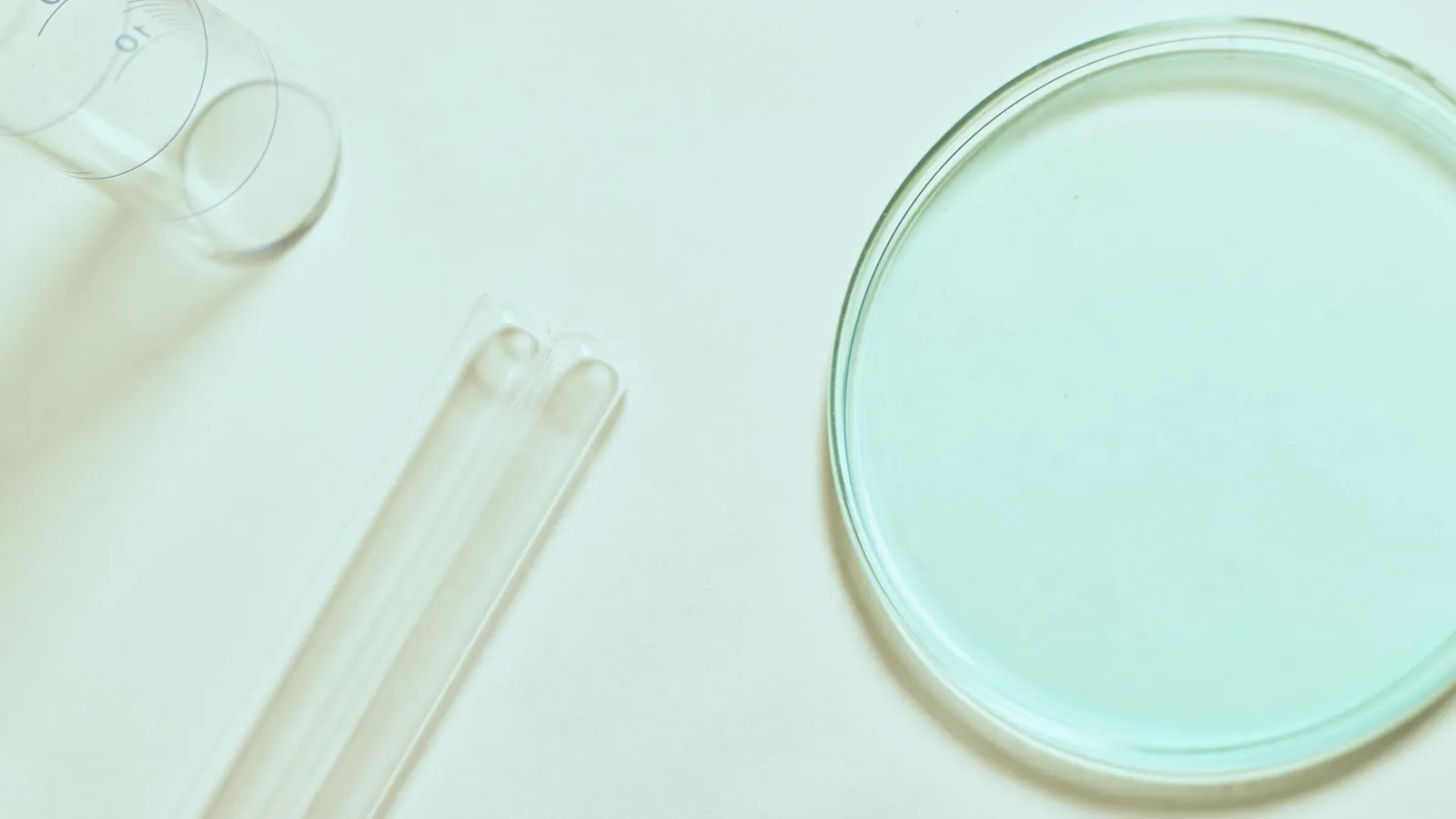
The note is short, and worth summarising closely. For more than a year, Petri wrote, he had been using flat double dishes 10 to 11 cm across and 1 to 1.5 cm high. The upper dish, a little wider, serves as the lid. Sterilised dishes are filled with liquid gelatin already mixed with the sample, lifting the lid only slightly while pouring, so that contamination from air germs is very rare.
He listed the advantages. The gelatin sets into a layer a few millimetres thick that can be kept and watched for a long time under the lid. Soil or sand can be mixed with the gelatin right in the dish. Every point of the layer can be reached by ordinary microscopes. The dishes are especially recommended for agar plates, which do not stick well to flat glass. And counting colonies is simple: remove the lid, lay on a glass plate ruled in square centimetres, and count. The area of the dish, he noted, can be calculated at once from its diameter. The paper is dated Berlin, February 1887.
Did Petri really invent it?
Probably not alone. In a 2019 paper, The "Petri" dish: a case of simultaneous invention in bacteriology, Gilbert Shama examined the rival claims. He concluded that no single person, Petri included, should get sole credit: the shallow, round, covered dish was invented independently by about half a dozen bacteriologists in the mid-1880s, out of the shared needs of the time. Other modifications of Koch's plate method were being published too, such as Esmarch's 1886 method in the Zeitschrift für Hygiene.
Worked example: counting colonies the way Petri suggested
The dish size is Petri's. The counts are sample numbers.
Problem. A dish has a diameter of 10 cm. You count colonies in 10 of the ruled one-square-centimetre squares and find 48 in total. The plate was poured with 1 mL of a sample diluted 1,000 times. Estimate the bacteria per mL of the original sample.
Area of the dish. r = 10 ÷ 2 = 5 cm. Area = πr² = 3.14 × 25 ≈ 78.5 cm².
Colonies per square centimetre. 48 ÷ 10 = 4.8.
Colonies on the whole plate. 4.8 × 78.5 ≈ 377.
Undo the dilution. 377 colonies came from 1 mL of a 1-in-1,000 dilution, so the original had about 377 × 1,000 = 377,000 colony-forming units per mL.
For an 11 cm dish the area is 3.14 × 5.5² ≈ 95 cm², so the same density would give about 456 colonies.
Common mistakes:
Using the diameter as the radius. That makes the area four times too big.
Dividing by the dilution instead of multiplying. A diluted sample has fewer cells, so the original must have more.
Sampling only crowded squares. Spread your sample squares across the dish, or the estimate is biased.
What can a student take from his way of working?
Petri did not make a grand discovery. He removed friction from a daily task and wrote it up clearly, with exact sizes, so anyone could copy it. Many useful steps in science are like that. His dish also needed a partner: firm agar, whose story is told in our post on Fanny Hesse and agar, and the bacteria grown on it are often first identified with Hans Christian Gram's stain.
Multi-step estimates like the one above are where small slips creep in. The Fermi Problem Library has worked problems with a step-by-step solver that explains the reasoning, which helps you see where a factor went wrong.
Try it now: repeat the worked example for a 9 cm dish with 30 colonies in 10 squares and a 1-in-10,000 dilution.