

On this page
If you throw a ball into the air, its path is a smooth, predictable parabola. But if you watch a pollen grain floating in water under a microscope, its path is a jagged, erratic walk. It changes direction constantly as millions of invisible water molecules collide with it. This is Brownian motion.
Albert Einstein used this motion to prove that atoms exist. He calculated the probability of where a particle would end up. But physicists still lacked the mathematical tools to describe the jagged path itself.
Traditional calculus, built by Isaac Newton and Gottfried Leibniz, relies on smooth curves. To find velocity, you draw a tangent line to a curve. But a Brownian path is nowhere differentiable. No matter how much you zoom in on the path, it never smooths out into a straight line; it is made entirely of sharp corners. For decades, mathematicians could not apply calculus to random motion.
Between 1939 and 1943, Kiyoshi Itô worked as a statistical officer for the Japanese government's Cabinet Statistics Bureau. His superiors gave him free time to pursue theoretical mathematics. During World War II, in this administrative job, Itô solved the problem that had stumped mathematicians for years.
In 1944, he published "Stochastic Integral" in the Proceedings of the Japan Academy. He defined a rigorous way to integrate unpredictable, jagged paths by separating the predictable drift of a system from its unpredictable diffusion or noise.
Why do we need stochastic calculus?
If a physical system has no noise, you can predict exactly where it will be tomorrow using standard differential equations. But most real-world systems are messy. The spread of alleles in a population, the thermal noise in an electrical circuit, and the fluctuating price of a stock all involve randomness.
Itô calculus gives a mathematical shape to this noise. It allows scientists to write Stochastic Differential Equations (SDEs), predicting how systems evolve when they are pushed by constant, random shocks.
If you are struggling to learn physics from first principles, not formulas, visualising these differences can help. The Fermi Simulation Lab provides interactive simulations for the ideas that are easier to see than to read, letting you watch how adding a random variable changes the outcome.
What is Itô's Lemma?
In 1951, Itô published "On a formula concerning stochastic differentials" in the Nagoya Mathematical Journal. This paper introduced Itô's Lemma, the most famous result in his field.
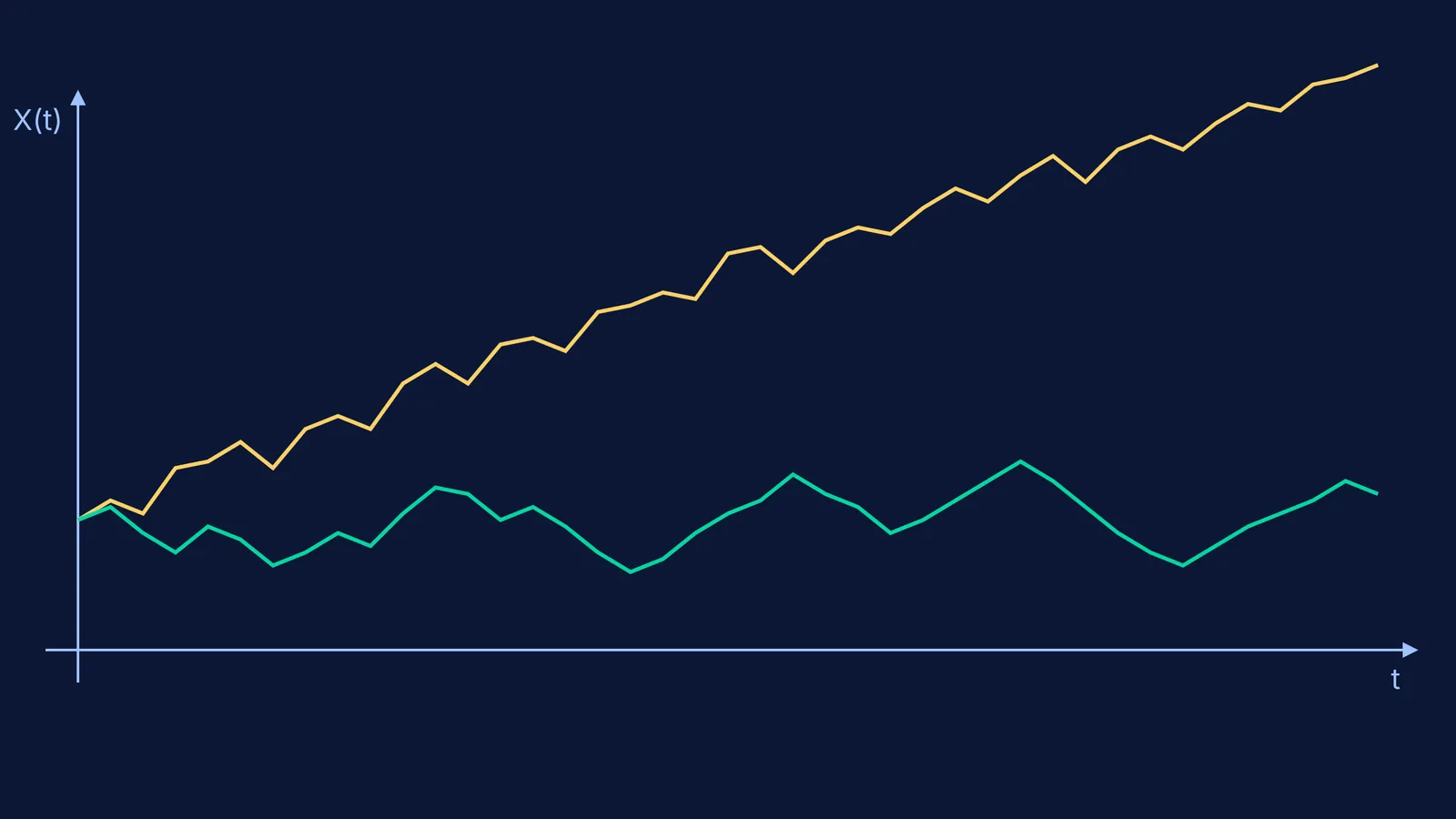
Itô's Lemma is the stochastic version of the chain rule. In standard calculus, the rate of change of a function depends only on its first derivative. But Itô showed that for random paths, you must include a second-order term. Because the path is so volatile, the variance itself affects the system's average path over time. It proves mathematically that in a random system, volatility acts as a constant force pulling on the outcome.
How do you know when to use stochastic calculus?
If you are studying a mathematical model, how do you know if standard calculus will fail? Check for these three signs of a stochastic process:
Continuous but jagged: The value does not jump instantly from one number to another, but its graph is spiky and constantly changing direction.
Unpredictable at the micro level: You cannot predict the exact next step, only the probability of where it will go.
Volatility over time: The variance of the path grows steadily as time passes.
If your system checks these boxes, standard derivatives will give you nonsensical answers, and you must use Itô's rules.
From physics to Wall Street
Itô's work was initially a purely theoretical breakthrough. Later, economists Fischer Black and Myron Scholes published a mathematical framework for pricing financial options. Their model treated stock prices as geometric Brownian motion, relying directly on Itô calculus.
Today, the Black-Scholes model is used globally to manage financial risk. Itô's mathematics became the backbone of quantitative finance, earning him the nickname "the most famous Japanese in Wall Street."
His work remained deeply influential across the sciences. At age 90, Itô was awarded the inaugural Carl Friedrich Gauss Prize in 2006 by the International Mathematical Union, honouring the profound impact his theoretical mathematics had outside the field of math itself.
When you solve complex probability problems, seeing the steps matters more than the final number. If you are stuck on a difficult derivation, the Fermi Problem Library has worked problems with a step-by-step solver that explains the reasoning rather than printing an answer. Or, if you want to know how to visualise hard physics ideas, tracing these paths on a graph is the best place to start.