

On this page
The modern bicycle, with its pedals, chains and pneumatic tyres, is an efficient everyday machine. But its earliest ancestor was a heavy wooden frame with two wheels in a line and no pedals at all. In 1817, a German inventor named Karl Drais demonstrated a machine that would prove human beings could balance on two wheels.
Why did a volcanic eruption lead to the running machine?
The story of the first bicycle begins with a global climate disaster. In April 1815, Mount Tambora in Indonesia erupted in the most powerful volcanic event in recorded human history (Wikipedia). The eruption injected immense amounts of volcanic ash and sulfur aerosols into the stratosphere. These particles scattered incoming sunlight, significantly reducing the amount of solar radiation reaching the Earth's surface and plunging global temperatures.
The following year, 1816, became widely known as the "Year Without a Summer" (Wikipedia). The unusually cold and wet weather caused widespread crop failures across Europe, Asia and North America. Snow fell in June in parts of North America, and relentless rain flooded European harvests. This sudden agricultural crisis led to a massive shortage of oats and other crops. Because oats were the primary fuel for horses—the main mode of transport, trade and agricultural labour at the time—the animals began to starve. Many were slaughtered for food or died from lack of fodder, leaving a desperate need for a horseless form of transportation.
This shortage of horses likely inspired Karl Drais, a German civil servant, forestry official and inventor, to solve this problem. He sought a mechanical alternative to the horse that did not require expensive fodder.
Who invented the first bicycle in 1817?
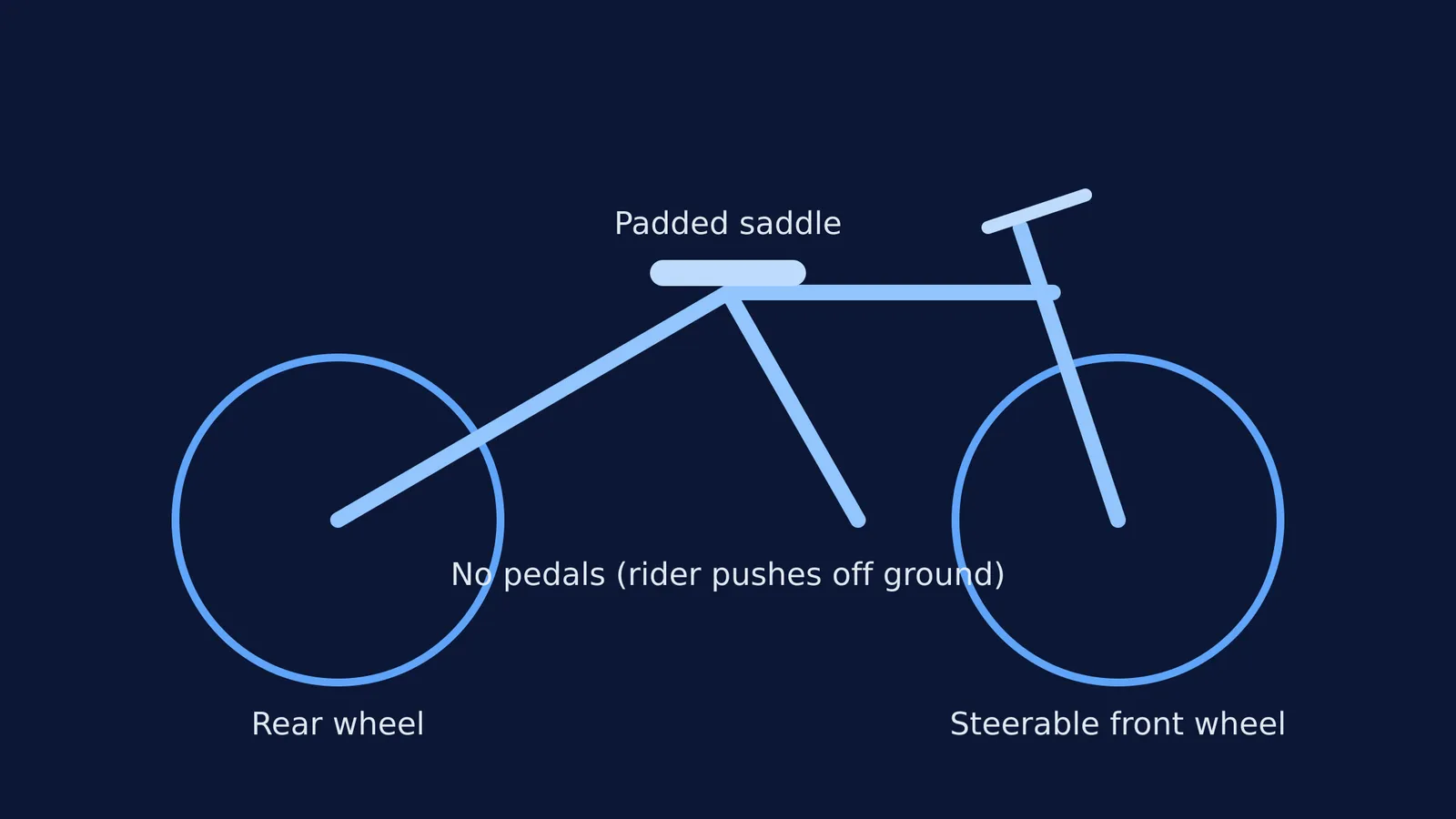
In 1817, Drais unveiled his creation: the *Laufmaschine*, which translates from German as "running machine" (Wikipedia). It was a two-wheeled vehicle made almost entirely of wood, built to carry a single person. The design featured a sturdy wooden frame, two inline wooden wheels with iron rims, a padded saddle for the rider to sit on, and a steerable front wheel connected to a rudimentary handlebar.
Crucially, it lacked pedals. The rider propelled the machine by straddling the frame and pushing their feet against the ground in a running motion, coasting between strides. Once enough momentum was built up, the rider could lift their feet and glide. On this machine, Drais could reach speeds of up to 16 km/h on well-maintained post roads, roughly doubling the average walking speed and offering a genuine, practical alternative to horse transport for personal travel (Wikipedia).
How did Karl Drais's running machine work?
The greatest innovation of the running machine was not just its speed, but its proof of dynamic balance. Before 1817, it was widely believed that a two-wheeled vehicle could not stay upright while in motion. By aligning two wheels in a row and allowing the front one to pivot, Drais proved that a human could balance a two-wheeled vehicle by continually steering into the direction of a fall.
As the machine begins to tip to the left, the rider naturally turns the front wheel to the left. This steering action brings the wheels back underneath the rider's centre of mass, correcting the tip and keeping the vehicle upright. This active, subconscious correction is the same mechanism that keeps modern cyclists from falling over.
This concept of dynamic balance is a fundamental physics principle still at work in modern cycling. If a student wants to see how forces and motion keep a moving object upright, the Fermi Simulation Lab offers interactive simulations for the ideas that are easier to see than to read.
From the running machine to the modern bicycle
Drais secured a patent for his invention in 1818. The vehicle quickly became an international craze, earning new names as it spread across Europe and North America. It was often called a "Draisine" in honour of its inventor, or a "velocipede" (from Latin roots meaning "fast foot"). In England, it became a fashionable status symbol among young men, known colloquially as the "hobby horse" or "dandy horse."
However, the initial craze was short-lived. Because the public roads of the early 19th century were deeply rutted by heavy carriage wheels and horse hooves, riders found it difficult to balance. Instead, they preferred to coast on smooth, paved pedestrian footpaths. The resulting collisions with pedestrians led authorities in several cities, including New York in 1819, to ban the running machine from public footpaths (Wikipedia).
Though the Draisine fell out of public favour and Drais himself saw little financial success from it, his invention laid the mechanical foundation for human-powered transport. Much like the story of William Grove and the first working fuel cell or the Montgolfier brothers and the physics of the first balloons, an early prototype established the crucial proof of concept.
It took until the 1860s for inventors to figure out how to add rotary pedals to the front wheel, creating the "boneshaker" velocipede. From there, innovations like the chain drive and pneumatic tyres led straight to the modern bicycle—an everyday machine born from the ashes of a volcano.
A checklist: The 1817 running machine vs the modern bicycle
If you look at the 1817 running machine, you can see both what it established and what was yet to be invented. Here is a checklist of the mechanical features:
Two inline wheels: Present. This was Drais's main innovation, proving that inline wheels could work.
Steerable front wheel: Present. This allowed the rider to maintain balance by steering into a fall.
Pedals: Missing. Riders had to push off the ground with their feet.
Chain drive: Missing. The wheels were not connected to a separate drivetrain or gears.
Pneumatic tyres: Missing. The wheels were wooden with iron rims, making for a bone-rattling ride over cobblestones.


