

On this page
Before the 18th century, the precise clockwork of the planets was widely seen as the direct handiwork of a creator. That changed when philosophers and mathematicians began applying Isaac Newton's laws of motion to the origins of the cosmos.
What was Immanuel Kant's nebular hypothesis?
In 1755, the philosopher Immanuel Kant published the nebular hypothesis in his book *Universal Natural History and Theory of the Heavens* (Wikipedia). Kant proposed that the solar system formed from a diffuse, rotating cloud of gas and dust called a nebula.
He argued that gravity pulled this chaotic cloud of particles inward toward a central point of accumulation. As the matter collapsed, collisions between particles caused the cloud to spin in a unified direction and flatten into a disk. The largest mass accumulated at the centre to form the Sun, while the remaining disk material clumped together to create the planets and their moons. Kant was among the first to rely on physical laws to explain how a scattered cloud could naturally organise itself into a flat, rotating planetary system.
Kant's work relied heavily on physical mechanics to explain this flattening. If you are studying mechanics yourself, the Fermi Concept Library maps out every concept in physics, chemistry, biology, mathematics and computing, each with its own lesson and its place in the map.
How did Pierre-Simon Laplace change the model?
Working independently, the French mathematician Pierre-Simon Laplace proposed a mathematical version of the model in 1796 in his book *Exposition du système du monde* (Wikipedia).
Laplace envisioned that the young Sun originally had an enormous, hot atmosphere that extended past the orbits of all the known planets. As this protosolar gas slowly cooled, it contracted. Because of the conservation of angular momentum, the shrinking cloud spun faster and faster as it grew smaller. Laplace proposed that the rapid spinning caused the cloud to shed rings of gas from its outer equator. He suggested that these isolated rings eventually condensed to form the individual planets, while the central mass became our Sun.
Laplace's mathematical approach required a deep understanding of rotational forces and gravity. For students tackling similar dynamics today, the Fermi Problem Library offers worked problems with a step-by-step solver that explains the reasoning rather than printing an answer.
Why did the solar nebula flatten into a disk?
The shape of the solar system comes down to a core physical principle: the conservation of angular momentum.
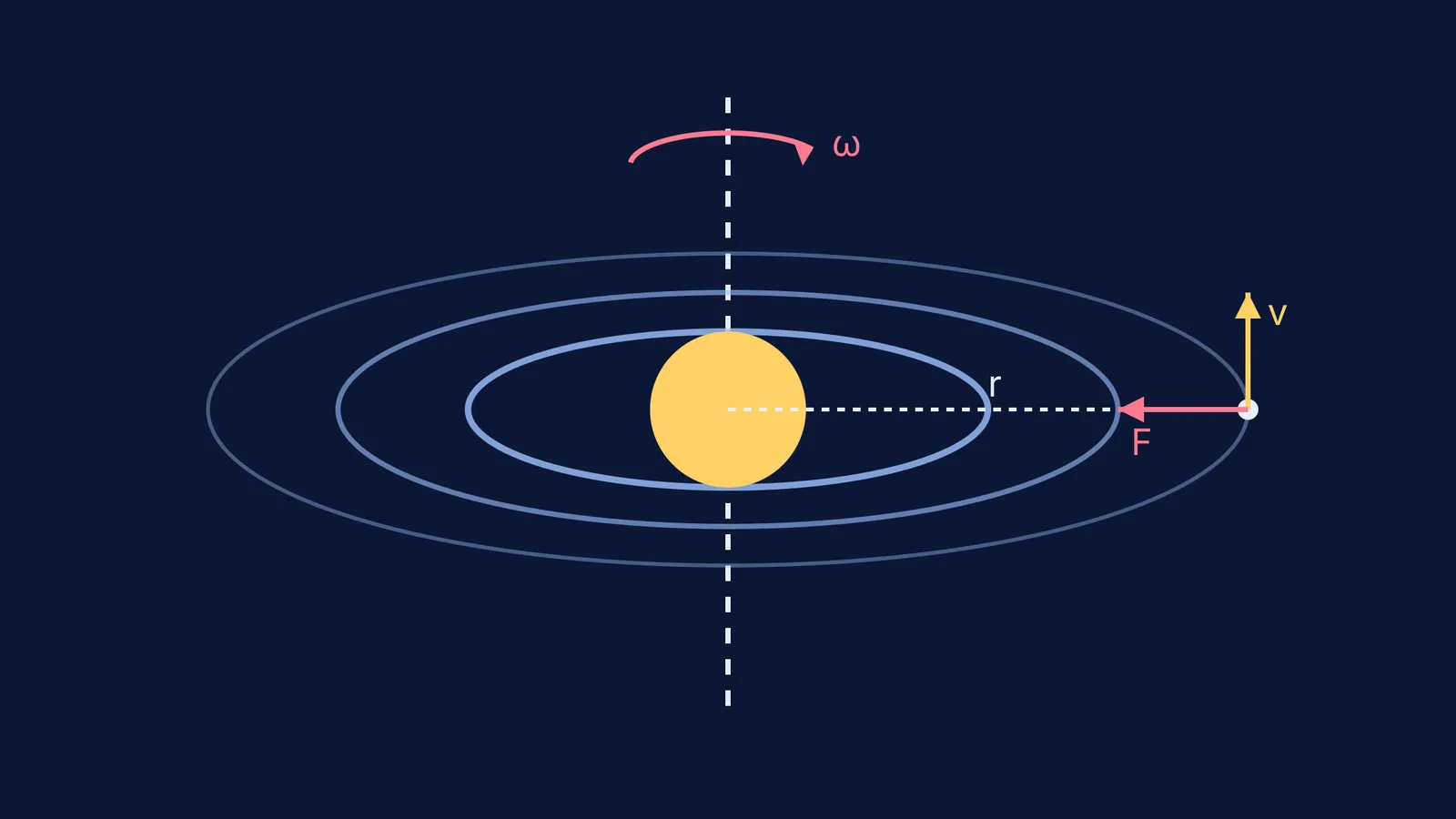
Angular momentum (L) for a particle of mass m moving at speed v in a circle of radius r is given by L = m × v × r. Because there are no outside twisting forces acting on the nebula, its total angular momentum must stay the same throughout the collapse.
As gravity pulls the gas inward, the radius r shrinks. To keep L constant, the rotational speed v must increase. The cloud spins faster as it collapses, just as an ice skater spins faster when they pull their arms inward during a spin.
While gravity pulls everything toward the centre, the rapid rotation creates a strong tendency for the material at the equator to continue moving in a straight line, fighting the inward pull. Material falling from the top and bottom poles faces no such resistance, so it collapses straight down. The result is a flattened disk.
These 3D dynamics can be hard to picture from equations alone. The Fermi Simulation Lab provides interactive simulations for the ideas that are easier to see than to read.
How to study physical models?
When you study historical scientific models for exams, it helps to use a structured approach to remember the details. You can use this checklist to break down any physical model:
Initial state: What does the system start as? (For Kant, a chaotic, diffuse cloud of gas).
Driving force: What causes the change? (Gravity pulling mass inward).
Physical constraint: What rule governs the movement? (Conservation of angular momentum forcing the spin to speed up).
Final state: What is the result? (A central star surrounded by an orbiting disk of planets).
What is the modern solar nebular disk model?
Today, scientists combine Kant and Laplace's early ideas into the Solar Nebular Disk Model (SNDM). The modern scientific consensus is that the solar system formed approximately 4.6 billion years ago from the gravitational collapse of a giant molecular cloud (Wikipedia).
Modern astronomy has refined the details of this process. We now know the Sun gathered about 99.86% of the total mass (Wikipedia), while the leftover material formed a spinning protoplanetary disk. Within this disk, microscopic dust grains collided and stuck together—a process called accretion—eventually building up the planets we see today. Just as a collapsing cloud conserves angular momentum, planets orbiting the Sun do the same, which is the basis of Kepler's second law of planetary motion.
While the original gas and dust are long gone, studying how the young Sun swept away the remaining material with the solar wind helps astronomers understand our origins. Kant and Laplace could not look through modern telescopes, but by trusting the laws of physics, they accurately predicted the birthplace of our planetary system.


