

On this page
Who was Kamoya Kimeu?
Kamoya Kimeu (1938–2022) was one of the most prolific fossil finders in paleoanthropology. Born in Kenya into the Kamba community, Kimeu grew up herding goats in the bush, developing an exceptional visual sensitivity to landscapes and subtle ground textures. In 1960, at age 21, he joined the team of Louis and Mary Leakey at Olduvai Gorge, as documented by the Leakey Foundation. His training coincided with the foundational era of East African hominin discovery, which we explore further in our account of Louis and Mary Leakey's early human fossil work.
Over the next four decades, Kimeu led an elite squad of Kenyan searchers known as the "Hominid Gang." By 1977, his skill earned him the appointment as Curator of Prehistoric Sites for the National Museums of Kenya. Richard Leakey noted that Kimeu had an intuitive talent for spotting small bone fragments where others saw only gravel. In 1985, the National Geographic Society awarded Kimeu the John Oliver La Gorce Medal, presented at the White House by President Ronald Reagan, recognizing his major contribution to paleoanthropology.
How was the Turkana Boy fossil found?
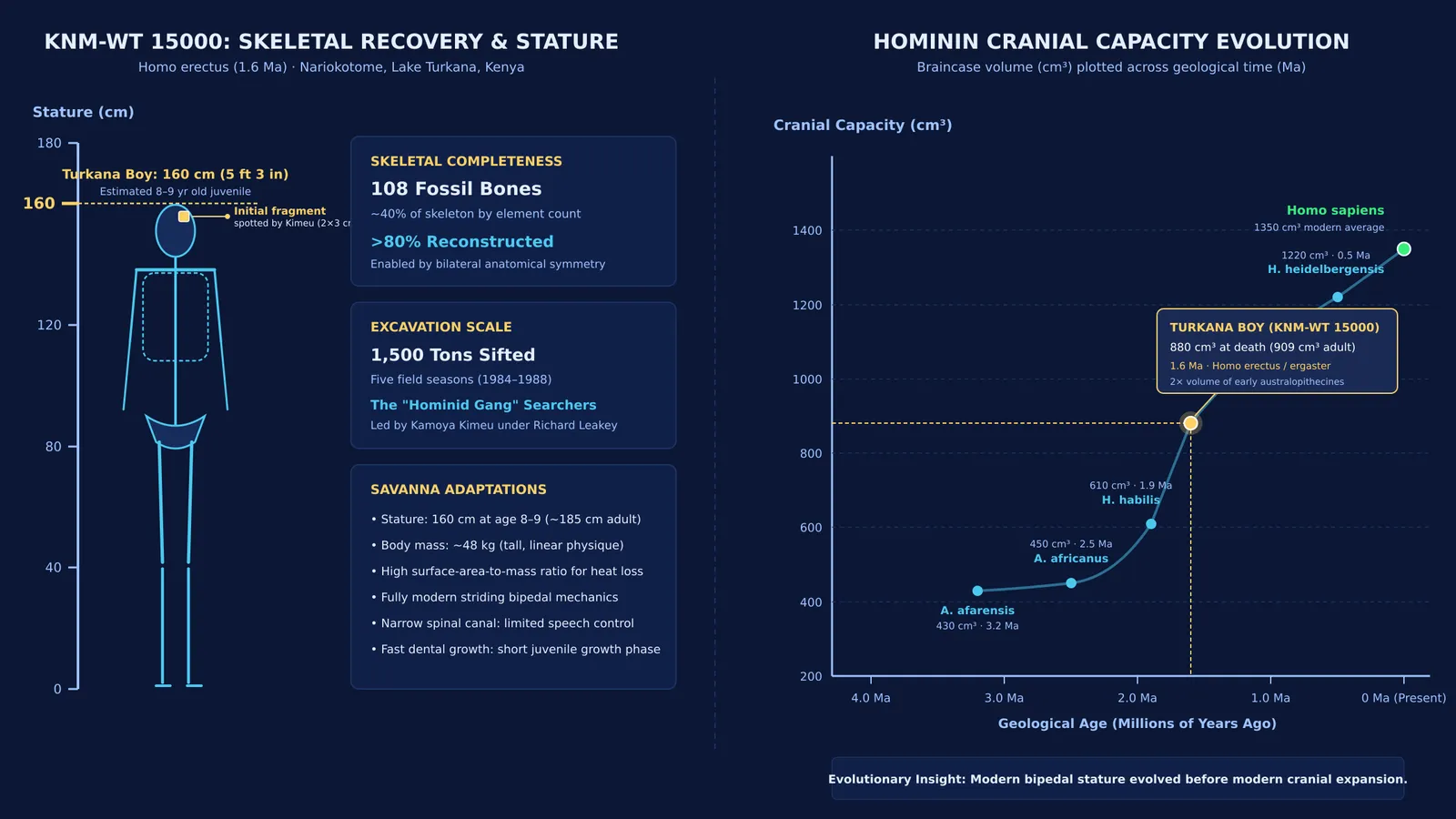
On August 23, 1984, Kimeu was surveying along the dry banks of the Nariokotome River, roughly 5 kilometres west of Lake Turkana in northern Kenya, as recorded by the Leakey Foundation. Walking beneath an acacia tree on a slope strewn with dark volcanic pebbles, he spotted a small fragment of bone measuring approximately 2 by 3 centimetres. While others would have walked past, Kimeu recognized the characteristic texture and curvature of a hominin cranial frontal bone.
Excavation began immediately and stretched across five field seasons through 1988. The team excavated and fine-sifted more than 1,500 tons of sediment, recovering 108 fossilized bones. Catalogued as KNM-WT 15000 and documented by Frank Brown and colleagues in Nature, the find preserved roughly 40% of the skeleton by bone count, as detailed by Alan Walker and Richard Leakey in *The Nariokotome Homo erectus Skeleton*. Because mammalian bodies are bilaterally symmetrical, mirroring intact limbs allowed researchers to reconstruct over 80% of the entire skeleton. Readers can explore this skeletal organisation in our guide on counting axial and appendicular bones in the human skeleton.
What did Turkana Boy reveal about human evolution?
Dated to approximately 1.53 million to 1.6 million years ago using argon-argon dating of surrounding volcanic tuff, Turkana Boy was identified as *Homo erectus* (or African *Homo ergaster*), as catalogued by the Smithsonian Institution. The skeleton clarified several key questions about human origins:
Modern body proportions: Standing 1.60 metres (5 feet 3 inches) tall and weighing roughly 48 kilograms, his tall, slender limbs and narrow pelvis proved that modern bipedal mechanics and heat-shedding body geometry evolved in the African savanna far earlier than previously thought.
Cranial capacity: His braincase measured 880 cubic centimetres, with an adult projection of 909 cubic centimetres. This expanded beyond the 450 cubic centimetres of earlier australopithecines—such as the specimen in our look at Raymond Dart and the Taung Child—while remaining below the modern human average of roughly 1350 cubic centimetres.
Accelerated maturation: Microscopic analysis of dental growth lines (perikymata) published in Nature by Christopher Dean and colleagues established that he died at only 8 to 9 years old. *Homo erectus* grew much faster than modern humans, showing that our prolonged childhood evolved later.
Speech anatomy: A relatively narrow thoracic spinal canal indicated smaller respiratory nerve volume, suggesting that fine muscular control over prolonged breathing for spoken language was not yet present.
How do scientists reconstruct an ancient skeleton?
Reconstructing ancient hominins requires an empirical workflow connecting anatomy, mineralogy, and geochronology, as detailed in *The Nariokotome Homo erectus Skeleton*. Field teams apply a 4-step framework to identify and interpret fragile remains:
Bone-stone discrimination: Scientists distinguish fossilized bone from volcanic basalt by checking cross-sectional porosity, Haversian canals, and vascular grooves under a hand lens.
Bilateral alignment: Because vertebrates have bilateral symmetry, intact appendicular bones provide exact templates for their missing opposites.
Dental micro-chronology: Counting daily perikymata lines across tooth enamel provides an objective developmental age, unaffected by skeletal growth variations.
Volcanic tephrostratigraphy: Dating potassium and argon isotopes in volcanic ash layers directly above and below the fossil layer securely brackets the specimen's geological age.
When studying human evolution, textbooks often reduce the topic to memorizing tables of cranial capacities and geological epochs. But deeper scientific appreciation comes from seeing how anatomy responds to physical constraints, such as surface area, heat loss, and joint biomechanics.
To build clear connections between skeletal form and physiology, the Fermi Concept Library covers every concept across biology with dedicated lessons and visual maps. If you want to move beyond rote memorization and see how biological structures function together, Fermi's AI tutor can work out what you already know and build a plan for your study session, guiding you step by step.


