

On this page
When you look at a rainbow arching across the horizon after an afternoon rain, you are witnessing an optical calculation performed simultaneously by billions of falling drops. For centuries, natural philosophers knew raindrops were involved, but they could not agree on how water produced circular bands of colour. The breakthrough did not happen by watching storms in the open air. Around 1309 in Tabriz, Persian polymath Kamal al-Din al-Farisi brought the sky indoors by filling a large, clear glass sphere with water to model a single enlarged raindrop inside a dark room.
Why did earlier theories fail to explain the rainbow?
Aristotle had argued in his *Meteorology* that the rainbow was caused by sunlight reflecting off a cloud as a whole, treating mist like an enormous, irregular mirror. Even the great 11th-century physicist Ibn al-Haytham, whose foundational work was later translated as Ibn al-Haytham's Book of Optics, struggled with the exact mechanism. Ibn al-Haytham proved that vision occurs when light rays enter the eye rather than leaving it, but he still treated the rainbow as a reflection from concave cloud surfaces.
Encouraged by his teacher Qutb al-Din al-Shirazi, al-Farisi undertook a systematic revision of Ibn al-Haytham's optics in his landmark treatise *Tanqih al-Manazir* (The Revision of the Optics). As science historian Roshdi Rashed documented in his study of transparent sphere optics, al-Farisi realised that explaining the rainbow required looking beyond the cloud as an aggregate body and investigating what occurs within an individual water drop.
How did al-Farisi use a water-filled glass sphere?
Because a falling raindrop measures only one to two millimetres across, observing the path of light inside it during a storm was impossible. To solve this, al-Farisi constructed a macroscopic model: a large spherical glass phial filled with clean water, as recounted in the MacTutor History of Mathematics biography of al-Farisi.
He mounted this artificial drop inside a camera obscura—a darkened room—and cut a small aperture in the window shutter to admit a controlled beam of sunlight. By testing the glass container empty and full, al-Farisi established that the thin glass walls did not distort the ray path, allowing the sphere to act as an oversized raindrop.
When the narrow sunbeam struck the upper hemisphere of the water-filled globe, al-Farisi traced the exact journey of the light:
The light ray bends as it passes from air into the denser water at the front surface (first refraction).
The beam travels across the sphere to the back concave surface, where it bounces off the water-air boundary (internal reflection).
The ray travels back toward the front wall and bends again as it emerges into the air (second refraction).
Al-Farisi proved that the primary rainbow is produced by two refractions and one internal reflection.
Why does the secondary rainbow have inverted colours?
Above the primary bow, observers often spot a fainter secondary rainbow with its colours reversed, running from red on the inside to violet on the outside. Al-Farisi used his water globe to explain this second bow as well.
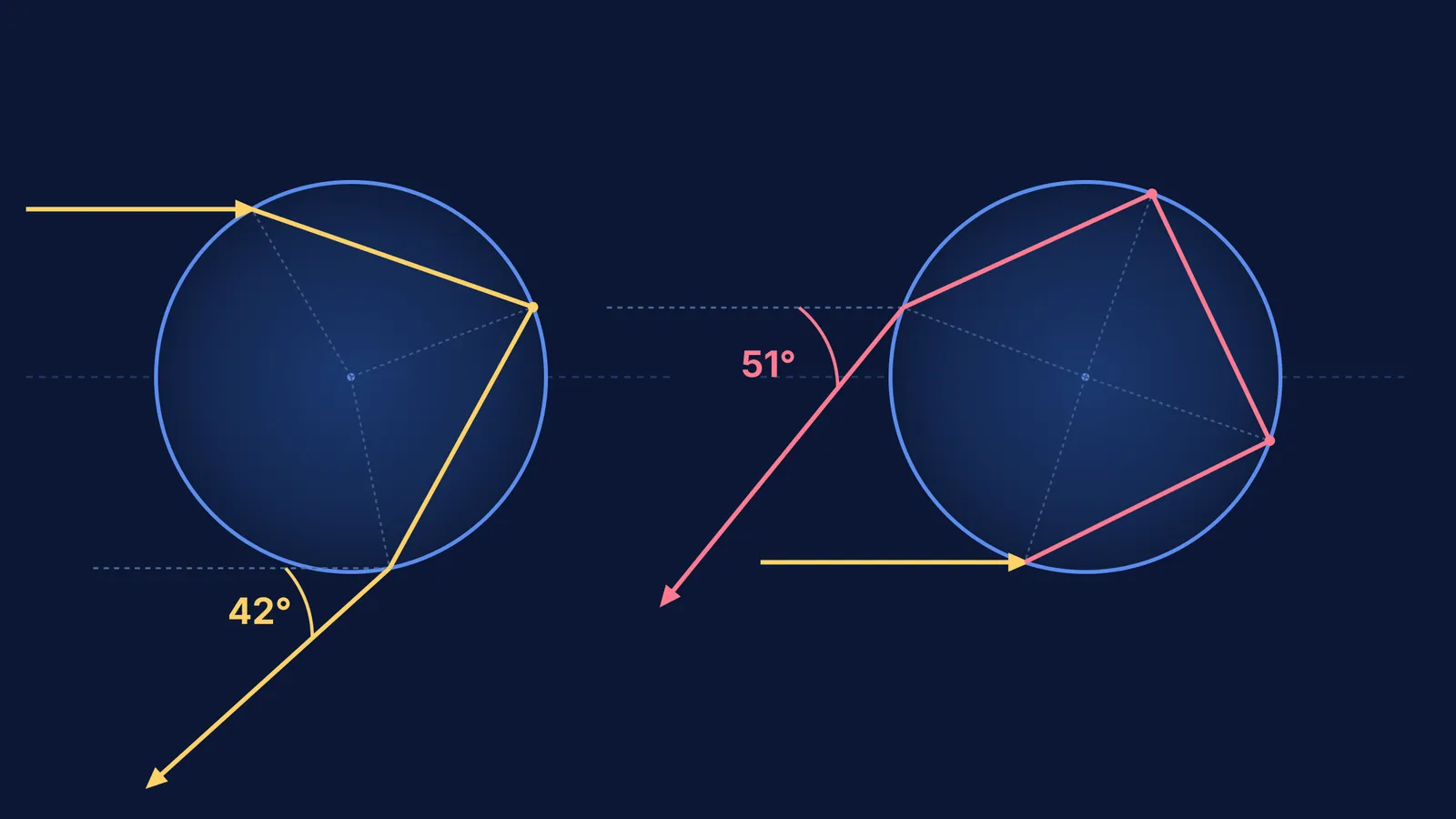
In his historical analysis of rainbow theories, science historian Carl Boyer showed in Isis that al-Farisi was the first to demonstrate that the secondary bow is formed by rays entering the lower part of the droplet. Inside the sphere, these rays undergo two refractions and two internal reflections before exiting toward the observer.
This geometry explained two everyday observations:
Why the secondary bow is fainter: Water does not act as a perfect mirror at internal angles. Part of the light escapes through the back wall at each bounce. Two internal reflections leave less radiant energy than one, making the secondary bow naturally dimmer.
Why the colour order flips: White light disperses into colours because different wavelengths bend by slightly different amounts, similar to the dispersion of white light by a glass prism. The second internal reflection crosses the ray paths inside the drop, inverting the spectral sequence so violet emerges at a steeper angle than red.
How do you trace the ray path through a spherical drop?
When you solve refraction through a glass sphere in physics class, you calculate how light deviates at curved surfaces using Snell's law: sin i = n sin r, where i is the angle of incidence, r is the angle of refraction, and n is the refractive index, as analyzed in Roshdi Rashed's geometric reconstruction.
For a primary rainbow ray with one internal reflection, the net angular deviation D between the incoming sunlight and the outgoing ray is:
D = 2(i − r) + (π − 2r) = π + 2i − 4r
The brightest part of the rainbow occurs at the angle of minimum deviation, where exiting rays bunch together. Setting the derivative dD/di = 0 gives:
cos² i = (n² − 1) / 3
For water with refractive index n = 4/3 (approximately 1.333):
cos² i = ((4/3)² − 1) / 3 = (7/9) / 3 = 7/27 ≈ 0.259
cos i = √(7/27) ≈ 0.509, which gives an angle of incidence i ≈ 59.4°
Using sin r = (sin 59.4°) / (4/3), we find r ≈ 40.2°
Net deviation D = 180° + 2(59.4°) − 4(40.2°) ≈ 138.0°
The exit angle relative to the incoming sunlight direction is 180° − 138.0° = 42.0°
For the secondary bow with two internal reflections, the stationary condition yields cos² i = (n² − 1) / 8. Substituting n = 4/3 gives i ≈ 71.8°, r ≈ 45.4°, and an exit angle of 51.0°.
How does active modeling clarify ray optics?
Al-Farisi's water sphere remains a masterclass in scientific problem-solving. When a physical phenomenon is too small or too distant to observe directly, building an accurate scale model reveals principles that pure contemplation misses.
In modern physics curricula, students face the same challenge: tracing multiple refractions and reflections across spherical surfaces can feel abstract when confined to static formulas. The Fermi Simulation Lab provides interactive simulations for ideas that are easier to see than to read, allowing you to manipulate incident rays and observe internal reflections dynamically. When you need to master the underlying boundary equations, the Fermi Concept Library maps every concept in physics and optics, while the Fermi Problem Library offers worked problems with a step-by-step solver that explains the reasoning rather than printing an answer.


