

On this page
What did John O'Keefe discover in the hippocampus?
For decades, neuroscientists debated the exact purpose of the hippocampus. Clinical cases had shown that hippocampal damage severely impairs long-term memory formation, yet animal studies yielded conflicting results. Understanding how different parts of the human brain coordinate behavior remained an open challenge.
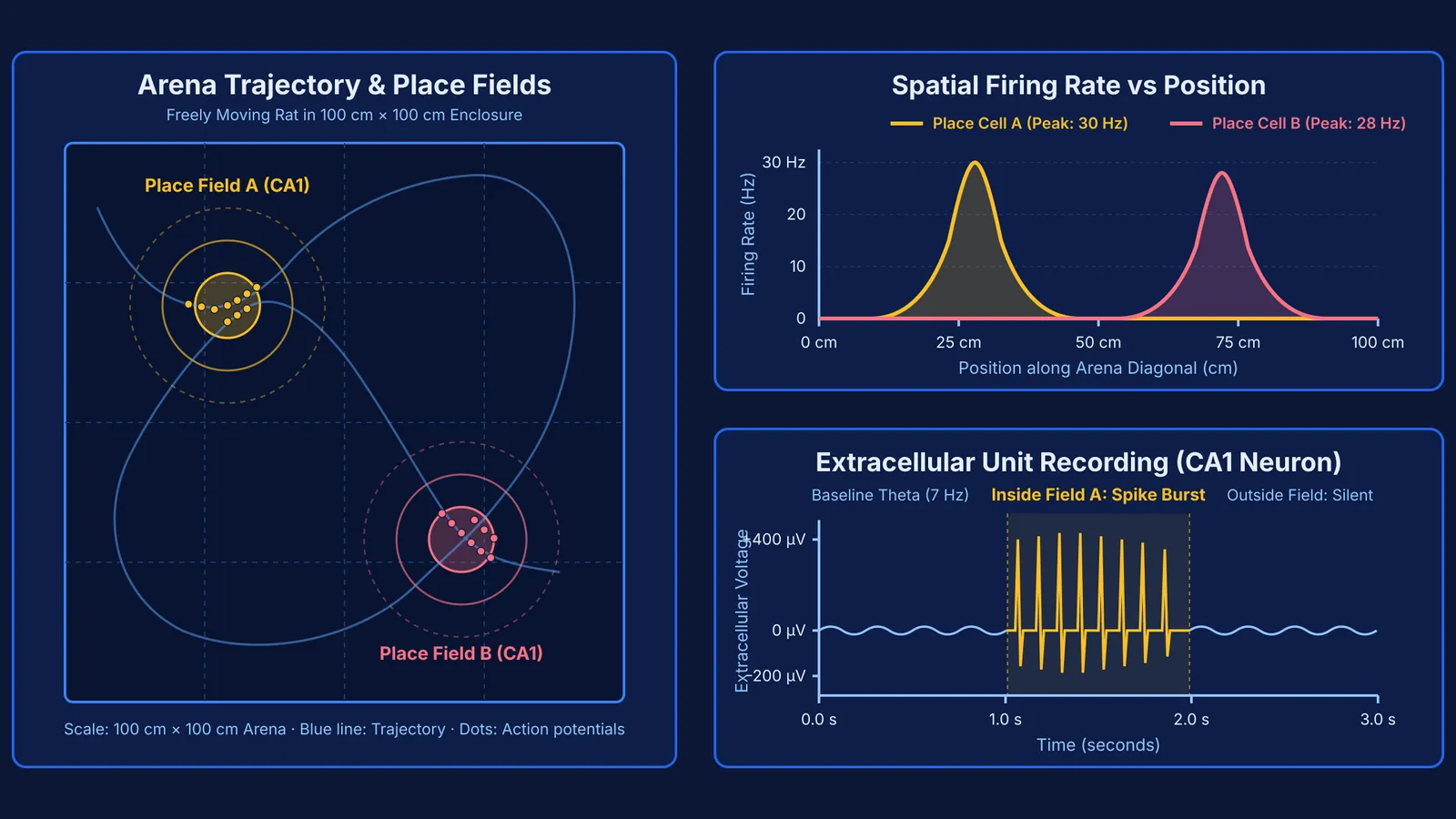
In 1971, American-British neuroscientist John O'Keefe uncovered how individual hippocampal neurons represent physical space. A place cell is a pyramidal neuron in the hippocampus that fires action potentials primarily when an animal occupies a specific, bounded region within its environment, known as its place field (O'Keefe and Dostrovsky, 197190358-1)). For this discovery, John O'Keefe received one half of the 2014 Nobel Prize in Physiology or Medicine (The Nobel Prize, 2014).
How did the 1971 experiment reveal place cells?
At University College London, O'Keefe and graduate student Jonathan Dostrovsky built microdrives with fine microelectrodes lowered into the dorsal hippocampus of freely moving rats (O'Keefe Biographical, Nobel Prize). Unlike classical experiments that restrained animals to present isolated sensory stimuli, they recorded single-cell electrical activity while rats explored an open arena.
In their 1971 paper in *Brain Research*, O'Keefe and Dostrovsky recorded from 76 individual hippocampal neurons (O'Keefe and Dostrovsky, 197190358-1)). Their data classified the units into distinct functional groups:
Exactly 8 of the 76 units (10.5%) fired solely or maximally when the rat stood in a specific location facing a particular direction (O'Keefe and Dostrovsky, 197190358-1)).
14 units responded to novel auditory or sensory arousal.
21 units fired in correlation with voluntary movement such as walking or turning.
33 units showed no clear correlation to the tested behaviors.
When O'Keefe rotated visual landmarks or extinguished the room lights, place cells continued firing reliably as the rat crossed their place fields (Nobel Prize Advanced Information, 2014). The hippocampus was constructing an autonomous spatial reference framework.
How do place cells build an internal cognitive map?
This breakthrough verified a hypothesis framed decades earlier. In 1948, psychologist Edward Tolman argued that animals navigate by building internal 'cognitive maps' rather than relying on rote sequences of motor habits (Tolman, 1948). O'Keefe and Lynn Nadel developed this into a comprehensive theory in their 1978 book, *The Hippocampus as a Cognitive Map*.
When an animal enters a new space, a distinct subset of place cells activates within minutes. This pattern remains stable across weeks, preserving a durable map of that environment (Nobel Prize Advanced Information, 2014). Moving to a different room triggers 'remapping,' where an alternative assembly of neurons fires without overwriting previous maps. This cellular plasticity mirrors findings in Eric Kandel's work on memory storage.
Connecting cellular neurobiology to overall anatomical systems is essential for mastering complex physiology. In the Fermi Concept Library, students explore concepts in biology and neuroscience with lessons organized into a structured map of ideas. When studying how voltage spikes and firing thresholds change across spatial coordinates, dynamic models make the underlying physiology clear; the Fermi Simulation Lab provides interactive simulations for ideas that are easier to see than to read.
Why does spatial mapping matter for memory and studying?
The hippocampus does not merely guide spatial navigation; in humans, it serves as the essential hub for episodic memory. Whenever you learn a multi-step concept or recall a laboratory experiment, the hippocampus links factual information ('what happened') to a spatial context ('where it happened').
This biological link explains why spatial mnemonic techniques, such as the ancient 'Method of Loci' or memory palace, remain so effective. Imagining key concepts positioned along a familiar physical path recruits hippocampal place networks to organize abstract facts. Research also investigates whether changing study locations boosts recall, showing that varied environmental cues can strengthen memory retrieval.
How can students use spatial indexing to revise complex topics?
Students preparing for exams like NEET-UG or CBSE Class 12 can use spatial indexing to master complex, sequential pathways:
Pick a familiar route: Select a well-known path, such as from your doorway to your study desk, noting four or five distinct physical stops.
Anchor concept milestones: Assign one logical stage to each stop. For instance, map the steps of a reflex arc or hormone pathway in sequence along the route.
Retrieve actively along the path: Mentally walk through the journey without notes, explaining each biochemical or physiological trigger out loud before proceeding.
Test in reverse: Walk the mental path backward to confirm you understand cause-and-effect relationships rather than reciting a rote list.
When working through multi-step analytical problems, it is common to get stuck when concepts intersect. Rather than guessing, Fermi's AI tutor can work out what you already know, notice where you are stuck, and build a plan for the session so you make steady progress.


