

On this page
In 1748 John Turberville Needham, an English priest who worked with microscopes, told the Royal Society he had watched life appear in broth that should have been sterile. His paper, "A summary of some late observations upon the generation, composition, and decomposition of animal and vegetable substances", fills pages 615 to 666 of volume 45 of the Philosophical Transactions of the Royal Society. The way it went wrong is still a clear lesson in how to design a fair test.
What did John Needham do in his broth experiment?
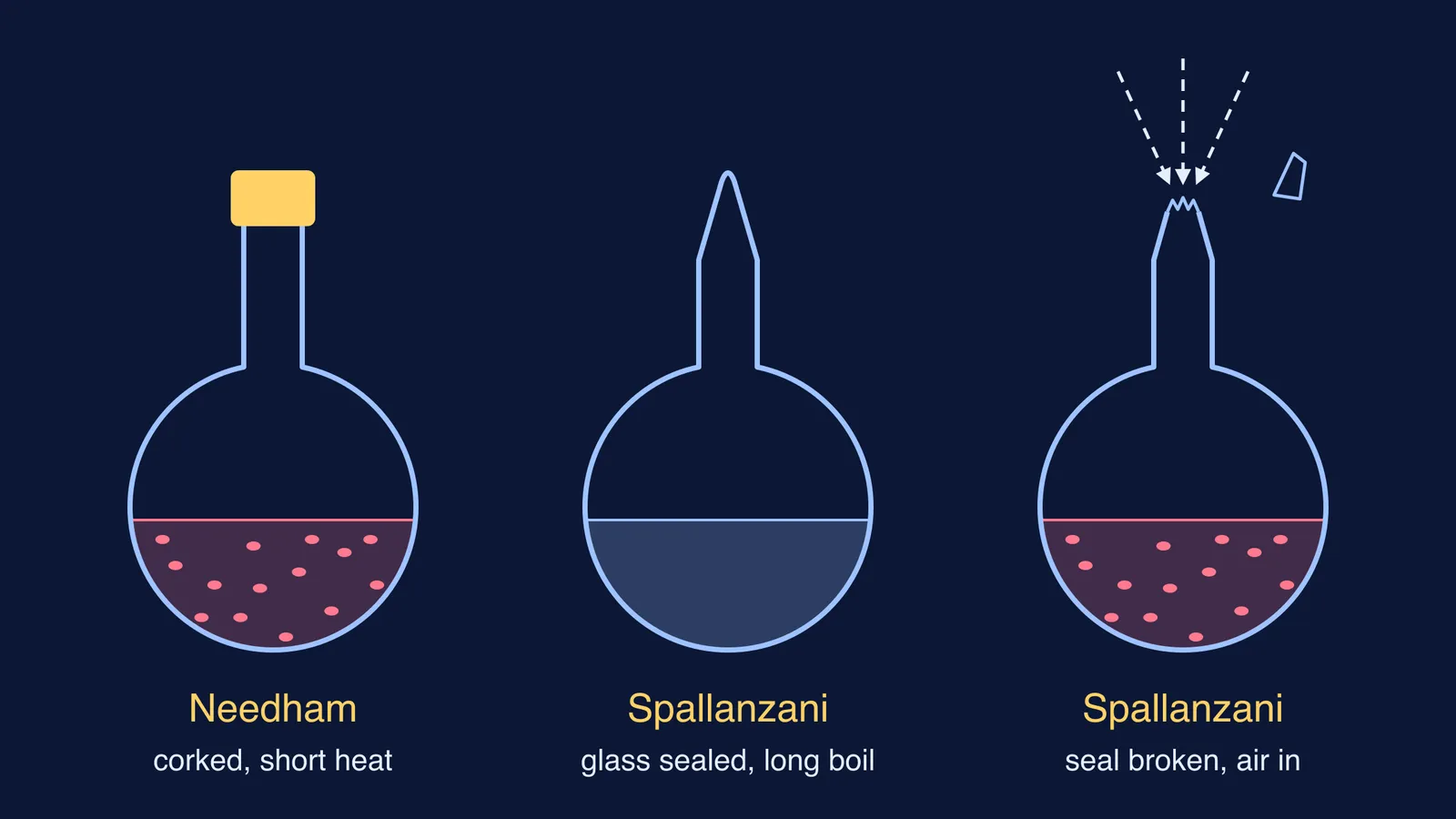
In his most famous trial, Needham took "mutton-gravy hot from the fire", sealed it up and heated it, as the Linda Hall Library's profile of Needham describes. He also put vegetable matter in vials, sealed them with cork and heated them, and found the contents teeming with microscopic life.
OpenStax Microbiology says he briefly boiled broth, hoping to kill every microbe already in it. After a few days the broth had turned cloudy and a single drop held numerous microscopic creatures. Needham (1713 to 1781) argued that these microbes must have arisen spontaneously.
Why did Needham believe in spontaneous generation?
Spontaneous generation is the idea that life can arise from nonliving matter, and Aristotle was one of the earliest scholars on record to state it (OpenStax Microbiology).
By Needham's time the idea was already in trouble for larger animals. Francesco Redi's 1668 experiment was one of the first to refute the idea that maggots spontaneously generate on meat (same OpenStax chapter; we tell that story in Francesco Redi's maggots experiment).
Needham concluded that nature held a "vegetative force" able to produce living things without eggs or seeds (Linda Hall Library). The same profile notes that the French naturalist Buffon held a similar view: that "organic molecules" could come together to form living things.
How did Spallanzani test Needham's experiment?
The Italian priest Lazzaro Spallanzani (1729 to 1799) did not accept Needham's conclusion and ran hundreds of carefully executed experiments with heated broth (OpenStax Microbiology). He published his book on the question in 1765 (Linda Hall Library).
Spallanzani changed two things. He heated flasks for different lengths of time, and found that some very small organisms seemed to survive liquid boiled for almost an hour (Encyclopedia.com, The Spontaneous-Generation Debate). When he boiled broth for 30 minutes and sealed the flask straight away by melting its glass neck shut, no microorganisms appeared (same source).
His heated, sealed flasks stayed clear unless they were later opened to the air, which suggested the microbes came in from the air (OpenStax Microbiology). Our profile of Lazzaro Spallanzani covers his wider work.
Why didn't Spallanzani settle the argument?
Needham had a reply. He argued that Spallanzani's long boiling destroyed the "life force" in the broth, and that sealing the flask stopped new life force from getting in (OpenStax Microbiology). Needham and Buffon kept defending spontaneous generation despite Spallanzani's criticism (Encyclopedia.com).
The reply worked because a sealed flask cuts off two things at once: microbes and air. Louis Pasteur later used flasks with long, bent necks that let air in but trapped airborne microbes in the bends (OpenStax Microbiology). That design answered the life-force objection, and his experiments won the Paris Academy of Sciences' Alhumbert Prize in 1862 (same source). Read more in how Louis Pasteur built germ theory.
How can you find the flaw in an experiment like Needham's?
Use these five questions on any experiment, from a textbook case to your own school practical. Here they are worked through for Needham.
What exactly is the claim? Life appeared in broth with no living parent.
What else could explain the result? Microbes survived a heating that was too short, or entered past the cork.
Which single change would separate the explanations? Boil longer, or seal in glass instead of cork. Spallanzani tried both.
What does each explanation predict? If spontaneous generation is right, sealed flasks still go cloudy. If contamination is right, they stay clear until opened.
Can the losing side escape? Yes: the life-force reply. So you need a test where air gets in but microbes cannot, which is what Pasteur's bent-neck flask did.
On your next practical write-up, ask what a sceptical classmate would say, then design the run that answers them.
If you get stuck on the biology behind these steps, the Fermi Concept Library has a lesson for every concept in biology, chemistry and physics. To practise the reasoning itself, Fermi's AI tutor can decide whether to explain, ask or show, so it can ask you what each explanation predicts before telling you the answer.


