On this page
In 1913, in Aachen, Johannes Stark watched the lines of glowing hydrogen break apart in a strong electric field. A magnet was already known to split spectral lines; Stark showed an electric field can too. If you study atomic structure for boards or JEE, seeing the two side by side stops you mixing them up.
What did Johannes Stark see in 1913?
Stark was studying canal rays, beams of glowing atoms and ions. The Nobel Committee's 1919 presentation speech says that in 1913 he sent canal rays through hydrogen in a strong electric field and saw the lines broaden. A closer look showed each line had split into several components with characteristic polarizations, caused by the field alone, not the atoms' motion.
Anthony Duncan and Michel Janssen, in a history of the Stark effect, write that Stark had begun these experiments years earlier in Göttingen. Detailed papers followed in 1914, including one in Annalen der Physik.
The Italian physicist Antonino Lo Surdo found the splitting of hydrogen lines virtually simultaneously and independently in 1913, according to a 2004 study in Physics in Perspective by Matteo Leone, Alessandro Paoletti and Nadia Robotti. The prize went to Stark alone: the 1919 Nobel Prize in Physics was awarded "for his discovery of the Doppler effect in canal rays and the splitting of spectral lines in electric fields".
Why does an electric field split hydrogen lines?
In hydrogen, several different electron states share the same energy for each value of n. An electric field pushes those states to slightly different energies, so one line becomes several. In 1916 Paul Epstein and Karl Schwarzschild independently worked this out with the Bohr–Sommerfeld theory, as Duncan and Janssen explain. Written with the Bohr radius a0, their result is that a level shifts by ΔE = (3/2) × n × k × e × a0 × E, where E is the field strength and k is a whole number from −(n − 1) to +(n − 1).
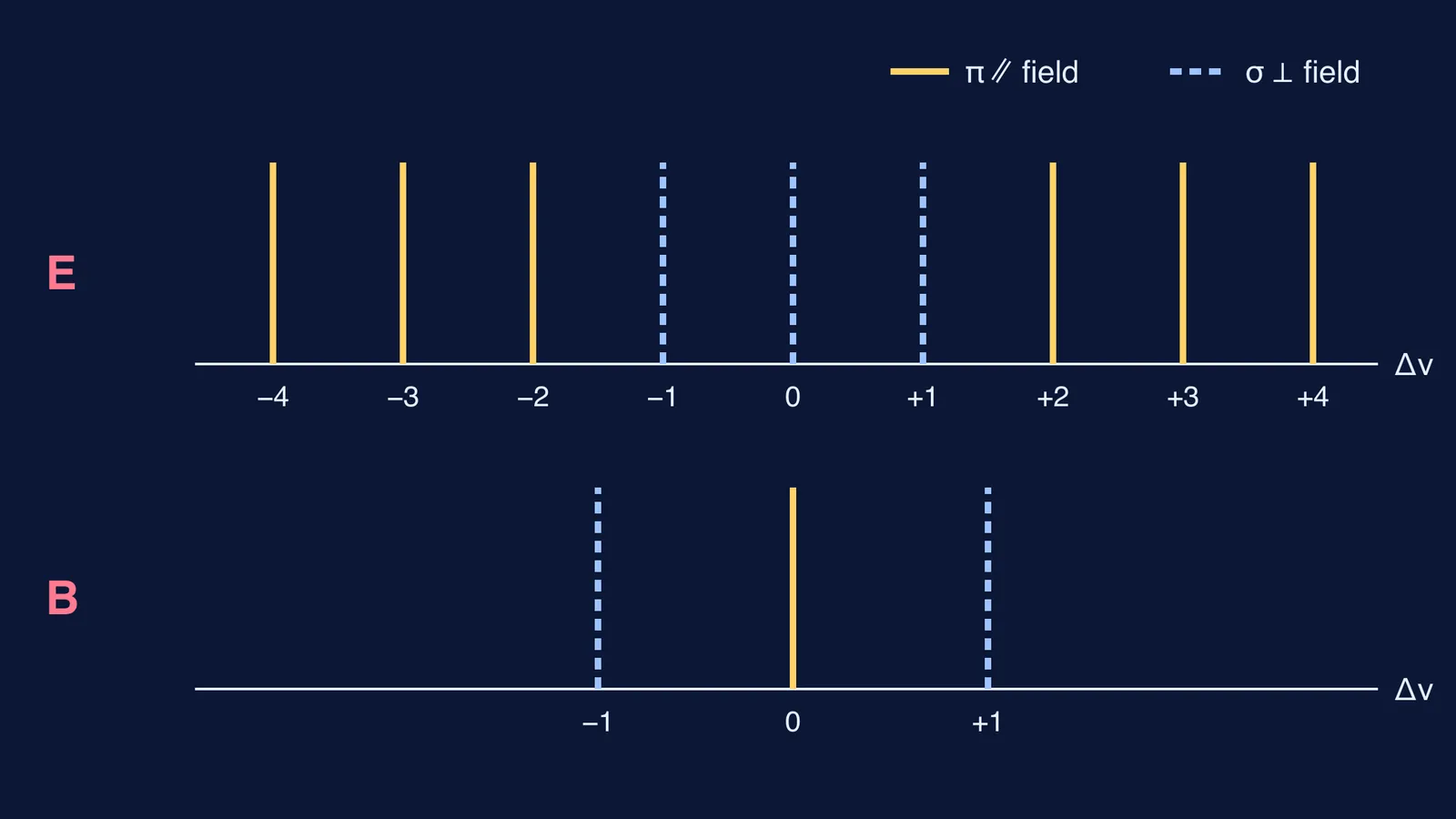
For the red Hα line (n = 3 to n = 2), the theory gives 15 possible frequencies. A selection rule removed six, and the nine left matched Stark's data: six components polarized parallel to the field, at ±2, ±3 and ±4 units of shift, and three polarized perpendicular to it, at 0 and ±1 unit.
How is the Stark effect different from the Zeeman effect?
Pieter Zeeman found the magnetic version in 1896 and described it in English in Philosophical Magazine in 1897. He and Hendrik Lorentz shared the 1902 Nobel Prize in Physics for research into "the influence of magnetism upon radiation phenomena". Read Pieter Zeeman and the spectral lines that split in a magnet for that story.
What splits the line: Stark, an electric field E. Zeeman, a magnetic field B.
Size of the shift: Stark in hydrogen, (3/2) n k e a0 E. Normal Zeeman, μB × B × m_l, where μB is the Bohr magneton (HyperPhysics).
Pattern for Hα: Stark, nine components placed symmetrically about the original line. Normal Zeeman, a triplet.
Spin: the full Zeeman effect involves electron spin; the Stark effect at the field strengths Stark used does not (Duncan and Janssen).
How big is the Stark splitting? A worked example
Take hydrogen's Hα line, which NIST lists at about 656.3 nm in air. Put it in an electric field of 10⁷ V/m (10⁵ V/cm) and, separately, a magnetic field of 1 T. These are round practice numbers.
One Stark unit is (3/2) × e × a0 × E. With a0 = 5.29 × 10⁻¹¹ m from NIST, that is 1.5 × 5.29 × 10⁻¹¹ × 10⁷ = 7.94 × 10⁻⁴ eV.
The outermost Hα components sit at ±4 units, a shift of about 3.2 × 10⁻³ eV.
The normal Zeeman shift is μB × B. With μB = 5.79 × 10⁻⁵ eV/T from NIST, 1 T gives 5.79 × 10⁻⁵ eV.
Ratio: 7.94 × 10⁻⁴ ÷ 5.79 × 10⁻⁵ ≈ 14. In these fields, one Stark unit is about 14 times the Zeeman shift.
If a step felt shaky, the Fermi Problem Library has worked problems with a step-by-step solver that explains the reasoning rather than printing an answer. If the gap is energy levels themselves, start with the Fermi Concept Library. For field-free practice, try these hydrogen spectrum problems on energy levels and series.
How do you tell them apart in a question?
Find the field. Charged plates, volts or V/m point to Stark; a magnet or tesla points to Zeeman.
Check the formula. A shift with a0 and E is Stark; one with μB, m_l and B is Zeeman.
Count the components. Many symmetric components of a Balmer line suggest Stark; three suggest the simple Zeeman picture.
A note on the man: Duncan and Janssen record that Stark was a staunch opponent of the Bohr–Sommerfeld theory that explained his own effect, and Physics Today records that under the Nazis he joined Philipp Lenard in the Deutsche Physik movement against the physics of Einstein and Heisenberg. Next time you see a split line, ask first: electric or magnetic?