

On this page
Until the late 1950s, meteorologists viewed clouds as passive passengers of atmospheric motion. Textbook models explained global weather through planetary circulation cells: warm air rose at the equator, moved poleward aloft, sank in the subtropics, and returned as trade winds. While Vilhelm Bjerknes's hydrodynamic model of weather fronts explained mid-latitude cyclones, the engine driving the tropical equatorial belt remained a deep mystery.
What was the tropical energy paradox that baffled meteorologists?
The puzzle was a contradiction known as the equatorial energy deficit. As documented by the NASA Earth Observatory, meteorologists knew the equatorial trough zone must export massive heat poleward to balance global temperatures.
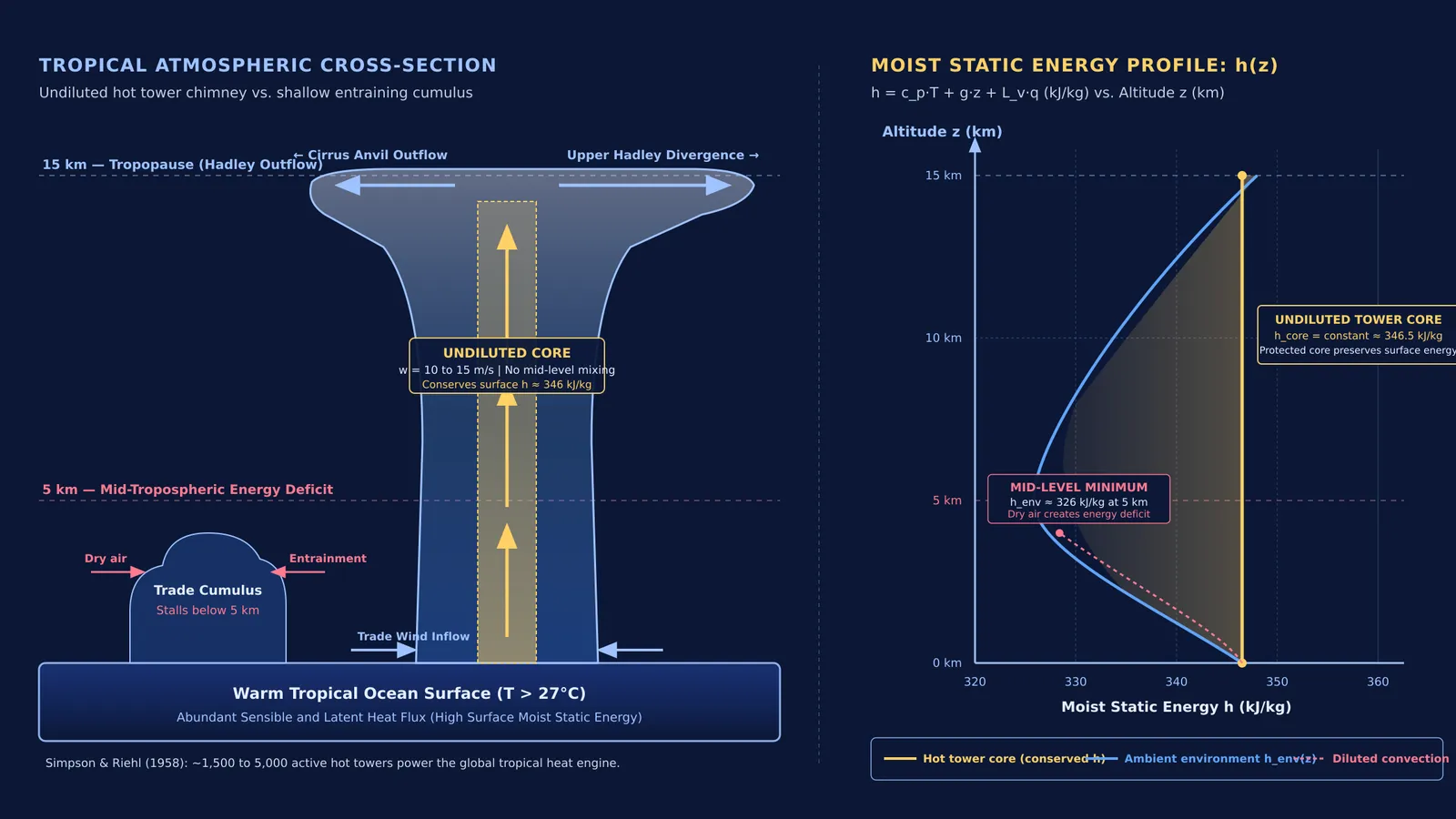
Yet atmospheric soundings showed that moist static energy—sensible enthalpy, gravitational potential energy, and latent heat combined—does not decrease steadily with height. Instead, it reaches a sharp minimum in the mid-troposphere near 5 kilometres.
As reviewed in the Bulletin of the American Meteorological Society, this created a paradox. A broad updraft would entrain dry air, diluting buoyancy and stalling ascent far below the tropopause. Without a mechanism to bridge this energy sink, global circulation could not operate.
How did Joanne Simpson prove that hot towers drive global winds?
The scientist who solved the paradox was Joanne Simpson (born Joanne Gerould in 1923). In 1949, she became the first American woman to earn a Ph.D. in meteorology at the University of Chicago, overcoming faculty claims that the discipline was unsuitable for women.
At Woods Hole, Simpson modeled entraining cumulus clouds in the Quarterly Journal of the Royal Meteorological Society. When rules barred women from research flights, naval officer Captain Max Eaton insisted "No Joanne, no airplane," securing her flight on a Navy PBY-6A Catalina to observe tropical clouds firsthand.
In 1958, Simpson and Herbert Riehl published their solution in *Geophysica*, reviewed in the Bulletin of the American Meteorological Society. They showed equatorial ascent occurs in narrow cumulonimbus chimneys Simpson named "hot towers." Riehl and Simpson calculated that 1,500 to 5,000 active towers—covering under 0.1% to 1% of the tropical ocean—suffice to balance Earth's heat budget.
How does moist static energy explain the cloud heat engine?
To explain how a hot tower ascends, Riehl and Simpson evaluated moist static energy, h, defined in thermodynamic analyses compiled by the NASA Earth Observatory:
h = c_p × T + g × z + L_v × q
Here, c_p × T is sensible enthalpy, g × z is gravitational potential energy, and L_v × q is latent heat.
At the sea surface, warmth and moisture yield peak values of h. In ambient air at 5 kilometres, dryness creates the energy minimum. Inside a hot tower's core, air ascends at 5 to 15 metres per second without mixing, conserving h. As moisture condenses, latent heat converts to sensible heat, keeping the parcel buoyant until 15 kilometres, where outflow enters the upper Hadley branch.
Simpson extended this model to hurricanes in Tellus, showing eyewall towers warm storm cores by 10°C to 18°C above surroundings. This convective engine also powers monsoon winds examined in Gilbert Walker's discovery of the Southern Oscillation.
How can you calculate the energy released by a tropical hot tower?
You can calculate the thermal power of a single hot tower using thermodynamic parameters documented by the NASA Earth Observatory:
Core mass flux (M): For radius r = 2,000 metres (area A ≈ 1.26 × 10⁷ m²), updraft w = 10 m/s, and density ρ = 1.2 kg/m³, mass flux M = ρ × A × w ≈ 1.51 × 10⁸ kg/s.
Condensed moisture (Δq): Tropical air has humidity q_in ≈ 0.020 kg/kg. Condensing to q_out ≈ 0.001 kg/kg at 15 kilometres leaves Δq = 0.019 kg/kg.
Latent power (P): With vaporization heat L_v = 2.5 × 10⁶ J/kg, latent power is P = M × L_v × Δq ≈ 7.2 × 10¹² watts (7.2 Terawatts).
Global export: Across 2,000 active towers, latent heating reaches roughly 1.4 × 10¹⁶ watts (14 Petawatts), balancing equatorial heat export.
Why does Simpson's cloud discovery matter for science students?
Simpson showed that global climate is governed by cloud thermodynamics. She later served as Project Scientist for NASA's Tropical Rainfall Measuring Mission (TRMM), documented in the Bulletin of the American Meteorological Society, which used space radar to map tropical latent heating. This satellite legacy mirrors P. R. Pisharoty's satellite studies of monsoon moisture.
For students connecting thermodynamic principles to physical systems:
When visualizing how phase changes, buoyancy, and lapse rates interact, the Fermi Simulation Lab provides interactive simulations for the ideas that are easier to see than to read.
When solving quantitative problems in heat transfer and fluid mechanics, the Fermi Problem Library offers worked problems with a step-by-step solver that explains the reasoning rather than printing an answer.
To build conceptual foundations across thermodynamics and earth systems, explore the Fermi Concept Library, which covers every concept in physics, chemistry, biology, mathematics and computing.


