

On this page
In 1976, a young Congolese virologist named Dr. Jean-Jacques Muyembe-Tamfum travelled to a remote mission hospital in Yambuku, Zaire, to investigate a mysterious and deadly fever. Working without protective gear, he performed liver biopsies on deceased patients and drew blood from infected individuals. He sent the samples to Belgium, where scientists confirmed the presence of what we now know as the Ebola virus. It was the beginning of a 40-year quest to find a cure, driven by a researcher who was the first scientist to come into contact with the virus and survive.
What did Jean-Jacques Muyembe discover about Ebola?
For nearly two decades, an Ebola diagnosis was considered a death sentence, with extremely high mortality rates. In 1995, during a major outbreak in Kikwit, Muyembe noticed that a few patients managed to survive the infection. He decided to test a bold hypothesis: what if the blood of these survivors held the key to fighting the virus?
Muyembe performed experimental transfusions, giving convalescent plasma—the blood of Ebola survivors—to eight infected patients. Seven of the eight survived. This small but pivotal trial proved that antibodies generated by the human immune system could neutralize the virus. The challenge then shifted from proving the concept to isolating the specific antibody responsible.
Understanding the mechanisms of viral replication and immune response is a core part of advanced biology. If you are preparing for exams, reviewing topics such as Viruses, viroids and lichens: the misfits of five-kingdom biology helps build the foundation for this kind of research. Students who want to explore these subjects deeply can use the Fermi Concept Library, which covers every concept in physics, chemistry, biology, mathematics and computing, each with its own lesson and its place in the map.
How did the 1995 discovery lead to a treatment?
The blood transfusion experiment in Kikwit laid the groundwork for modern monoclonal antibody therapies. More than a decade later, Muyembe's team at the National Institute of Biomedical Research (INRB) in Kinshasa collaborated with researchers from the U.S. National Institutes of Health. They tracked down one of the survivors from the 1995 outbreak who had maintained circulating antibodies for 11 years.
From this survivor's blood, scientists cloned specific immune cells and isolated a single, highly effective antibody known as mAb114. This antibody works by binding to the core of the Ebola virus surface glycoprotein, physically blocking the virus from entering human cells.
When students study the structure of proteins and genetic material, tools like the Fermi Simulation Lab provide interactive simulations for the ideas that are easier to see than to read.
When was Ebanga approved for Ebola Zaire?
The true test for mAb114 came during the 2018–2020 Ebola outbreak in the Democratic Republic of the Congo. Muyembe helped lead the PALM (Pamoja Tulinde Maisha) clinical trial, which compared mAb114 against other experimental drugs in the middle of an active outbreak zone.
The results were decisive. The trial was halted early because mAb114 proved highly effective. For patients who were treated shortly after infection while their viral loads were low, the survival rate reached approximately 90%.
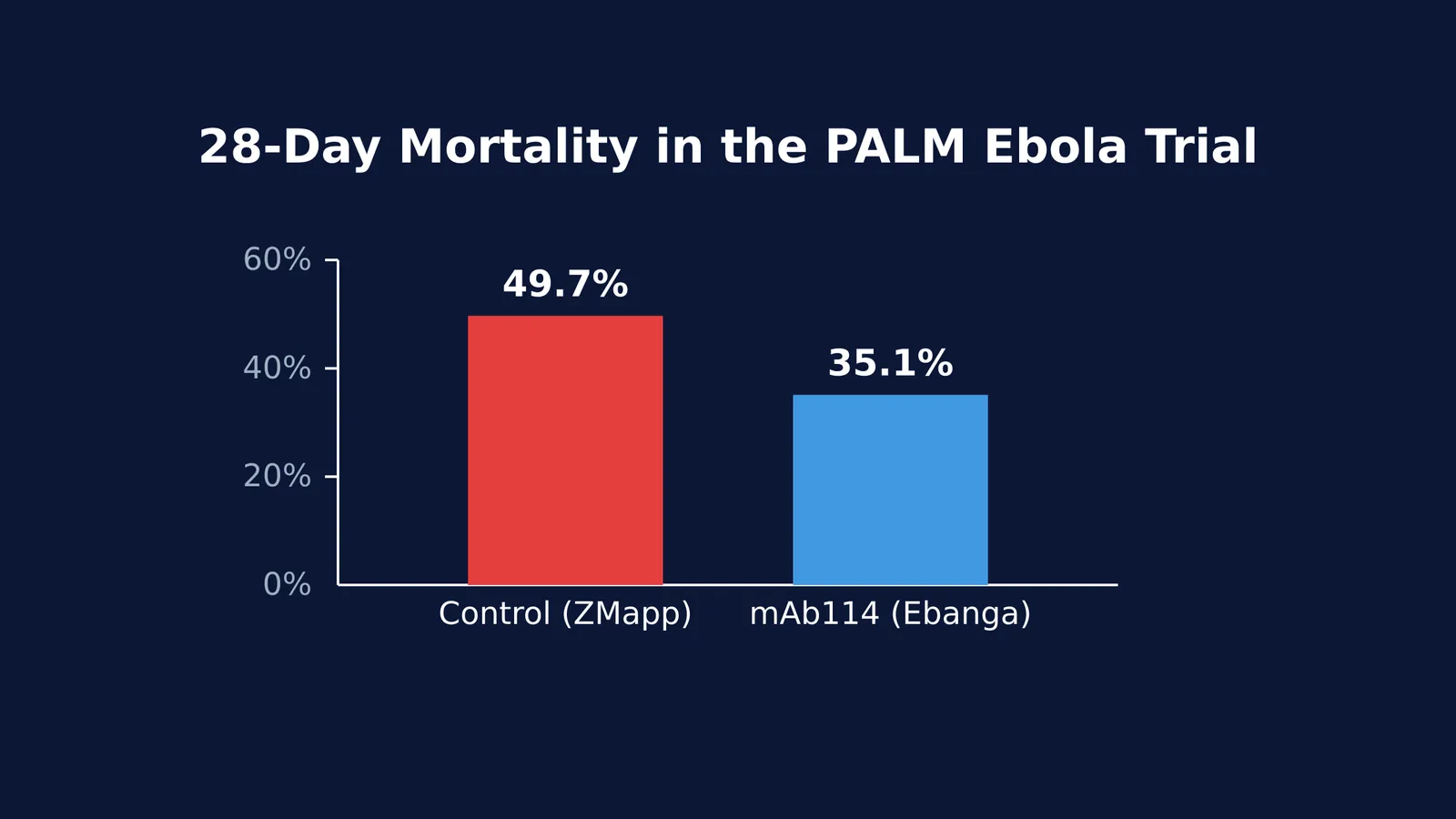
On December 21, 2020, the U.S. Food and Drug Administration (FDA) officially approved mAb114 under the brand name Ebanga for the treatment of *Zaire ebolavirus* in adults and children. In the overall trial, the 28-day mortality for patients receiving Ebanga was 35.1%, compared to 49.7% in the control group.
Framework: Solving hard problems the Muyembe way
Muyembe’s 40-year journey offers a clear framework for tackling seemingly impossible academic or scientific problems:
Go to the source: Muyembe travelled directly to the outbreak and collected samples himself. When you hit a roadblock in your studies, go back to the primary source material or fundamental concepts instead of relying on summaries.
Test bold hypotheses: He observed survivors and tested if their blood could help others. Look for patterns in your errors and test new study methods when the old ones fail.
Persist through the gap: It took over a decade to isolate the specific antibody from the 1995 survivor. Do not expect immediate answers to complex problems; leave room for iterative progress over time.
A legacy of scientific leadership
Dr. Muyembe's career shows that groundbreaking science requires both field observation and laboratory precision. He started by collecting samples with bare hands in a village hospital and eventually oversaw advanced clinical trials that yielded an FDA-approved drug. Today, as the Director-General of the INRB, he continues to lead the global fight against infectious diseases.
For students exploring the pathways of medical research, understanding cell biology is crucial. You can review related mechanisms, such as Eukaryotic RNA polymerases: what each one makes, to see how cells function at a molecular level. If you are stuck on a difficult biology problem, the Fermi Problem Library has worked problems with a step-by-step solver that explains the reasoning rather than printing an answer.
Muyembe's 40-year journey transformed a terrifying, newly discovered virus into a treatable condition, offering a powerful example of what long-term scientific dedication can achieve.


