

On this page
In 1965, British chemist James Lovelock was consulting for NASA's Jet Propulsion Laboratory, designing tests to detect life on Mars. Rather than scooping soil, Lovelock realized that a planet's atmosphere reveals whether life exists. A dead planet settles into thermodynamic equilibrium, where chemical reactions cease. A living planet does the opposite: its metabolism drives the atmosphere into persistent chemical disequilibrium.
This insight formed the Gaia hypothesis, introduced by Lovelock in a 1972 paper in Atmospheric Environment90076-5) and refined with microbiologist Lynn Margulis in their 1974 Tellus study. Named after the Greek goddess of the Earth on novelist William Golding's advice, Gaia proposes that living organisms, air, oceans, and rocks act as a coupled, self-regulating system maintaining habitable conditions.
How did atmospheric disequilibrium reveal living planets?
When Lovelock analysed planetary data in a 1967 study in Icarus with Dian Hitchcock90059-0), infrared spectra revealed that Mars and Venus hold over 95% carbon dioxide, existing at stable chemical equilibrium.
Earth defies abiotic chemistry. In his 1965 Nature paper, Lovelock established that a living planet drives its atmosphere into persistent thermodynamic disequilibrium. As documented in his 1974 Tellus study with Margulis, Earth sustains 21% reactive oxygen alongside 1.5 parts per million of methane—concentrations departing from chemical equilibrium by roughly 30 orders of magnitude. In sunlight, oxygen and methane react rapidly to form carbon dioxide and water; maintaining both requires organisms to continuously produce over 10¹⁵ grams of methane each year while photosynthesizers replenish oxygen. Just as Vladimir Vernadsky described the biosphere as a geological force, Lovelock showed that Earth's air is a biological construction.
How did Gaia resolve the Faint Young Sun paradox?
Astrophysics presented a serious puzzle: Carl Sagan and George Mullen calculated in Science in 1972 that the Sun was 25% to 30% dimmer 3.8 billion years ago. Under modern atmospheric chemistry, early Earth would have been frozen solid. Yet ancient sedimentary rocks prove liquid oceans existed.
Lovelock and Margulis showed that the biosphere acts as a thermostat. Early methanogens produced greenhouse gases to keep the young planet warm. As solar luminosity increased, plants and weathering microbes drew down atmospheric carbon dioxide, depositing it as carbonate rock to prevent overheating.
How does the Daisyworld model prove self-regulation?
Critics like Richard Dawkins objected that planetary regulation would require teleology—foresight or global cooperation impossible under natural selection. To answer them, Andrew Watson and James Lovelock published the Daisyworld model in Tellus B in 1983.
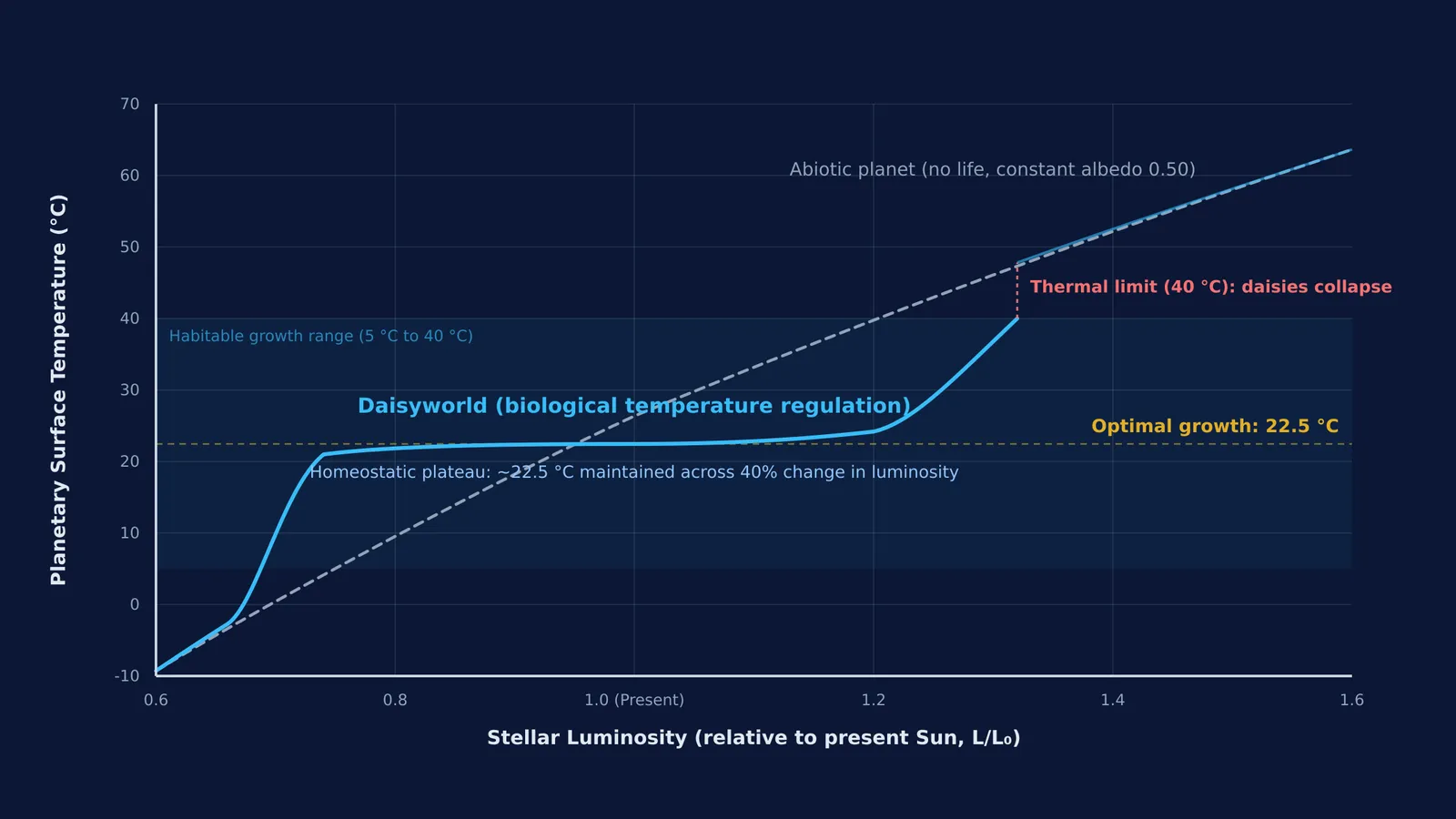
Daisyworld features a cloudless planet orbiting a warming star, with bare soil (albedo 0.50) and two species:
Black daisies (albedo 0.25): absorb radiation, warming themselves and the planet.
White daisies (albedo 0.75): reflect radiation, cooling themselves and the planet.
Both species grow best at 22.5 °C. When the star is cool, black daisies absorb heat, proliferate, and warm the planet. As the star brightens, white daisies stay cooler, outcompete black daisies, and reflect heat. Surface temperature stays near 22.5 °C across a wide luminosity range without any conscious design.
What biological feedbacks stabilise climate today?
Modern Earth system science traces several Gaian feedback loops:
Cloud albedo: In a 1987 Nature paper, Robert Charlson, James Lovelock, Meinrat Andreae, and Stephen Warren showed that marine phytoplankton emit dimethyl sulfide, forming cloud condensation nuclei that brighten clouds and cool oceans.
Chemical tracking: Lovelock's 1957 electron capture detector measured atmospheric chlorofluorocarbons in a 1973 Nature paper, providing data that later enabled Joseph Farman and the discovery of the ozone hole.
Climate modelling: Feedbacks between vegetation and radiation now form the foundation of global climate simulations, building on Syukuro Manabe's early climate models.
How can students analyse environmental feedback loops?
Students tackling ecology or biogeochemical cycles in Class 12 Biology can evaluate planetary feedbacks using this framework:
Identify the disturbance: Note changes in solar flux, temperature, or gas concentrations.
Trace the biotic response: Determine how organism growth or metabolism shifts.
Assess the physical effect: Track changes in albedo, cloud cover, or weathering rates.
Classify loop polarity: A response that opposes the disturbance is negative (stabilising); one that reinforces it is positive (destabilising).
Mastering coupled systems is easier when you can test variables directly. The Fermi Simulation Lab offers interactive simulations for ideas that are easier to see than to read. When working through complex equilibrium problems, Fermi's AI tutor notices where a student is stuck and holds a line of reasoning across a session. To strengthen core foundations in thermodynamics and nutrient cycles, explore the Fermi Concept Library.


