

On this page
How do you look at a molecule without destroying it?
When scientists use an electron microscope to look at a biological sample, they face a severe physical barrier: the microscope's interior must be a high vacuum. If a biological molecule is placed in a vacuum at room temperature, the water surrounding it evaporates instantly, collapsing its delicate three-dimensional structure into a useless, dry heap.
To prevent evaporation, the obvious solution is to freeze the sample. However, freezing introduces a new and equally destructive problem. When water cools slowly, its molecules arrange themselves into an ordered crystal lattice. Because ice is less dense than liquid water, it expands as it forms. These growing, sharp ice crystals puncture cell membranes, warp complex proteins, and tear apart the very structures scientists are trying to see. For decades, it seemed impossible to use electron microscopy on biological samples in their natural, water-rich environment.
Why did Jacques Dubochet use liquid ethane?
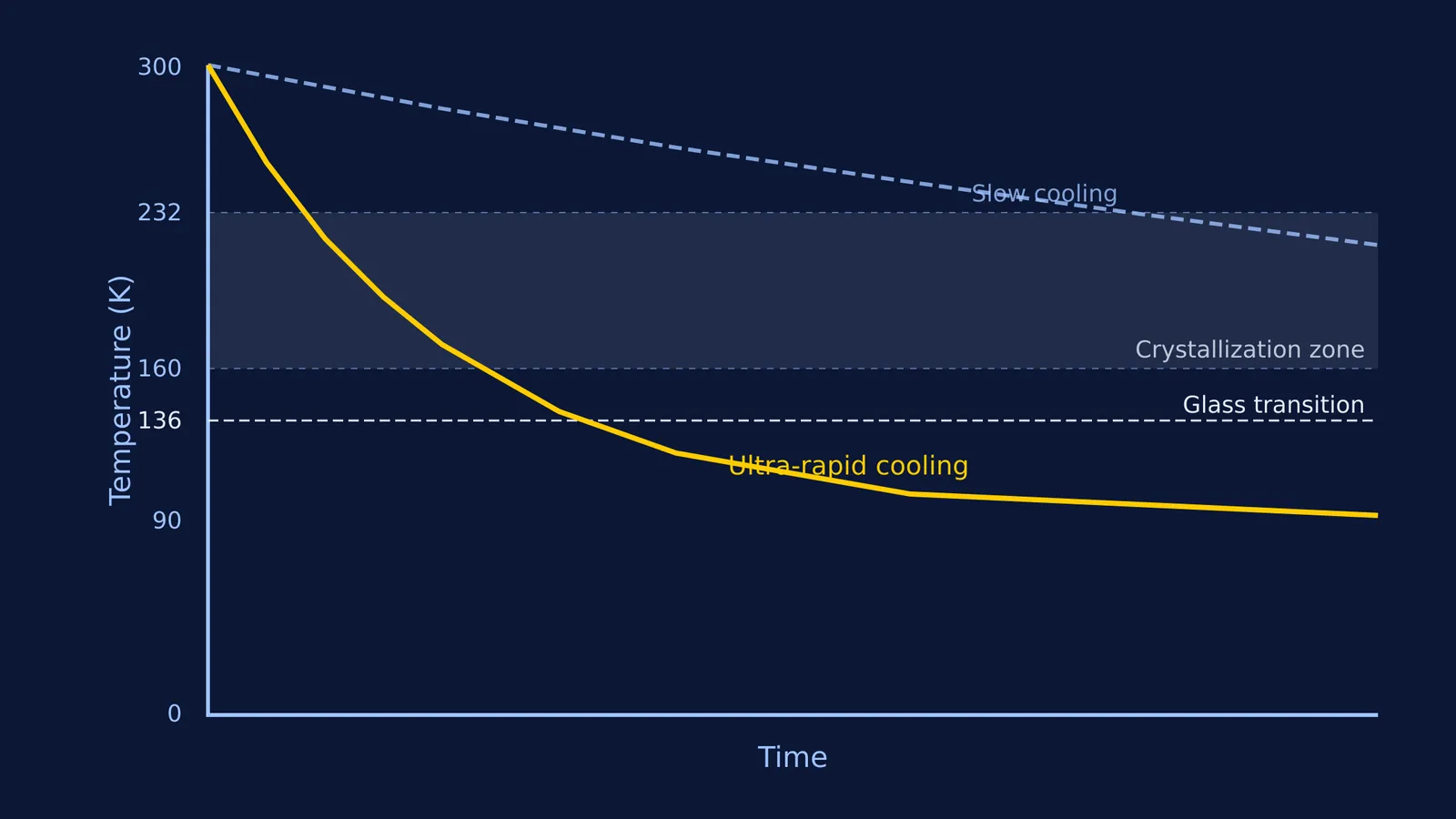
Dubochet's strategy was to trick the water. If water could be cooled so rapidly that its molecules did not have time to form a lattice, it would solidify in the disordered, amorphous state of a liquid. This state is known as vitreous ice.
To achieve this, the water must pass through the temperature zone where ice crystals form (roughly 232 K down to 160 K) in a matter of microseconds, dropping below its glass transition temperature of approximately 136 K Nature.
At the European Molecular Biology Laboratory in the early 1980s, Dubochet and his team tried plunging samples into liquid nitrogen at −196 °C. It failed because it did not cool the water fast enough to prevent crystallization, allowing destructive ice crystals to form NobelPrize.org.
Instead, Dubochet turned to liquid ethane cooled by liquid nitrogen. While liquid nitrogen boils rapidly when a warm sample is dropped into it, ethane has a much higher boiling point. By plunging a thin film of water into the liquid ethane, he achieved a staggering cooling rate of 10⁶ K/s. The water cooled from room temperature to a glass-like state in microseconds, long before any ice crystals had the time to organise and grow Nature.
How did vitreous ice change structural biology?
This plunge-freezing method transformed structural biology. By embedding viruses and proteins in a thin layer of vitreous ice, scientists could place them inside the harsh vacuum of an electron microscope without damage. The biomolecules were frozen mid-action in their native, hydrated state, surrounded by a glass-like solid that provided mechanical support without scattering the electron beam the way a crystal lattice would.
The technique, which Dubochet first used to image adenoviruses in 1984, became the foundation of cryo-electron microscopy (cryo-EM). While Ernst Abbe defined the optical limits of microscopes and Stefan Hell bypassed them with fluorescence, Dubochet’s work ensured the electron beam had a perfectly preserved subject to look at. Before this, scientists had to use heavy metal stains or dyes to protect samples, which often obscured fine details. Now, they could see the atoms themselves. Decades later, during the COVID-19 pandemic, scientists relied on cryo-EM to map the SARS-CoV-2 spike protein in record time—a modern continuation of the early virus imaging by June Almeida.
In 2017, Jacques Dubochet was awarded the Nobel Prize in Chemistry alongside Joachim Frank and Richard Henderson for developing this technique NobelPrize.org.
Why do cooling rates matter for chemistry students?
Questions about cooling curves, phase transitions, and amorphous versus crystalline solids are common in chemistry courses. The distinction between an ordered lattice (which has a sharp melting point) and an amorphous solid (which softens over a range of temperatures) is a core concept.
If you struggle to picture how molecules slow down and lock into place during a phase change, the Fermi Simulation Lab lets you adjust temperature and watch the particle motion shift from liquid to solid. For thermodynamics problems involving heat transfer, specific heat capacity, and extreme cooling rates, you can work through the steps and the math in the Fermi Problem Library.


