

On this page
Who was Ibn Butlan and what are the Tables of Health?
Abū 'l-Ḥasan al-Mukhtār ibn Buṭlān was an Arab Christian physician born in Baghdad between 1001 and 1025. He lived during a vibrant period of intellectual exchange in the Abbasid Caliphate, traveling extensively through Syria, Egypt, and the Byzantine Empire. During his travels, he observed the varied lifestyles of different cultures, which deeply influenced his holistic view of human health.
He wrote the *Taqwīm al-Ṣiḥḥa* (Tabular Register of Health), a medical handbook that shifted the focus from treating disease to preventative wellness. Unlike the dense medical treatises of his time, he organized numerous items into a systematic grid, borrowing the tabular format from astronomical almanacs to make the information accessible and easy to reference.
Translated into Latin in the mid-13th century in Palermo or Naples as the *Tacuinum Sanitatis*, the work became wildly popular in Western Europe. Later illuminated manuscripts from Northern Italy provided detailed depictions of medieval daily life, showcasing these health practices in action. The book was so ubiquitous that the word *taccuino* still means "notebook" in modern Italian.
What are the six non-naturals?
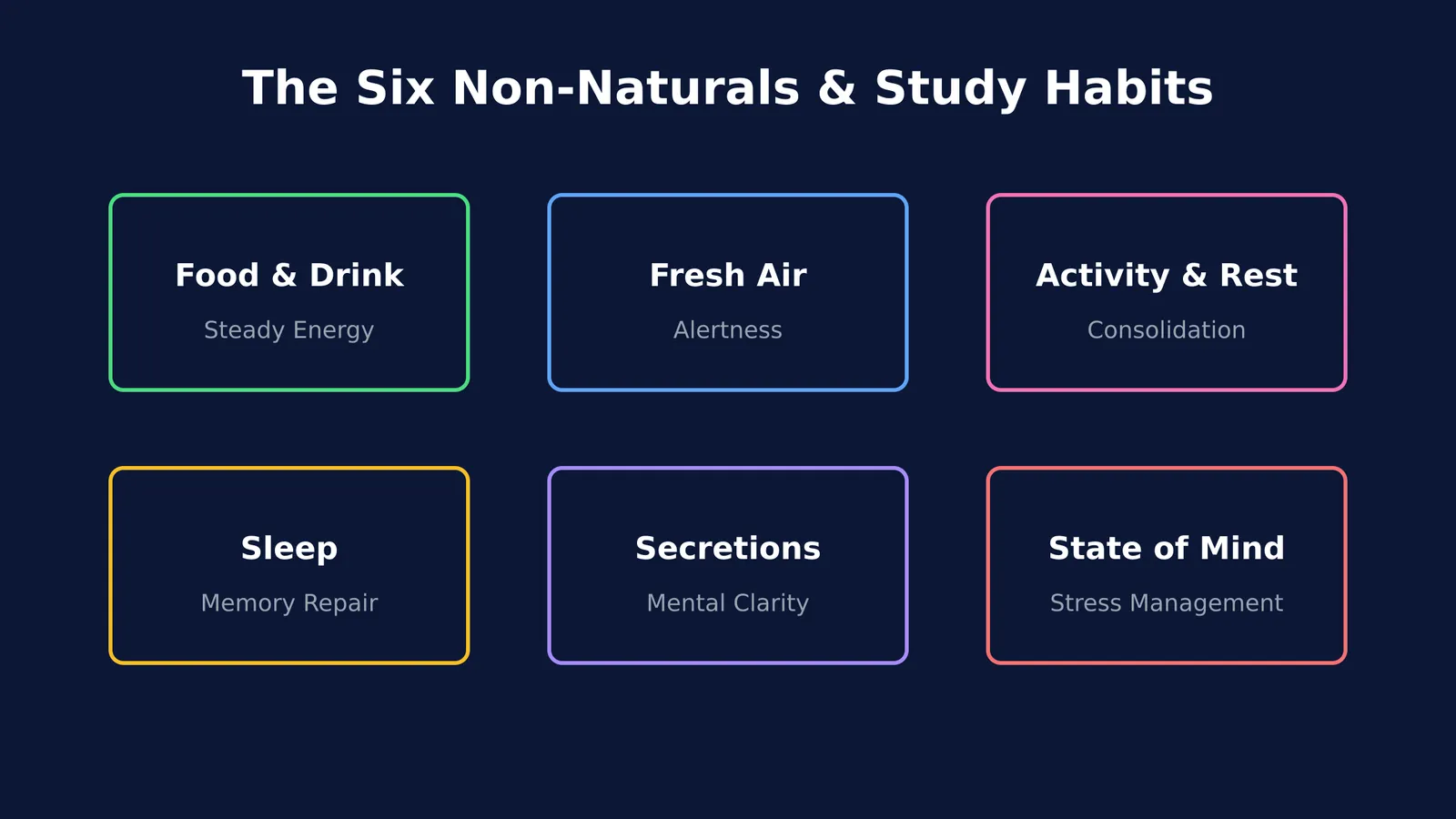
The core philosophy of the *Tacuinum Sanitatis* is that health depends on the balance of six "non-natural" factors—things external to the body that affect its state. Ibn Butlan listed them as:
Sufficient food and drink in moderation
Fresh air and environment
Alternations of activity and rest
Alternations of sleep and wakefulness
Secretions and excretions of humours
Effects of states of mind, such as joy, anger, and fear
For a student preparing for competitive exams, this 11th-century framework translates directly into the building blocks of a sustainable routine.
How do the Tables of Health map to study habits?
Food, drink, and air
Ibn Butlan's first two elements cover the physical inputs to the body. Studying for long hours requires steady energy, generated at the cellular level as fats and proteins enter respiration as an amphibolic pathway. Instead of heavy meals that induce lethargy, regular, moderate nutrition keeps focus sharp. Similarly, fresh air and a well-ventilated study environment prevent the grogginess that comes from sitting in a stuffy room all day.
Activity, rest, and sleep
Elements three and four are where many students struggle. The *Tacuinum Sanitatis* emphasizes the alternation of activity and rest. Your brain needs breaks to consolidate what it has learned. Sleep is not merely the absence of activity; it is the active period during which the brain repairs itself and solidifies memories. Building a schedule that intersperses intense focus with genuine rest—and strictly protecting your sleep cycle—is far more effective than all-night cramming. If you are struggling with how to structure your revision time, Fermi's AI tutor can work out what you already know and build a plan for the session, so you sit down to a clear next step without exhausting yourself.
Mental state and managing stress
The final element, the effects of states of mind, recognizes that emotions impact cognitive performance. Frustration and fear of failure can derail exam preparation. Managing this stress is just as critical as memorizing formulas. When wrong-method mistakes cause frustration, using the Fermi Problem Library—a step-by-step solver that explains the reasoning rather than printing an answer—can ease anxiety by guiding you logically through the roadblock.
Secretions and clearing mental clutter
The fifth element, secretions and excretions of humours, was central to medieval medicine. While we now understand biological waste differently—such as how ammonotelic, ureotelic and uricotelic animals process waste in distinct ways—the underlying principle remains valid: the body and mind must efficiently clear what they do not need. Taking time away from screens to clear mental clutter is vital for maintaining your focus.
How can you put the framework into practice?
Ibn Butlan's contribution was not just in listing these elements, but in organizing them systematically. You can create your own "Tables of Health" for study:
Map your routine: Write down your daily inputs, including food, sleep, study time, and breaks.
Identify the optimum: Note when you work best, much like Ibn Butlan listed the optimum condition for every item.
Neutralize the harm: If a long study session causes fatigue, offset it with a walk in fresh air, just as the tables suggested neutralizing the harm of certain foods with specific pairings.
A balanced approach to learning is not a modern invention. By treating your study routine as a complete system of well-being, just as ecologists look at entire biological systems from viruses, viroids and lichens to complex organisms, you can prepare for exams with the wisdom of an 11th-century physician. Embracing this holistic view ensures that when exam day arrives, you are not just intellectually prepared, but physically and mentally resilient.


