On this page
In short
Christiaan Huygens published *De Ratiociniis in Ludo Aleae* in 1657, making it the first printed textbook on probability. It formalised the concept of expected value by calculating the fair price of a gamble, a step that transformed gambling puzzles into rigorous mathematics (Wikipedia, 2024).
The mathematical rules that govern casino games, insurance premiums and modern physics were not born in a classroom. They emerged from 17th-century letters about interrupted games of chance. While Blaise Pascal and Pierre de Fermat exchanged the foundational ideas in 1654, it was the Dutch scientist Christiaan Huygens who first published them as a complete mathematical system.
Huygens' 1657 treatise, *De Ratiociniis in Ludo Aleae* (On Reasoning in Games of Chance), served as the standard probability textbook for over 50 years (Wikipedia, 2024). Its most lasting contribution was introducing the idea of mathematical expectation, or expected value.
Why did Huygens write his 1657 probability book?
In 1655, Huygens visited Paris and learned about the famous correspondence between Pascal and Fermat. The two French mathematicians had been debating the "problem of points": how to fairly divide the prize money if a game of chance is stopped early.
Huygens did not see their exact calculations, but the problem fascinated him. He returned home and independently worked out the logic of probability. He then compiled his findings into a 1657 appendix to a mathematical text. By publishing his work, Huygens made probability available to students across Europe, long before the Pascal-Fermat letters were printed.
What is expected value?
Huygens did not define probability merely as the ratio of winning outcomes to total outcomes. Instead, he framed the mathematics around what a game is worth to the player. He argued that the value of your expectation in a game is the amount you would be willing to pay for a fair chance to play it.
If you have an equal chance of winning amount A or amount B, Huygens reasoned that the fair price to play is the average, or (A + B) / 2. He extended this to unequal chances, giving the first general formula for expected value. The modern expected value is simply the sum of all possible outcomes, each multiplied by its probability.
How do you calculate expected value?
Expected value tells you what happens on average if you repeat an uncertain event many times. This is identical to how we calculate the weighted average of any outcome.
To find it:
Identify every possible outcome.
Find the probability of each outcome.
Multiply each outcome by its probability.
Add all these values together.
A worked example
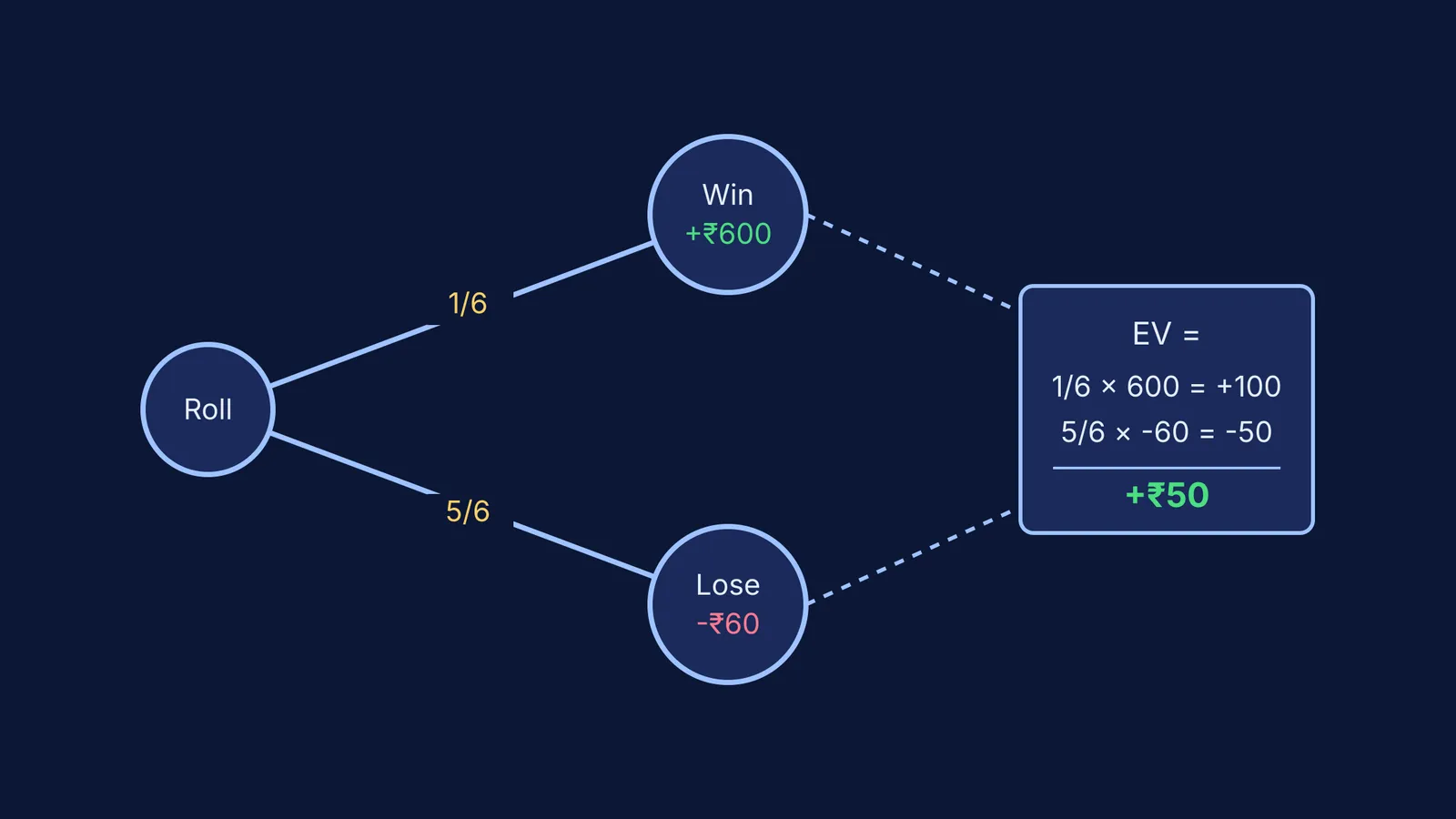
Imagine a simple game: you roll a standard six-sided die. If you roll a 6, you win ₹600. If you roll anything else (1 through 5), you lose ₹60. Should you play?
Winning outcome: The probability of rolling a 6 is 1/6. The value is +₹600.
Losing outcome: The probability of rolling 1 to 5 is 5/6. The value is -₹60.
Now multiply and add: Expected value = (1/6 × 600) + (5/6 × -60) Expected value = 100 - 50 = ₹50.
Because the expected value is +₹50, playing the game is mathematically in your favour. Even if you lose ₹60 on many individual rolls, you will average a ₹50 profit per roll if you play long enough.
From gambling puzzles to modern mathematics
Huygens' framework shifted probability from a gambling curiosity to a structural pillar of mathematics. His ideas influenced later mathematicians like Jakob Bernoulli and Abraham de Moivre, who built the theories that today power machine learning, statistics and quantum mechanics.
Whether you are figuring out probability problems with and without replacement or converting odds in favour and against, you are using the logic Huygens formalised. Understanding these foundational steps is often what makes probability click for students.
If probability distributions feel abstract, the Fermi Concept Library has every concept in physics, chemistry, biology, mathematics and computing, each with its own lesson and its place in the map. When you are ready to practise, the Fermi Problem Library offers worked problems with a step-by-step solver that explains the reasoning rather than printing an answer.