

On this page
The Harvard Mark I, officially known as the IBM Automatic Sequence Controlled Calculator (ASCC), was one of the earliest general-purpose electromechanical computers. When it began running programs in 1944 for the war effort, it marked a physical bridge between mechanical calculators and the electronic computers of the future.
What was the Howard Aiken Harvard Mark I computer?
Howard Aiken, while a physics graduate student at Harvard University in 1935, conceived the idea of a large-scale calculating machine to solve advanced mathematical equations. In November 1937, he presented his proposal to IBM 1. By 1939, IBM chairman Thomas Watson Sr. approved the funding and construction of the machine. The computer was designed to calculate mathematical tables automatically, much like British inventor Charles Babbage had envisioned for his analytical engine over a century earlier.
One of its earliest programs was initiated in March 1944 by mathematician John von Neumann. He used the machine to compute complex mathematical models for the Manhattan Project. Specifically, he needed to determine whether implosion was a viable method to detonate an atomic bomb. The Mark I was able to run continuous simulations that would have taken human computers months to complete by hand, proving the immense value of automated calculation for large-scale physics problems 1.
How big was the Harvard Mark I?
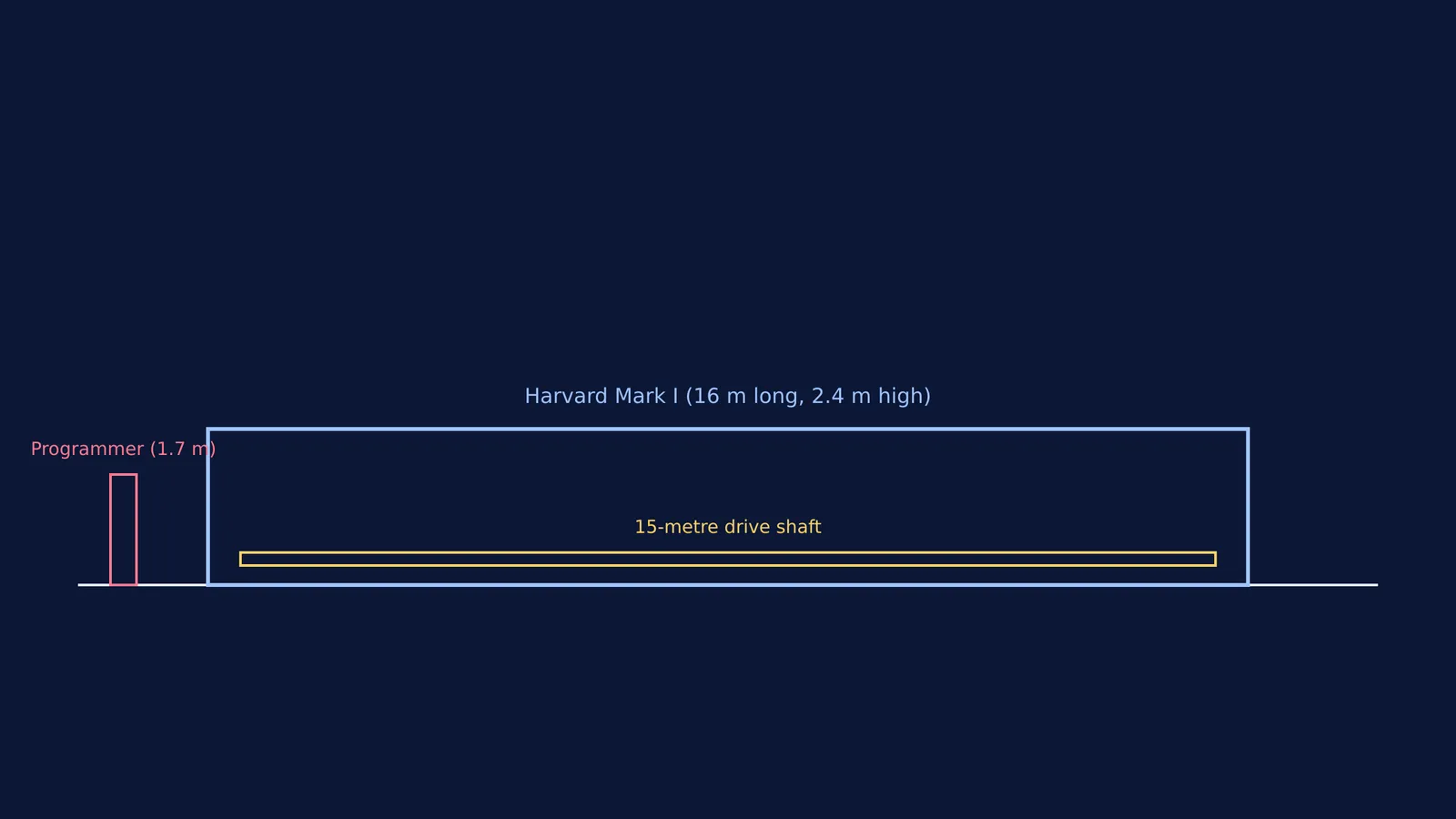
The machine was famously massive. The Harvard Mark I was 16 metres (51 feet) long, 2.4 metres (8 feet) high, and 0.61 metres (2 feet) deep 1. It weighed 4.3 tonnes (9,445 pounds) and contained 765,000 electromechanical components 1.
Because its basic calculating units were entirely mechanical and had to be physically synchronized, they were operated by a 15-metre (50-foot) drive shaft 1. A 5-horsepower electric motor turned this shaft, providing both the main power and serving as the system clock 1.
The Mark I could perform three additions or subtractions in a single second. A single multiplication took 6 seconds, and a division took 15.3 seconds 1.
Who programmed the Harvard Mark I?
Grace Hopper, a mathematician and United States Naval Reserve officer, was assigned to the Harvard computation project in 1944 2. She became one of the first programmers of the Mark I. Hopper wrote the comprehensive manual of operations for the machine, which laid the foundation for future programming practices.
Grace Hopper later pioneered machine-independent programming languages. The operators of the Mark I, including Hopper, often referred to the machine as "Bessy", affectionately naming it after the Bessel functions it computed 1. Her work on the Mark I helped connect physical machines to modern code, building on early ideas like how the Jacquard loom's punched cards inspired the first computer.
How does electromechanical computing work?
When studying early computing or learning basic logic gates in physics, it helps to understand how physical motion translates to calculation. Here is a three-step framework for how the Mark I computed:
Input: Data is entered mechanically. The Mark I used 60 sets of 24 manual switches to set constant numbers, and a 24-channel punched paper tape for reading instructions 1.
Clock: Every operation must happen in sequence. Instead of an electronic crystal, the Mark I used its physical 15-metre drive shaft to synchronize every gear and relay 1.
Execution: The punched holes in the paper tape engaged specific mechanical clutches. These clutches connected the rotating drive shaft to calculation wheels, physically turning them to add or subtract.
This translates well to modern logic: you still have input, a clock cycle, and execution logic, but electrons have replaced physical gears and shafts. When learning about computing history or the mathematical logic of programming, mapping out these early physical architectures helps make the abstract concepts concrete. Building this intuition is similar to learning physics from first principles rather than memorising formulas.
You can use the Fermi Concept Library to see how fundamental ideas in mathematics and computing connect, tracing the evolution from mechanical switches to modern electronic architecture. If you want to work through logic step by step, you can use the Fermi Problem Library, which has worked problems with a step-by-step solver that explains the reasoning rather than printing an answer. Developing a strong, methodical approach here is just like solving physics problems step by step: you learn to break the large, complex computation down into individual, verifiable instructions.


