

On this page
In short The *Dongui Bogam*, compiled by royal physician Heo Jun in 1613, systematically organised more than 2,000 years of traditional Korean and Chinese medical knowledge into five distinct chapters. By categorising information by human organs rather than isolated diseases, the work offered a clear framework for mastering vast subjects, earning it a place on UNESCO's Memory of the World Register in 2009.
Who was Heo Jun and what is the Dongui Bogam?
Heo Jun (1539–1615) was a royal physician during Korea's Joseon dynasty who faced a monumental challenge: the medical knowledge of his time was vast, disorganised and often contradictory. In 1596, King Seonjo commissioned him to compile a comprehensive medical text. Despite the severe disruptions of the Japanese invasions of Korea, Heo Jun remained dedicated to the task. He spent 15 years synthesising existing literature into a single, cohesive encyclopaedia called the *Dongui Bogam* (Treasured Mirror of Eastern Medicine). The book, which was published in 1613, effectively synthesised 2,000 years of traditional medical knowledge.
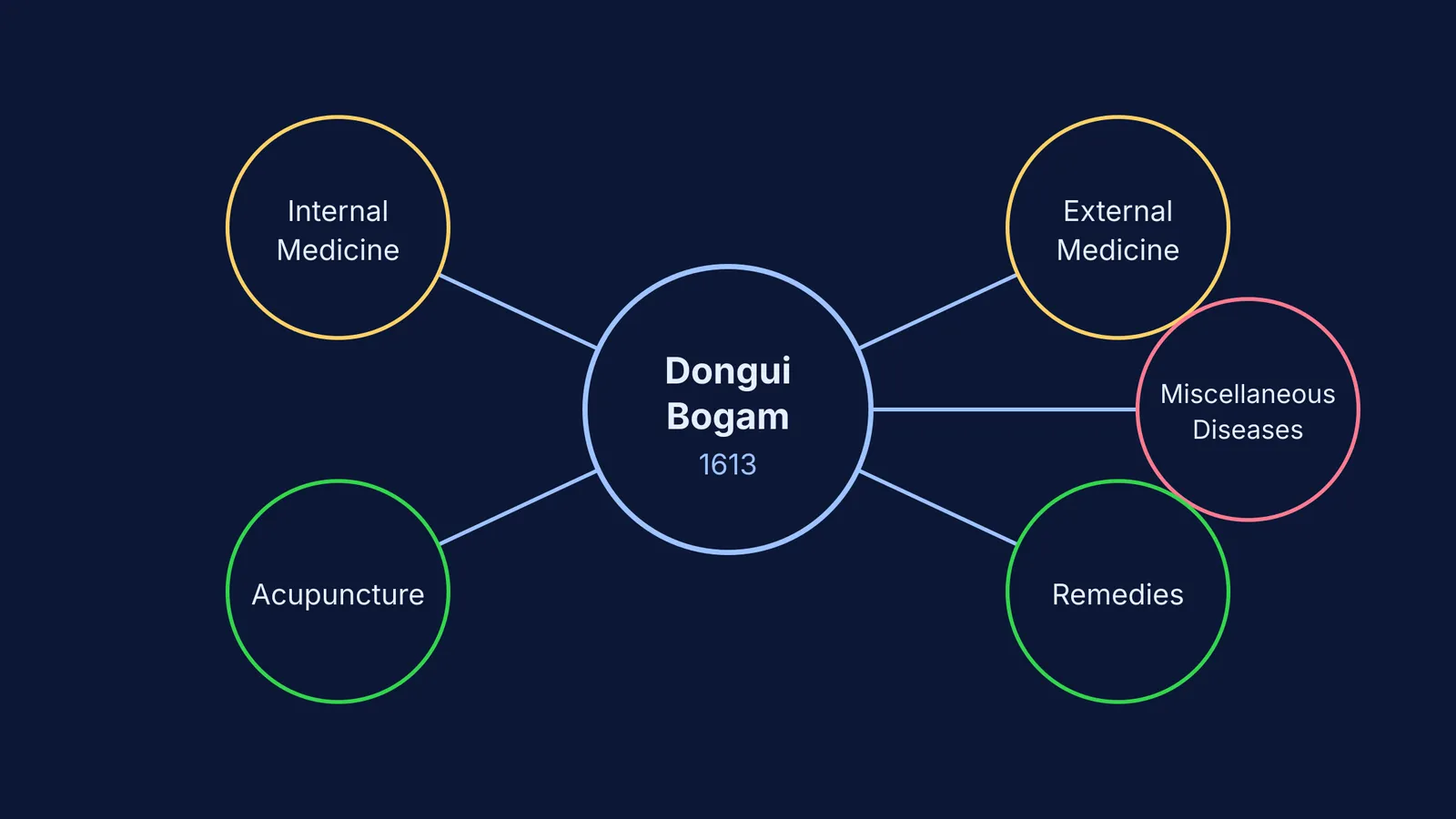
What made this text remarkable was its structure. Rather than simply listing diseases and their cures alphabetically, Heo Jun ordered the information by the affected human organs and systems. He divided the work into five logical chapters: Internal Medicine (covering the interactions of the liver, lungs, kidneys, heart and spleen), External Medicine (explaining the skin, muscles and bones), Miscellaneous Diseases, Remedies, and Acupuncture. This rigorous and highly accessible system of organisation is a major reason why the text was added to UNESCO's Memory of the World Register in 2009.
What can Heo Jun teach us about studying biology?
Students today often face the exact same problem Heo Jun did when tackling a massive syllabus for their board exams. When you try to memorise a vast number of isolated facts—such as the endless exceptions found among viruses, viroids and lichens: the misfits of five-kingdom biology—the details inevitably blur together. Heo Jun succeeded because he created a mental map before filling in the details.
By grouping illnesses according to the organ systems they affect, he turned raw, unstructured data into a network of knowledge. This is the essence of active learning: you do not just store information; you build a framework to hold it. When you struggle to connect the dots in a complex topic, the Fermi Concept Library applies this same principle. It covers every concept in physics, chemistry, biology, mathematics and computing, each with its own lesson and its place in the map, so you always see how the intricate details fit into the big picture.
How can you apply the Dongui Bogam method to your studies?
You can apply the *Dongui Bogam* method to your own study routine to manage information overload. Whether you are revising plant physiology or human anatomy, treating your syllabus like a systematised encyclopaedia makes it much easier to recall.
Map the systems, not the symptoms: Like Heo Jun's chapters on internal and external medicine, start by understanding the broad, overarching systems. If you are learning human physiology, first understand how the heart, lungs and blood vessels interact to transport oxygen before you try to memorise specific cardiovascular disorders. Draw a flowchart of the system first, and only then add the individual components to your diagram.
Translate into plain language: During the Joseon era, medical texts were written in complex Chinese characters (Hanja) that only highly educated scholars could read. Heo Jun deliberately included the names of readily available medicinal herbs in Hangul, the simple Korean alphabet, so ordinary people could understand and find them. You should do the same with your textbooks. When you take notes, force yourself to explain the concept in your own simple words rather than passively copying the textbook's dense vocabulary. If you cannot explain it simply, you have not yet mastered the underlying system.
Cross-reference your knowledge: The *Dongui Bogam* drew on multiple medical traditions, sharing the spirit of comprehensive works like that of Li Shizhen and the great compendium of medicinal substances, to create one cohesive text. Knowledge does not exist in isolation. When you finish a chapter in biology or chemistry, actively look for connections to the topics you studied weeks ago. Ask yourself how cellular respiration connects to the digestive system, or how plant transport mechanisms rely on basic properties of water.


