

On this page
Heinrich Wilhelm Olbers spent his days as a doctor and his nights as an astronomer. Born on 11 October 1758 and trained in medicine at Göttingen, he practised in Bremen and turned the upper storey of his house into an observatory, where he discovered the asteroids Pallas in 1802 and Vesta in 1807 (biography of Olbers). In 1823 he described the puzzle that now carries his name.
He was not the first to ask it. Johannes Kepler posed the problem in 1610, and Edmond Halley and Jean-Philippe Loys de Chéseaux gave it its mature form in the 18th century (history of Olbers' paradox). The question sounds childish: if space goes on forever and is sprinkled with stars, why isn't the whole night sky as bright as the Sun?
Why should an infinite universe have a bright night sky?
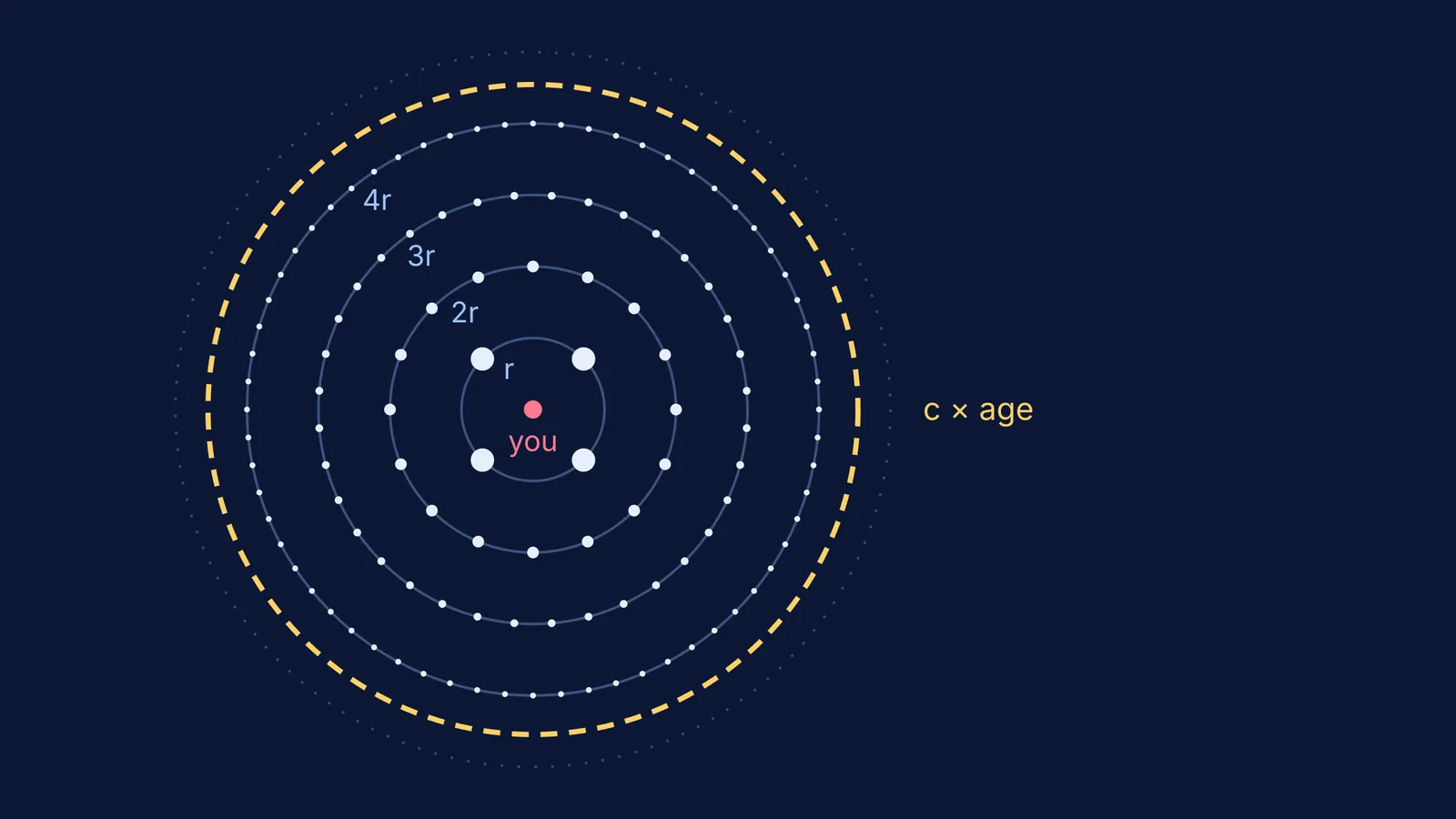
The classic argument slices space into thin, nested shells around you, like an onion. As one summary of the paradox puts it, a shell twice as far away has four times as many stars, yet each appears one quarter as bright, so each shell sends you the same amount of light.
Check it with a pencil:
Picture a thin shell of space 100 light-years away holding N stars.
A shell of the same thickness at 200 light-years has twice the radius, so four times the area, so about 4N stars.
By the inverse-square law, each of those stars looks one quarter as bright.
Multiply: 4N stars at one quarter brightness gives the same light as the first shell.
The same holds at 300, 400 or a million light-years. Add infinitely many equal shells and the total has no limit.
Nearer stars block the ones behind them, so the sky would not be infinitely bright. But every line of sight would end on a star, and every point in the sky would be like the surface of a star (same source).
Could dust between the stars block the light?
It is the first idea most people reach for, and it fails. Light falling on dust would eventually heat it until it glowed as brightly as the stars, as Scientific American's explainer points out.
Why is the night sky dark, then?
Because the universe is not infinitely old. Light travels at about 300,000 kilometres per second, so in a universe of finite age you can only receive light from objects close enough for it to have arrived (Scientific American). The same explainer adds a second reason: stars are not infinitely long-lived, so nearby stars dim long before light from very distant ones could fill the gaps.
NASA's WMAP mission measured the age of the universe as 13.77 billion years, to within half a percent (NASA WMAP overview). That age caps how many shells can contribute, so the sum stops.
Edgar Allan Poe's 1848 essay Eureka anticipated parts of this answer in words, and, by historian Harrison's account, Lord Kelvin set out the first satisfactory mathematical resolution in a little-known 1901 paper (history of the paradox).
Does the expanding universe explain it?
Partly. Expansion stretches light from distant galaxies to redder, weaker wavelengths; read how Vesto Slipher measured the first galaxy redshifts and how Georges Lemaitre worked out the expanding universe. The farthest light of all, from the Big Bang itself, has been redshifted from an energy like that of star surfaces down to a glow at 2.73 K (overview). That glow is the background Penzias and Wilson found as noise in their antenna.
But expansion is the smaller effect. Paul Wesson, K. Valle and R. Stabell tackled the question in a 1987 paper in The Astrophysical Journal, titled "The extragalactic background light and a definitive resolution of Olbers's paradox" (DOI record). Writing about Wesson's June 1989 Sky & Telescope article, science writer Chet Raymo reported that expansion dims the Olbers light by about a factor of two, not enough on its own to explain the dark night (Raymo's column). The finite age does most of the work.
How can you explain Olbers' paradox in one minute?
A good test of understanding. Try this script on a friend, or your parents after dinner:
"If stars went on forever, every direction you look would end on a star."
"Far shells hold more stars, and that exactly makes up for each star being fainter."
"So an eternal, endless universe would have a sky as bright as a star's surface."
"It's dark because the universe had a beginning. Light from far enough away hasn't reached us yet."
"Stars also burn out, and expansion stretches distant light, so it gets dimmer still."
If the inverse-square step won't stick, the Fermi Simulation Lab has interactive simulations for ideas that are easier to see than to read. If redshift itself feels shaky, the Fermi Concept Library gives each concept in physics its own lesson and its place in the map.
Tonight, look at the dark between the stars: it is evidence of a beginning.


