

On this page
The night sky holds smudges of light that early astronomers called nebulae. On 26 April 1920, the scientific community gathered at the U.S. National Museum in Washington, D.C., to argue over what these objects really were (Wikipedia)). The event, now known as the Great Debate, featured two prominent astronomers: Harlow Shapley and Heber Curtis.
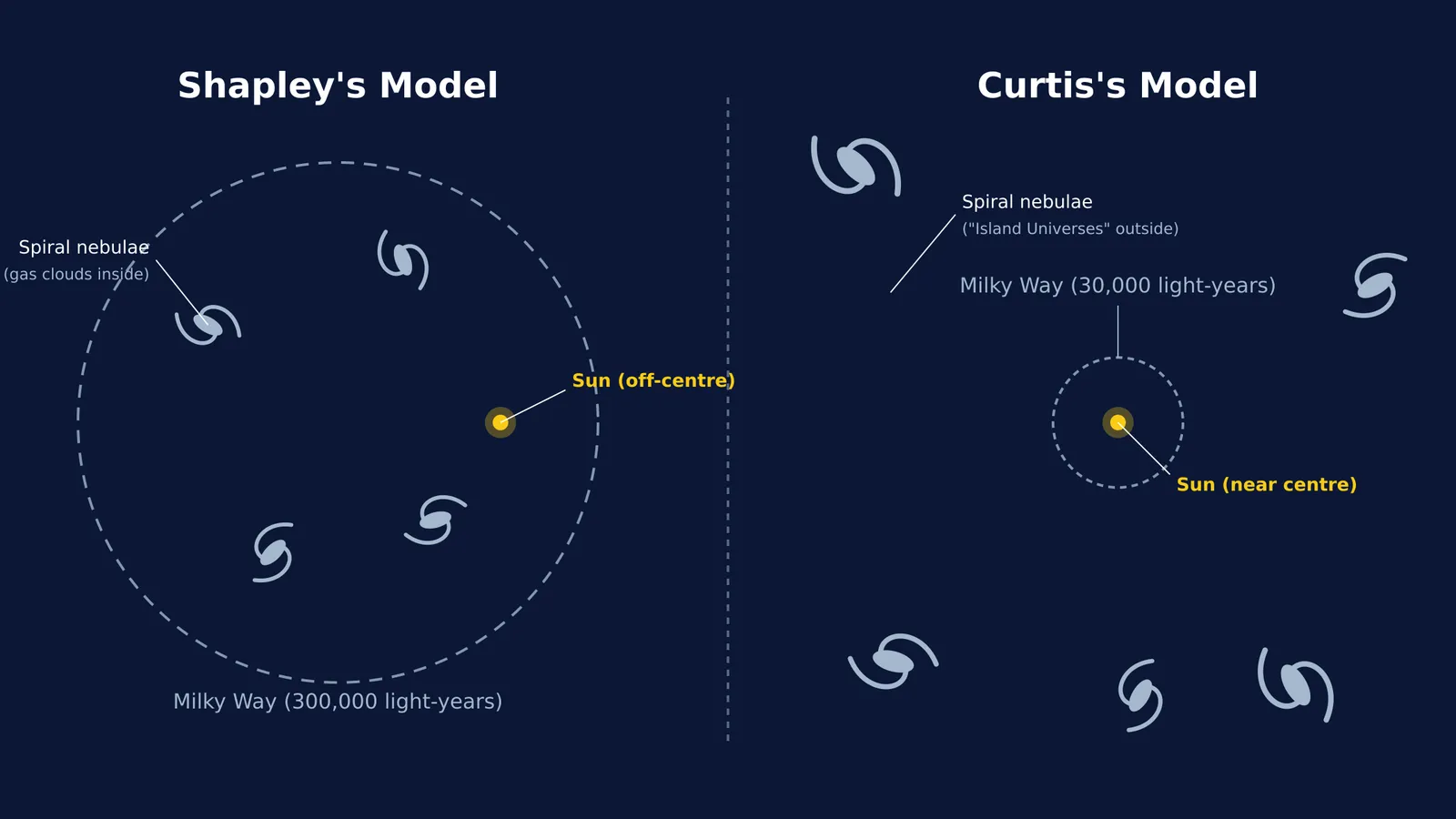
They were arguing over the scale of the universe, a question that fundamentally defined humanity's place in the cosmos. Shapley believed the Milky Way was the entire universe and that our solar system sat far from its centre. Curtis argued that the spiral-shaped nebulae were "island universes" — entirely separate galaxies just like our own, and that the Sun was located near the centre of a much smaller Milky Way.
What were the Shapley and Curtis arguments?
The two scientists had vastly different models for the Milky Way. Shapley estimated our galaxy was 300,000 light-years across (Wikipedia)). If the Milky Way was that massive, he reasoned, the spiral nebulae had to be small gas clouds trapped within it. To back this up, Shapley pointed to data from astronomer Adriaan van Maanen, who claimed to have measured the rotation of the Pinwheel Galaxy over a period of just a few years. If the Pinwheel were a distant, massive galaxy, its outer edges would have to be moving faster than the speed of light to show such visible rotation over a human timescale. Therefore, Shapley concluded, they must be small and nearby.
Curtis disagreed entirely. He estimated the Milky Way was only 30,000 light-years across — one-tenth of Shapley's figure (Wikipedia)). He argued that Van Maanen's rotation measurements were simply flawed and at the very limit of what contemporary photographic plates could reliably resolve. According to Curtis, the spirals were independent galaxies lying far beyond the Milky Way's borders. Both men were working at a time of immense discovery in astronomy, much like the work of Vesto Slipher and the first redshifts of galaxies, but neither had the definitive distance measurements needed to prove their case that night. In retrospect, both men were partially right and partially wrong: Shapley correctly placed the Sun away from the galactic centre, while Curtis correctly identified the nature of spiral nebulae.
Who won the Shapley-Curtis debate?
The debate ended without a clear winner, but the definitive answer finally came from Edwin Hubble. In 1924, Hubble was examining photographic plates of the Andromeda Nebula taken with the 100-inch Hooker Telescope at Mount Wilson Observatory (Wikipedia). He spotted stars whose brightness rose and fell in a predictable pattern — Cepheid variables.
Because a Cepheid's pulsation period is tied directly to its true, intrinsic brightness, Hubble could use it as a "standard candle" to measure distance. This technique is conceptually tied to understanding stellar properties like those found in the Hertzsprung, Russell and the diagram that sorts the stars. By comparing the star's apparent brightness in the sky with its true brightness, the distance can be calculated using the inverse-square law of light.
Hubble calculated that Andromeda was much too distant to be part of the Milky Way (Wikipedia). This proved definitively that Andromeda was a separate "island universe," confirming Curtis's core argument and setting the stage for future breakthroughs like Georges Lemaitre and the expanding universe, step by step.
How can you study the expanding universe?
When you are learning astrophysics, it is easy to get lost in the sheer scale of the numbers. Memorising that a galaxy is millions of light-years away means little until you understand the observational techniques used to measure it. The history of astronomy is filled with examples of data being misinterpreted, highlighting the need for rigorous methods.
Instead of just reading about standard candles, it helps to see how the geometry and light curves work in practice. The Fermi Simulation Lab holds interactive simulations for the ideas that are easier to see than to read, letting you plot light curves and test distance formulas yourself. If you are preparing for an exam and find yourself missing the underlying principles of orbital mechanics or gravitation, the Fermi Concept Library breaks down every concept in physics, chemistry, biology, mathematics and computing, each with its own lesson and its place in the map.
When solving a problem about the scale of the universe, keep this checklist in mind:
Identify the standard candle: Are you using a Cepheid variable, a Type Ia supernova, or stellar parallax? Each has a different valid range and specific mathematical formula.
Check the units: Distance in astronomy might be given in light-years, parsecs, or astronomical units (AU). Always convert your given values to the unit required by the question before applying formulas.
Verify the physics: Remember the lesson from Van Maanen's flawed rotation data. If your calculated speed exceeds the speed of light, check your assumptions and start again.


