

On this page
Before the 1940s, a diagnosis of *Haemophilus influenzae* meningitis in an infant carried a case fatality rate close to 100% according to records from the Centers for Disease Control and Prevention. At Babies Hospital in New York, pediatrician and microbiologist Dr Hattie Alexander transformed that grim reality. Over two decades, she developed an effective rabbit antiserum that slashed infant mortality, then uncovered the biological foundation of antibiotic resistance: Darwinian selection acting on pre-existing rare mutations.
Why was Haemophilus influenzae meningitis nearly 100% fatal?
*Haemophilus influenzae* is a fastidious Gram-negative coccobacillus. In 1931, microbiologist Margaret Pittman demonstrated in the Journal of Experimental Medicine that virulent strains possess a polysaccharide capsule, designated type b (*H. influenzae* type b, or Hib). This capsule prevents phagocytosis, allowing bacteria to invade the bloodstream and penetrate the central nervous system.
Infants lack maternal antibodies after the first few months and cannot readily generate anticapsular antibodies on their own. Early attempts to treat children with horse serum failed because the antibodies were large, penetrated the cerebrospinal fluid poorly, and triggered dangerous serum sickness.
How did Hattie Alexander cut meningitis mortality with rabbit serum?
Alexander realized that antibody molecular structure dictated clinical success. Working with immunochemist Michael Heidelberger, she immunized rabbits against type b *H. influenzae*. Rabbit antibodies were smaller than horse antibodies, allowing them to cross tissue barriers into the cerebrospinal fluid with far fewer allergic reactions.
Alexander standardized dosing by measuring specific antibody-nitrogen content. In a 1944 study in The Journal of Pediatrics80173-1), she treated 75 infants using refined rabbit antiserum combined with sulfadiazine: 58 recovered, dropping the mortality rate to 22.7%. When streptomycin arrived in the mid-1940s, she integrated it into therapy. Yet in several patients who initially improved, the infection rebounded with bacteria impervious to massive doses of the drug.
How did Alexander prove antibiotic resistance was genetic, not adaptive?
Prevailing medical opinion assumed that bacteria adapted their metabolism in response to sub-lethal antibiotic exposure. In their 1947 study in the Journal of Experimental Medicine, Alexander and Grace Leidy challenged this view by plating quantified bacterial populations on agar containing 1,000 µg/mL of streptomycin:
Careful study revealed that resistant members were present in all ten initial strains examined.
Pre-existing resistant mutants occurred at an incidence between 1 in 1.1 billion and 1 in 13.8 billion organisms.
Because resistance arose in a single step and persisted through 100 subcultures without streptomycin, Alexander and Leidy proved it was a permanent, heritable trait.
In 1953, they showed in the Journal of Experimental Medicine that purified DNA from resistant strains transformed sensitive bacteria into resistant ones within 10 minutes. This provided cornerstone evidence for both the molecular basis of inheritance and natural selection and antibiotic resistance.
What does bacterial resistance teach us about combination therapy today?
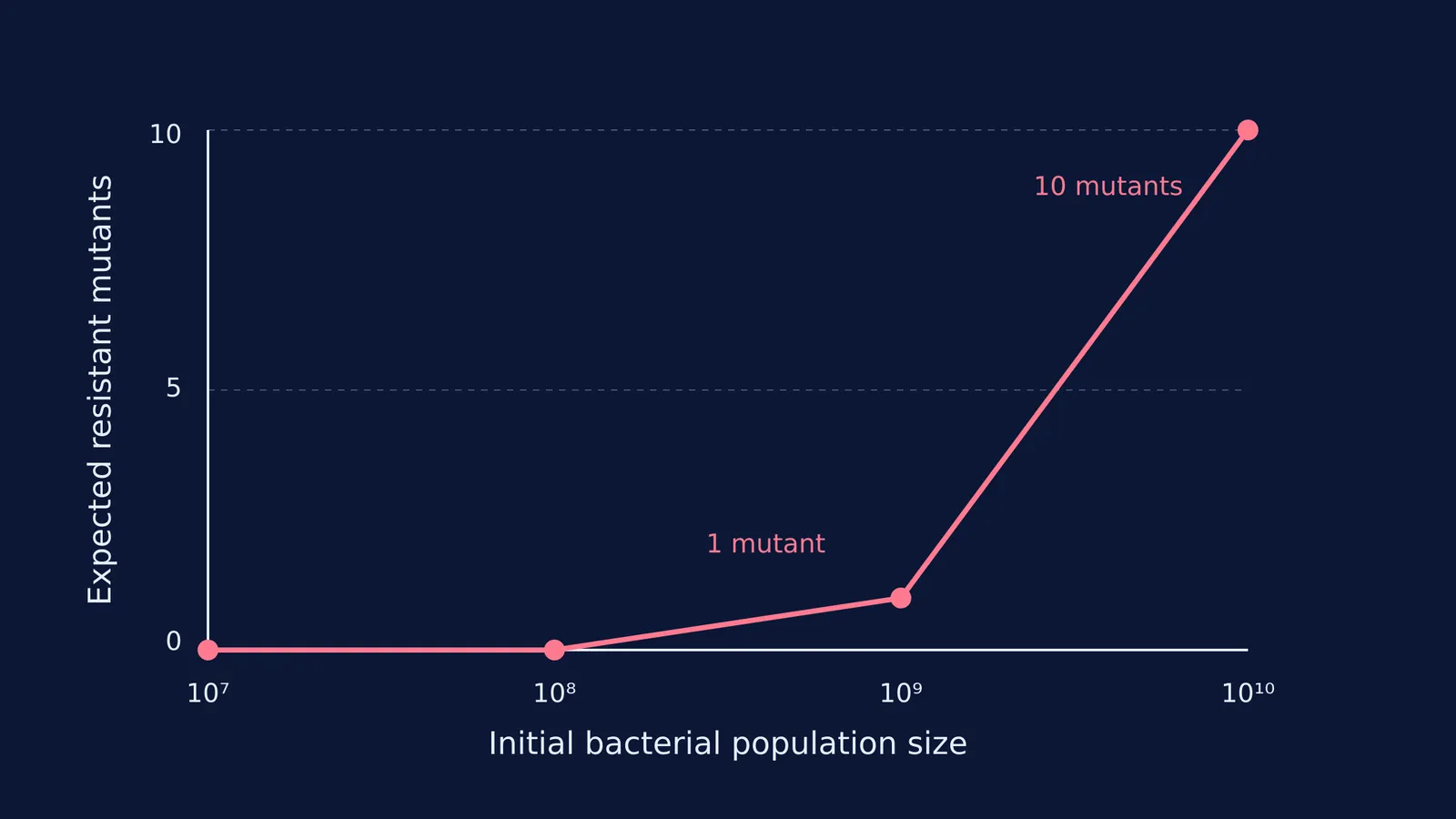
Alexander demonstrated in the Journal of Experimental Medicine that bacterial population size dictates treatment success. In mild infections, the chance of a resistant mutant being present is remote. But in severe meningitis, the massive bacterial population ensures mutants are already present. Giving streptomycin alone eliminates the sensitive bacteria, clearing the field for rare pre-existing variants to multiply into a fatal relapse.
Alexander's answer was combination therapy: pairing two agents with independent cellular targets.
Single-drug risk: If an antibiotic has a mutation frequency of 1 in a billion, a severe infection of 10 billion cells already contains 10 resistant bacteria.
Two-drug protection: If a second independent antibiotic also has a mutation frequency of 1 in a billion, the probability of a cell mutating against both simultaneously is 1 in a billion squared (1 in a quintillion).
Double mutants: In 10 billion bacteria, the expected number of double mutants is practically zero.
Combining streptomycin with sulfadiazine or antiserum ensured that mutants surviving one drug were destroyed by the other, preventing the directional selection curves and population shifts seen in drug-resistant outbreaks.
When working through genetics or probability problems where independent events multiply, the Fermi Problem Library has worked problems with a step-by-step solver that explains the reasoning. To review how directional selection differs from physiological adaptation, the Fermi Concept Library contains every concept in biology, each with its own lesson.


