

On this page
When you leave an iron tool out in the rain, it quickly develops a flaky, orange coat of rust. Yet the cutlery in your kitchen, despite constant washing, stays perfectly bright. The difference between the two is a microscopic barrier discovered by accident just before the First World War.
On 13 August 1913, according to the British Stainless Steel Association, metallurgist Harry Brearley created a new alloy in a Sheffield laboratory. He was looking for an erosion-resistant metal for gun barrels, but he noticed that his samples containing 12.8% chromium and 0.24% carbon resisted nitric acid etching during microscopic analysis, while standard steel dissolved. He called his invention "rustless steel," though a cutlery manager, Ernest Stuart, later suggested the name we use today: stainless steel, after testing the metal in vinegar.
How does the chromium oxide layer work?
The secret to stainless steel is not that it refuses to react with oxygen. In fact, it reacts *faster* than normal steel. This process is called passivation).
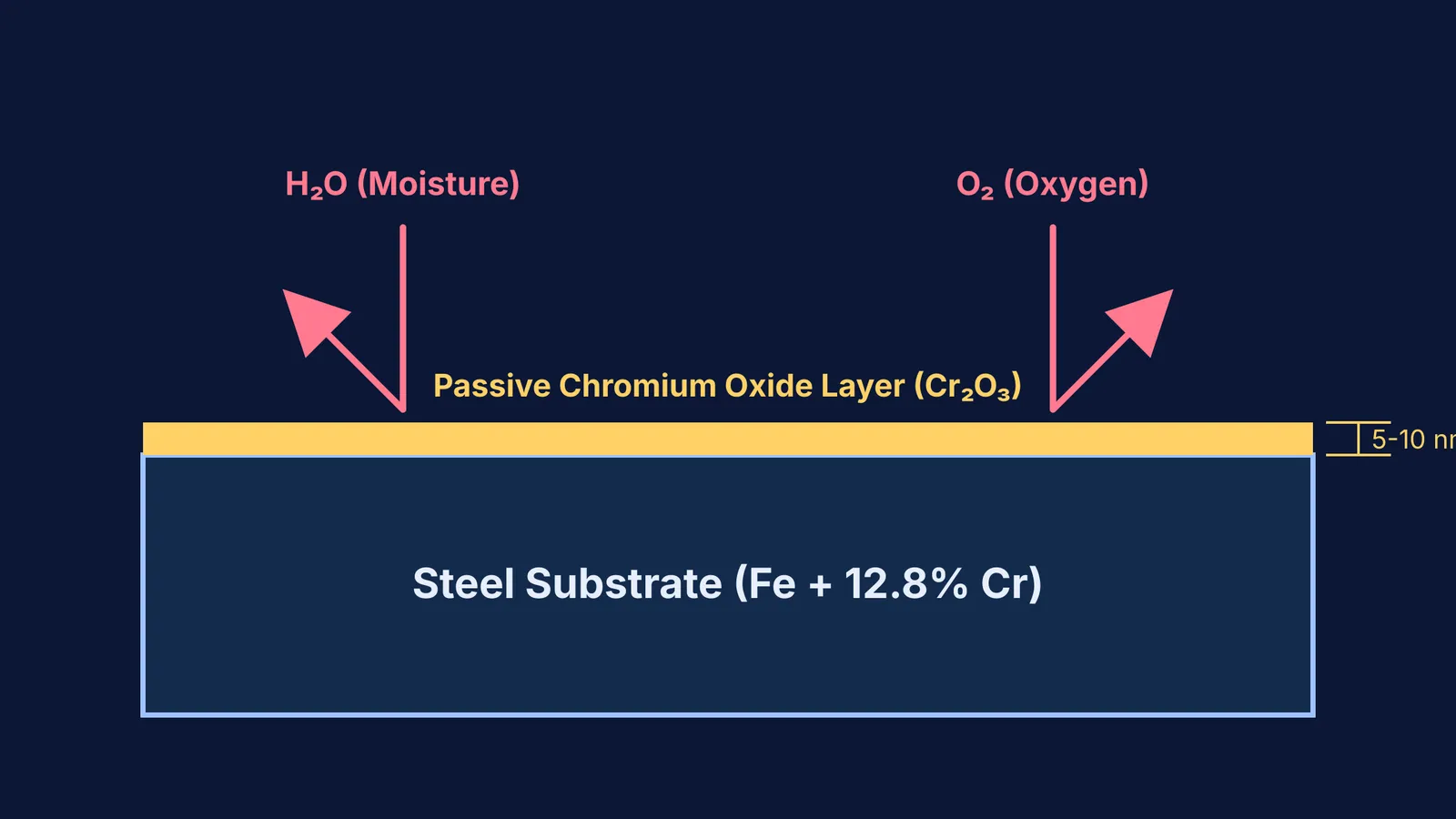
For a steel to be considered "stainless," it must contain at least 10.5% chromium, according to material standards. When the chromium at the surface is exposed to oxygen from the air or water, it reacts immediately to form chromium oxide (Cr₂O₃). This creates a transparent film that is microscopically thin—just the outer few layers of atoms, typically measuring between 5 and 10 nanometres in the self-repairing zone.
Why does iron rust but chromium protect?
The answer lies in the volume of the oxides, a concept measured by the Pilling–Bedworth ratio. This ratio compares the volume of the metal oxide to the volume of the original metal atoms it replaces.
For a protective layer to form, the ratio should ideally be between 1 and 2. If the ratio is less than 1, the oxide layer is stretched too thin and cracks. If the ratio is significantly greater than 2, the oxide is so voluminous that it creates massive internal compressive stresses, causing the coating to buckle, crack and flake away.
When standard steel rusts, it forms iron oxides like Fe₂O₃, which have a Pilling–Bedworth ratio of 2.14. Because the rust takes up more than twice the space of the iron atoms, the stress causes it to flake off, exposing fresh iron to the environment. This means the corrosion can continue indefinitely.
Chromium, however, forms chromium oxide (Cr₂O₃) with a ratio of 2.07. It forms a dense, continuous, and highly adherent layer that acts as a perfect diffusion barrier. Because it remains physically intact, the underlying steel substrate is permanently shielded from further attack.
Why do some environments cause stainless steel to rust?
The passivation mechanism requires oxygen to maintain its barrier. If you deprive stainless steel of oxygen—for example, by trapping it under a tight rubber gasket in stagnant water—the layer cannot heal itself if damaged. This leads to crevice corrosion.
Similarly, environments rich in chlorides, such as seawater, can break the barrier. Chloride ions are small enough to penetrate the oxide layer and attack the underlying metal, causing deep pits to form.
How to study reaction mechanisms for chemistry exams?
If you are preparing for board exams or competitive tests, you will often need to explain why certain reactions happen or why specific compounds resist reacting. You can use the stainless steel mechanism as a study framework for any protective chemical process. When answering a "give the mechanism" question, check that you have included these four parts:
Identify the reactive element (e.g. chromium).
Name the compound formed (e.g. chromium oxide).
Describe its physical properties (e.g. dense, continuous diffusion barrier).
Explain the dynamic response (e.g. repassivation if scratched).
If you are unsure whether your explanation is complete, Fermi's AI tutor can work out what you already know and build a plan for the session, holding a line of reasoning to help you spot the gaps in your own answers. To revise the fundamentals of oxidation and reduction before trying mechanism questions, you can review our guide to everyday oxidation in Class 10 science, or see how to find oxidation numbers from structure. If you need to check the properties of transition metals like chromium, you can look them up in the Concept Library.


